
Structure of Atom is the most searched Physical Chemistry chapter among NEET aspirants, and for good reason. The formulas are few, the numbers are fixed, and the same question styles return almost every year. This structure of atom NEET PYQ analysis shows what NTA keeps asking, how to solve each type fast, and where students lose easy marks.
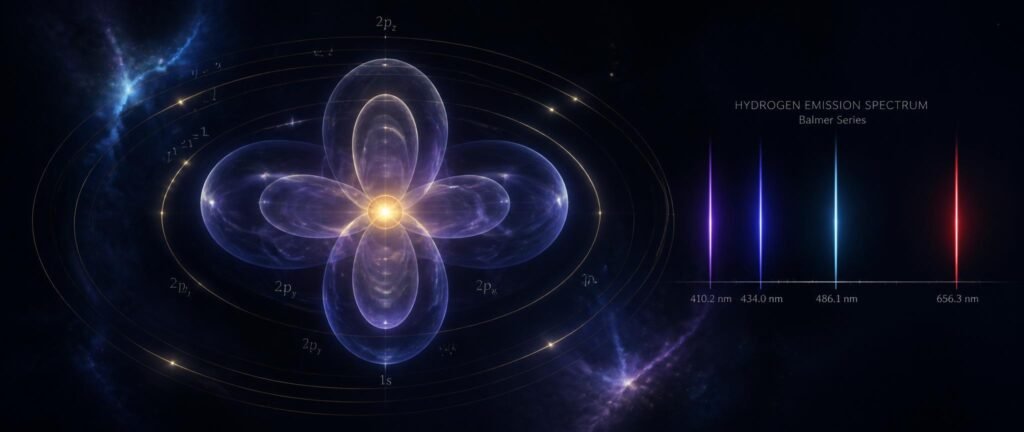
For the full chapter-wise plan, start with our complete physical chemistry guide and use this article for chapter-level detail.
Want to test yourself first? Solve the Structure of Atom PYQs for free, then use this guide to fix the gaps.
Table of Contents
Why This Chapter Is a Scoring Opportunity
NEET usually asks one to two questions from Structure of Atom. Most are short numericals or direct concept checks that take under a minute once you know the formula.
It also supports other chapters. Electronic configuration feeds periodic trends and bonding, which is why our chemical bonding strategy guide assumes you are strong here. Check the NEET 2027 chapter weightage to see where this chapter sits in the Chemistry section.
Structure of Atom NEET PYQ Analysis: The Five Repeated Question Types
When you sort a decade of NEET chemistry PYQs from this chapter, five question types cover almost everything. Students search for these as atomic structure NEET PYQs, and they cluster clearly.
| Question type | Frequency | What it tests |
|---|---|---|
| Quantum rules and nodes | Most frequent | Allowed sets, orbitals, radial and angular nodes |
| Bohr orbit calculations | Very frequent | Energy, radius and velocity of an electron in orbit n |
| Hydrogen spectrum | Very frequent | Series, wavelength, number of spectral lines |
| Electronic configuration | Regular | Aufbau, Hund’s rule, exceptions like Cr and Cu |
| Dual nature and uncertainty | Regular | de Broglie wavelength, Heisenberg principle, photoelectric effect |
Quantum rules lead most years. Our list of the most repeated NEET topics shows how often this chapter returns in Chemistry. For a quick warm-up before the full set, try these five quick atomic structure questions.
Quantum Numbers and Nodes
- n (principal): 1, 2, 3 …
- l (azimuthal): 0 to n − 1 (s = 0, p = 1, d = 2, f = 3)
- mₗ (magnetic): −l to +l
- mₛ (spin): +½ or −½
Useful counts:
- Orbitals in a shell = n²; maximum electrons = 2n²
- Radial nodes = n − l − 1
- Angular nodes = l
- Total nodes = n − 1
Any set where l is equal to or greater than n is impossible. NTA tests this almost every year. To build a steady practice routine, see our guide to using PYQs for 2027.
Bohr Model Formulas
For a hydrogen-like species with atomic number Z:
- Radius: rₙ = 52.9 × n²/Z pm
- Energy: Eₙ = −13.6 × Z²/n² eV
- Velocity: vₙ ∝ Z/n
So the radius grows as n², but energy becomes less negative as n increases. The same orbit and photon ideas appear in our overlapping Modern Physics chapter. These questions often ask for ratios, like the radius of He⁺ in its first orbit compared with hydrogen.
Hydrogen Spectrum
The wavenumber of a spectral line is:
1/λ = R_H (1/n₁² − 1/n₂²), with R_H = 109,677 cm⁻¹
| Series | Lower level n₁ | Region |
|---|---|---|
| Lyman | 1 | Ultraviolet |
| Balmer | 2 | Visible |
| Paschen | 3 | Infrared |
| Brackett | 4 | Infrared |
| Pfund | 5 | Infrared |
When an electron falls from level n to the ground state, the maximum number of spectral lines is n(n − 1)/2.
Dual Nature and Electronic Configuration
- de Broglie: λ = h/mv = h/p
- Heisenberg: Δx · Δp ≥ h/4π
- Photoelectric effect: the kinetic energy of emitted electrons depends on frequency, not intensity
For configuration, fill orbitals in increasing (n + l). When two orbitals have the same value, the one with lower n fills first. Two exceptions appear in almost every revision list: Cr is [Ar] 3d⁵ 4s¹ and Cu is [Ar] 3d¹⁰ 4s¹, because half-filled and fully filled d subshells are extra stable.
Worked PYQ-Pattern Questions
Q1. An electron in a hydrogen atom falls from n = 5 to n = 1. What is the maximum number of spectral lines?
Answer: 10. n(n − 1)/2 = 5 × 4/2 = 10.
Q2. How many radial nodes does a 3p orbital have?
Answer: 1. Radial nodes = n − l − 1 = 3 − 1 − 1 = 1.
Q3. What is the energy of an electron in the second orbit of a hydrogen atom?
Answer: −3.4 eV. E₂ = −13.6/2² = −3.4 eV.
Q4. Which of these sets is not possible? (a) n = 2, l = 1, mₗ = 0 (b) n = 2, l = 2, mₗ = 1 (c) n = 3, l = 2, mₗ = −2 (d) n = 1, l = 0, mₗ = 0
Answer: (b). l cannot be equal to n, so n = 2, l = 2 is impossible.
Q5. What is the ground-state electronic configuration of chromium (Z = 24)?
Answer: [Ar] 3d⁵ 4s¹, not [Ar] 3d⁴ 4s², because a half-filled d subshell is more stable.
Common Traps in This Chapter
- Allowing l = n in a quantum number set
- Using n − 1 for radial nodes instead of n − l − 1
- Forgetting Z² in the energy formula for He⁺ or Li²⁺
- Writing Cr and Cu with the regular Aufbau order
- Assuming a more intense light gives photoelectrons more kinetic energy
Practise Every Structure of Atom PYQ
This structure of atom NEET PYQ analysis gives you the patterns. Solving real past questions turns them into speed. Every previous year question from this chapter is available chapter-wise, free:
👉 Solve all Structure of Atom NEET PYQs
Write the four node and orbital formulas on a card before every practice set. They answer a big share of this chapter’s questions.
Conclusion
Structure of Atom rewards students who master a handful of formulas and rules. Use this structure of atom NEET PYQ analysis to focus on quantum rules, Bohr’s orbits, the hydrogen spectrum and the two configuration exceptions. Then practise until every calculation takes less than a minute.
❓ FAQ
Q: How many questions come from Structure of Atom in NEET? A: Usually one to two questions. They are mostly short numericals or rule-based concept questions.
Q: What is the most important topic in Structure of Atom for NEET? A: Quantum rules and nodes are the most tested, followed by Bohr orbit calculations and the hydrogen spectrum.
Q: How do I find the number of radial nodes? A: Radial nodes = n − l − 1. Angular nodes = l, and total nodes = n − 1.
Q: Why is the configuration of chromium an exception? A: Chromium is [Ar] 3d⁵ 4s¹ because a half-filled d subshell gives extra stability. Copper is similar, with a fully filled 3d¹⁰ subshell.
Q: Are atomic structure NEET PYQs repeated? A: The exact questions rarely repeat, but the question types do. A structure of atom NEET PYQ analysis like this one shows which patterns come back most often.
Q: Where can I practise Structure of Atom NEET PYQs for free? A: You can solve every Structure of Atom previous year question chapter-wise for free using the practice link in this article.
[…] in NH₃ and 104.5° in H₂O. Getting electron counts right starts one chapter earlier, as our Structure of Atom PYQ patterns article explains. The same shape logic also helps in our coordination compounds […]
[…] questions are solved this way. The same step-by-step habit helps in the next chapter too, as our Structure of Atom PYQ patterns article shows. Our list of the most repeated NEET topics shows how often this pattern […]