
Redox Reactions is a short chapter with very predictable questions. Almost every one of them comes down to finding an oxidation number correctly. This redox reactions NEET PYQ analysis shows the question types NTA repeats, the rules that solve them, and the exceptions students forget in the exam hall.
For the full plan, see our complete physical chemistry guide. This article gives you the chapter-level detail.
Want to test yourself first? Solve the Redox Reactions PYQs for free, then use this guide to fix the gaps.
Table of Contents
Why Redox Reactions Is an Easy Scoring Chapter
NEET usually asks one question directly from this chapter, and sometimes two. The ideas also support Electrochemistry, d-Block and many Inorganic reactions, so the effort pays off more than once.
In the NMC syllabus, the chapter sits in the unit “Redox Reactions and Electrochemistry”. See every unit in our full Chemistry chapter list, and check the NEET 2027 chapter weightage for its share of the paper.
Redox Reactions NEET PYQ Analysis: The Repeated Question Types
When you sort a decade of NEET chemistry PYQs from this chapter, four question types cover almost everything.
| Question type | Frequency | What it tests |
|---|---|---|
| Finding the oxidation state | Most frequent | Rules and exceptions for O, H and unusual compounds |
| Types of redox reactions | Very frequent | Spotting disproportionation |
| Oxidising and reducing agents | Regular | Which species is oxidised or reduced |
| Balancing and mole ratios | Regular | Electrons transferred, n-factor of KMnO₄ and K₂Cr₂O₇ |
For a quick warm-up before the full set, try these five quick redox practice questions.
Oxidation Number: Rules and Exceptions
- The sum of all oxidation states equals the charge on the species.
- Fluorine is always −1.
- Hydrogen is +1, except in metal hydrides such as NaH, where it is −1.
- Oxygen is −2, with three exceptions: −1 in peroxides (H₂O₂), −½ in superoxides (KO₂) and +2 in OF₂.
Values worth remembering:
| Compound | Element | Oxidation state |
|---|---|---|
| KMnO₄ | Mn | +7 |
| K₂Cr₂O₇ | Cr | +6 |
| H₂SO₄ | S | +6 |
| Na₂S₂O₃ | S | +2 (average) |
| Fe₃O₄ | Fe | +8/3 (average) |
These calculations build on mole and stoichiometry skills, which our Mole Concept PYQ patterns article covers.
Types of Redox Reactions
| Type | What happens | Example |
|---|---|---|
| Combination | Elements combine | C + O₂ → CO₂ |
| Decomposition | A compound breaks down | 2H₂O → 2H₂ + O₂ |
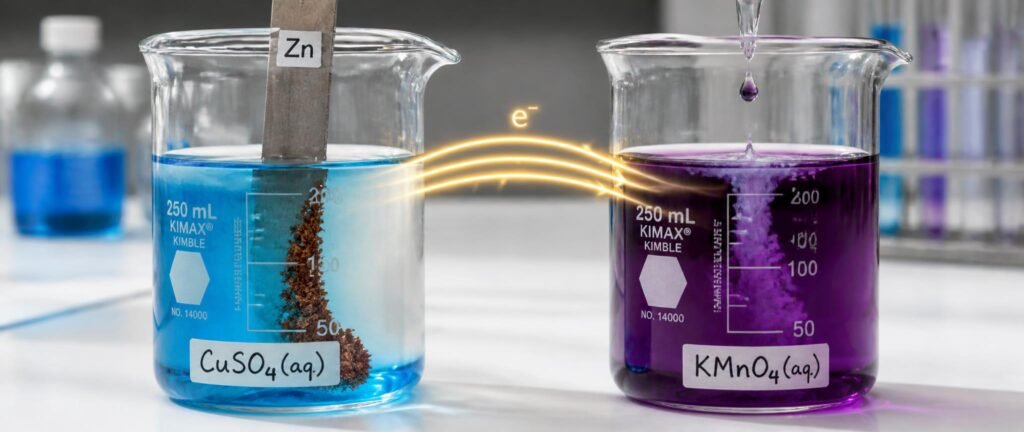
| Displacement | One element replaces another | Zn + CuSO₄ → ZnSO₄ + Cu |
| Disproportionation | The same element is both oxidised and reduced | Cl₂ + 2NaOH → NaCl + NaOCl + H₂O |
A disproportionation reaction is only possible when the element is in an intermediate oxidation state. That is why fluorine cannot disproportionate: it can only be 0 or −1.
Also remember:
- A species in its highest oxidation state can act only as an oxidising agent (for example, KMnO₄).
- A species in its lowest oxidation state can act only as a reducing agent (for example, H₂S). These ideas lead straight into cell reactions.
Balancing Redox Reactions and Electrons Transferred
In the exam, you rarely need to balance a full equation. You need the number of electrons gained or lost.
| Oxidising agent | Medium | Product | Electrons gained |
|---|---|---|---|
| KMnO₄ | Acidic | Mn²⁺ | 5 |
| KMnO₄ | Neutral | MnO₂ | 3 |
| KMnO₄ | Strongly basic | MnO₄²⁻ | 1 |
| K₂Cr₂O₇ | Acidic | 2Cr³⁺ | 6 |
Electrons lost by the reducing agent must equal electrons gained by the oxidising agent. Use that single rule to get mole ratios when balancing redox reactions.
Worked PYQ-Pattern Questions
Q1. What is the oxidation state of Cr in K₂Cr₂O₇?
Answer: +6. 2(+1) + 2x + 7(−2) = 0, so x = +6.
Q2. Which of these shows disproportionation? (a) Zn + CuSO₄ → ZnSO₄ + Cu (b) Cl₂ + 2NaOH → NaCl + NaOCl + H₂O (c) 2H₂ + O₂ → 2H₂O (d) CaCO₃ → CaO + CO₂
Answer: (b). Chlorine goes from 0 to −1 in NaCl and to +1 in NaOCl.
Q3. How many moles of KMnO₄ are needed to oxidise 1 mole of Fe²⁺ in acidic medium?
Answer: 1/5 mole. Each MnO₄⁻ gains 5 electrons, and each Fe²⁺ loses 1 electron.
Q4. What is the oxidation state of oxygen in OF₂?
Answer: +2. Fluorine is more electronegative than oxygen and is always −1.
Q5. In Zn + Cu²⁺ → Zn²⁺ + Cu, which species is the reducing agent?
Answer: Zn. Zinc loses electrons and is oxidised, so it reduces Cu²⁺.
Common Traps in This Chapter
- Taking oxygen as −2 in peroxides, superoxides or OF₂
- Taking hydrogen as +1 in metal hydrides
- Mixing up the oxidising agent with the species that is oxidised
- Using 5 electrons for KMnO₄ in neutral or basic medium
- Calling CaCO₃ → CaO + CO₂ a redox reaction (no oxidation state changes)
Practise Every Redox Reactions PYQ
This redox reactions NEET PYQ analysis gives you the rules and exceptions. Practice makes them automatic. Every previous year question from this chapter is available chapter-wise, free:
👉 Solve all Redox Reactions NEET PYQs
Write the oxidation state above each atom before reading the options. Most errors disappear once the numbers are on paper.
Conclusion
Redox Reactions rewards careful counting more than memory. Use this redox reactions NEET PYQ analysis to master the oxygen and hydrogen exceptions, the four reaction types and the electron counts for KMnO₄ and K₂Cr₂O₇. Then practise until you can assign oxidation states at a glance.
❓ FAQ
Q: How many questions come from Redox Reactions in NEET? A: Usually one question, and sometimes two. Its concepts also appear in Electrochemistry and Inorganic Chemistry questions.
Q: What is a disproportionation reaction? A: It is a reaction in which the same element is oxidised and reduced at the same time. The element must start in an intermediate oxidation state.
Q: What is the oxidation state of oxygen in H₂O₂? A: It is −1. Oxygen is −2 in most compounds, but −1 in peroxides, −½ in superoxides and +2 in OF₂.
Q: How many electrons does KMnO₄ gain in acidic medium? A: Five electrons, because Mn changes from +7 to +2. In neutral medium it gains 3, and in strongly basic medium it gains 1.
Q: How should I revise this chapter for NEET? A: Use a redox reactions NEET PYQ analysis to list the repeated rules and exceptions, then solve past questions chapter-wise.
Q: Where can I practise Redox Reactions NEET PYQs for free? A: You can solve every previous year question from this chapter for free using the practice link in this article.