Chemical Bonding is one of the highest-weightage chapters in NEET Chemistry, and it also decides how well you understand Inorganic and Organic Chemistry. This chemical bonding NEET PYQ analysis shows which question types NTA repeats, the shortcuts that solve them in seconds, and the traps that catch even well-prepared students.
For concept building, pair this with our chemical bonding strategy guide. This article focuses on what past papers actually ask.
Want to test yourself first? Solve the Chemical Bonding and Molecular Structure PYQs for free, then use this guide to fix the gaps.
Table of Contents
Why Chemical Bonding Is a Must-Do Chapter
NEET usually asks two to three questions from Chemical Bonding and Molecular Structure, which makes it one of the top-scoring chapters in Class 11 Chemistry. The questions are short: a shape, a bond order, a dipole moment.
The chapter also supports p-Block, Coordination Compounds and Organic mechanisms. Check its place in the NEET 2027 chapter weightage, and see every Chemistry unit in our full Chemistry chapter list.
Chemical Bonding NEET PYQ Analysis: The Five Repeated Question Types
When you sort a decade of NEET chemistry PYQs from this chapter, five question types cover almost everything.
| Question type | Frequency | What it tests |
|---|---|---|
| Shape and hybridisation | Most frequent | Geometry of molecules and ions |
| MOT and bond order | Very frequent | Bond order, magnetic nature, stability |
| Polarity of molecules | Very frequent | Polar vs non-polar molecules |
| Hydrogen bonding | Regular | Intramolecular vs intermolecular, effect on boiling point |
| Ionic character and Fajans’ rule | Regular | Covalent character in ionic compounds |
Shape questions lead every year. Many of these trends are pure memory, and our inorganic memorisation guide shows how to retain them. For a quick warm-up before the full set, try these five quick bonding practice questions.
Hybridisation and VSEPR Theory: The Shape Table
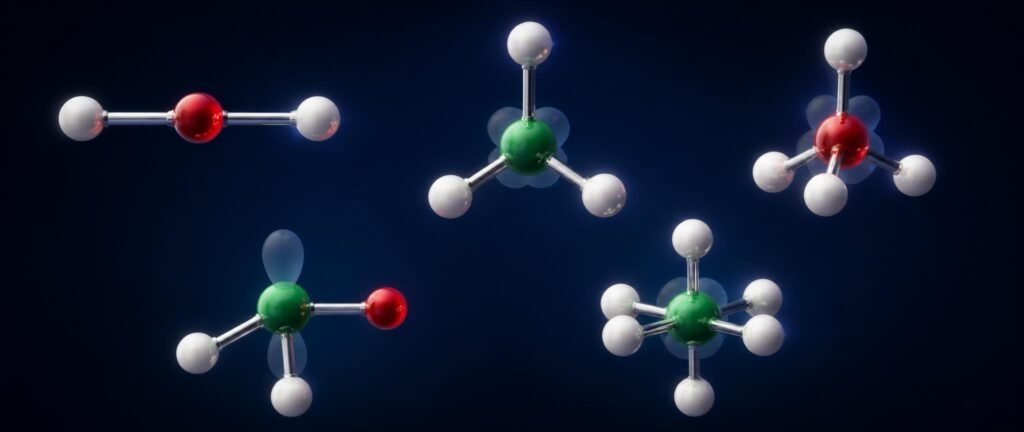
Find the steric number first: bond pairs (sigma bonds) plus lone pairs on the central atom.
| Steric number | Hybridisation | Lone pairs | Shape | Example |
|---|---|---|---|---|
| 2 | sp | 0 | Linear | BeCl₂, CO₂ |
| 3 | sp² | 0 | Trigonal planar | BF₃ |
| 4 | sp³ | 0 | Tetrahedral | CH₄ |
| 4 | sp³ | 1 | Pyramidal | NH₃ |
| 4 | sp³ | 2 | Bent | H₂O |
| 5 | sp³d | 0 | Trigonal bipyramidal | PCl₅ |
| 5 | sp³d | 1 | See-saw | SF₄ |
| 5 | sp³d | 2 | T-shaped | ClF₃ |
| 5 | sp³d | 3 | Linear | XeF₂ |
| 6 | sp³d² | 0 | Octahedral | SF₆ |
| 6 | sp³d² | 1 | Square pyramidal | BrF₅ |
| 6 | sp³d² | 2 | Square planar | XeF₄ |
Lone pairs repel more strongly than bond pairs. That is why the bond angle falls from 109.5° in CH₄ to 107° in NH₃ and 104.5° in H₂O. Getting electron counts right starts one chapter earlier, as our Structure of Atom PYQ patterns article explains. The same shape logic also helps in our coordination compounds guide.
Molecular Orbital Theory: Bond Order and Magnetism
Bond order = ½ (bonding electrons − antibonding electrons)
| Species | Bond order | Magnetic nature |
|---|---|---|
| N₂ | 3 | Diamagnetic |
| O₂ | 2 | Paramagnetic |
| O₂⁺ | 2.5 | Paramagnetic |
| O₂⁻ | 1.5 | Paramagnetic |
| O₂²⁻ | 1 | Diamagnetic |
| He₂ | 0 | Does not exist |
Higher bond order means a shorter and stronger bond. Species with the same number of electrons have the same bond order, so N₂, CO and NO⁺ (14 electrons each) all have a bond order of 3.
Dipole Moment, Hydrogen Bonding and Fajans’ Rule
- Non-polar despite polar bonds: symmetrical molecules such as CO₂, BF₃, CCl₄ and BeF₂, even though their bonds are polar.
- NH₃ vs NF₃: NH₃ is more polar, because in NF₃ the bond dipoles oppose the lone pair.
- Hydrogen bonding: o-nitrophenol has intramolecular hydrogen bonding, so it has a lower boiling point than p-nitrophenol, which has intermolecular hydrogen bonding.
- Fajans’ rule: a small, highly charged cation and a large anion give more covalent character. So LiCl is more covalent than NaCl.
Worked PYQ-Pattern Questions
Q1. What is the shape of XeF₄?
Answer: Square planar. Xe has four bond pairs and two lone pairs, giving sp³d² with the lone pairs opposite each other.
Q2. Which of these has zero dipole moment? (a) NH₃ (b) H₂O (c) BF₃ (d) CHCl₃
Answer: (c) BF₃. It is trigonal planar and symmetrical, so the bond dipoles cancel.
Q3. What is the bond order of O₂⁺?
Answer: 2.5. Removing one antibonding electron from O₂ (bond order 2) raises the bond order to 2.5.
Q4. Which of these is paramagnetic? (a) N₂ (b) O₂ (c) F₂ (d) CO
Answer: (b) O₂. It has two unpaired electrons in antibonding π orbitals.
Q5. What is the hybridisation and shape of SF₄?
Answer: sp³d and see-saw. Sulphur has four bond pairs and one lone pair, so the steric number is 5.
Common Traps in This Chapter
- Forgetting to count lone pairs on the central atom
- Assuming any molecule with polar bonds must be polar
- Saying NF₃ is more polar than NH₃
- Linking a higher bond order with a longer bond (it is shorter)
- Calling O₂ diamagnetic because all its electrons “look paired” in a Lewis structure
Practise Every Chemical Bonding PYQ
This chemical bonding NEET PYQ analysis gives you the tables and shortcuts. Solving real past questions makes them automatic. Every previous year question from this chapter is available chapter-wise, free:
👉 Solve all Chemical Bonding NEET PYQs
For each shape question, write the steric number and lone pair count before looking at the options. It takes five seconds and prevents most mistakes.
Conclusion
Chemical Bonding rewards students who learn two tables well: shapes and bond orders. Use this chemical bonding NEET PYQ analysis to master VSEPR shapes, bond orders, polarity and hydrogen bonding. Then practise until you can name a shape as fast as you can read the formula.
❓ FAQ
Q: How many questions come from Chemical Bonding in NEET? A: Usually two to three questions, which makes it one of the highest-weightage chapters in Class 11 Chemistry.
Q: What is the most important topic in Chemical Bonding for NEET? A: Shapes of molecules using VSEPR theory are the most tested, followed by bond order and polarity questions.
Q: How do I find the shape of a molecule quickly? A: Count the sigma bonds and lone pairs on the central atom to get the steric number. Then use the shape table to match the number of lone pairs to the geometry.
Q: Why is O₂ paramagnetic? A: According to molecular orbital theory, O₂ has two unpaired electrons in its antibonding π orbitals, which makes it paramagnetic.
Q: Do Chemical Bonding PYQs repeat in NEET? A: The molecules change, but the question types repeat every year. A chemical bonding NEET PYQ analysis like this one shows the patterns.
Q: Where can I practise Chemical Bonding NEET PYQs for free? A: You can solve every previous year question from this chapter for free using the practice link in this article.