The lac operon is a group of genes in the bacterium E. coli that is switched on only when lactose is available. It is the classic NCERT example of how gene expression is regulated, and NEET asks about it often: the names of the genes, what each one codes for, what the inducer is, and why the control is called negative regulation. This page explains the lac operon step by step, with two simple diagrams, quick revision points and practice questions at the end.
Lac Operon at a Glance
- Found in: Escherichia coli (a prokaryote)
- Proposed by: François Jacob and Jacques Monod
- Genes: one regulator gene (i) and three structural genes (z, y, a), plus a promoter (p) and an operator (o)
- Inducer: lactose
- Type of control: negative regulation, because a repressor switches the genes off
- Type of operon: inducible, because it stays off until the inducer (lactose) is present
What Is an Operon?
In bacteria, genes that work together for one job are often arranged side by side and controlled as a single unit. Such a unit is called an operon. An operon has:
- Structural genes, which code for the proteins or enzymes needed for the job
- A promoter, where RNA polymerase binds to start transcription
- An operator, a stretch of DNA next to the promoter, where a regulatory protein can bind
- A regulator gene, which codes for the regulatory protein (the repressor)
The structural genes of an operon are transcribed together into one long mRNA. This is called a polycistronic mRNA, because it carries the code for more than one protein. Each operon is named after the substrate it handles, so the lac operon handles lactose, the trp operon handles tryptophan, and so on.
Parts of the Lac Operon and What They Do
| Gene or region | Product | Function |
|---|---|---|
| i (regulator gene) | Repressor protein | Binds the operator and switches the operon off. The word “i” comes from inhibitor |
| p (promoter) | None | Binding site for RNA polymerase |
| o (operator) | None | Binding site for the repressor |
| z (structural gene) | β-galactosidase | Hydrolyses lactose into glucose and galactose |
| y (structural gene) | Permease | Increases the permeability of the cell to lactose, so lactose can enter |
| a (structural gene) | Transacetylase | Third enzyme coded by the operon |
The i gene is always active and keeps making the repressor. In NCERT’s words, the regulator gene is constitutively expressed. Only the three structural genes are switched on and off.
How the Lac Operon Works
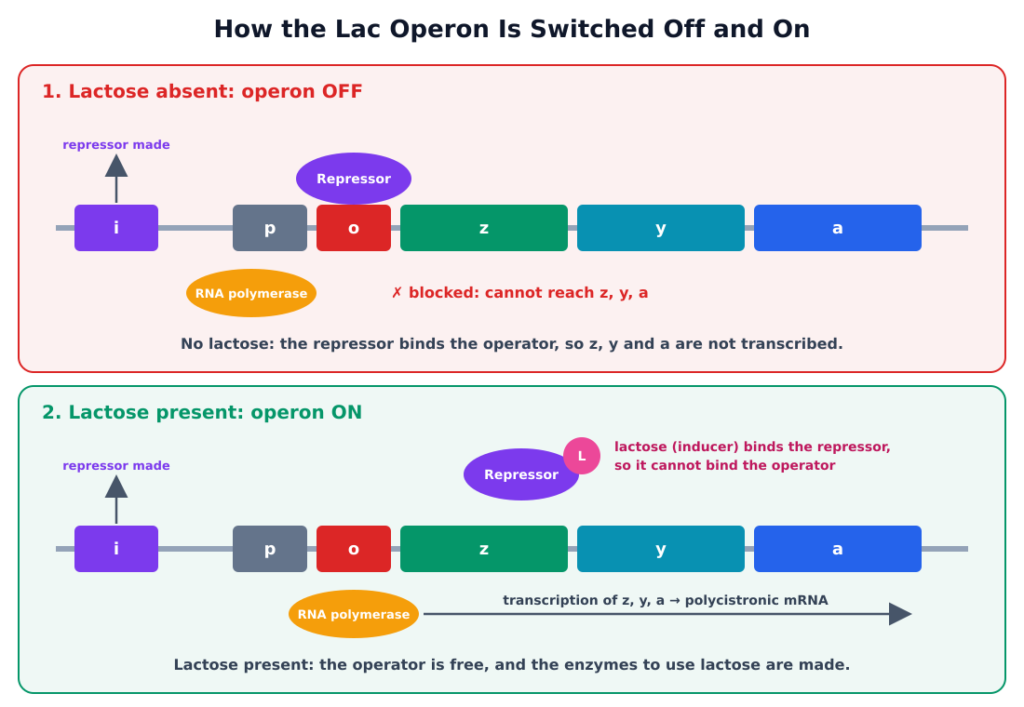
When Lactose Is Absent: the Operon Is Off
- The i gene makes the repressor protein.
- The repressor binds to the operator.
- With the operator blocked, RNA polymerase cannot move forward to transcribe the structural genes.
- So z, y and a are not transcribed, and the cell does not waste energy making enzymes it does not need.
When Lactose Is Present: the Operon Is On
- A very low level of permease is always present in the cell, so some lactose can enter.
- Inside the cell, lactose acts as the inducer. It binds to the repressor and changes its shape.
- The changed repressor can no longer bind to the operator.
- RNA polymerase is now free to transcribe z, y and a into one polycistronic mRNA.
- The cell makes β-galactosidase, permease and transacetylase, and starts using lactose as its energy source.
When all the lactose has been used up, there is no inducer left. The repressor binds the operator again, and the operon switches off. So the operon is on only as long as lactose is there to keep it on.
Why It Is Called Negative Regulation
Regulation of the lac operon by the repressor is called negative regulation, because the regulatory protein (the repressor) stops transcription when it binds. The default state of the operon is off, and it is switched on only when the inducer removes the repressor.
The lac operon is also called an inducible operon, because a substrate (lactose) induces the production of the enzymes that act on it.
Lactose is the inducer in NCERT. Some reference books mention allolactose, a form of lactose made inside the cell, as the actual molecule that binds the repressor. For NEET, follow NCERT and answer lactose. NCERT also notes that glucose and galactose cannot act as inducers of the lac operon.
Quick Revision Points for NEET
- The lac operon is found in E. coli and was described by Jacob and Monod.
- i = regulator gene (repressor), p = promoter, o = operator.
- z = β-galactosidase, y = permease, a = transacetylase. The order to remember is z-y-a.
- β-galactosidase breaks lactose into glucose and galactose.
- Lactose is the inducer. Glucose and galactose cannot act as inducers.
- The repressor binds the operator, not the promoter.
- The structural genes are transcribed as one polycistronic mRNA.
- Control by the repressor is negative regulation, and the lac operon is an inducible operon.
Practice Questions on the Lac Operon
1. In the lac operon, the z gene codes for
- (A) permease
- (B) transacetylase
- (C) β-galactosidase
- (D) repressor
2. The inducer of the lac operon is
- (A) glucose
- (B) galactose
- (C) lactose
- (D) the repressor protein
3. In the absence of lactose, the repressor of the lac operon binds to the
- (A) promoter
- (B) operator
- (C) structural gene z
- (D) RNA polymerase
4. The i gene in the lac operon codes for
- (A) a repressor that is always produced
- (B) an inducer
- (C) β-galactosidase
- (D) RNA polymerase
5. The regulation of the lac operon by a repressor is referred to as
- (A) positive regulation
- (B) negative regulation
- (C) feedback inhibition
- (D) constitutive expression
6. Which enzyme increases the permeability of the cell to β-galactosides such as lactose?
- (A) β-galactosidase
- (B) Transacetylase
- (C) Permease
- (D) Lactase
Answers
- (C) β-galactosidase. The z gene codes for β-galactosidase, which hydrolyses lactose into glucose and galactose.
- (C) lactose. NCERT names lactose as the inducer. Glucose and galactose cannot induce the operon.
- (B) operator. The repressor binds the operator and blocks RNA polymerase from transcribing the structural genes.
- (A) a repressor that is always produced. The i gene is constitutively expressed and keeps making the repressor.
- (B) negative regulation. The repressor switches the operon off when it binds, so the control is negative.
- (C) Permease. The y gene codes for permease, which lets lactose into the cell.
Keep Practising
The lac operon is one part of the Molecular Basis of Inheritance chapter. Revise the full chapter, including DNA replication, transcription, the genetic code, translation and the Human Genome Project, from the Molecular Basis of Inheritance Class 12 notes. This chapter gives more NEET questions than any other Biology chapter, so solve the Molecular Basis of Inheritance NEET PYQs next. For other chapters, see all Class 11 and 12 Biology notes.
Frequently Asked Questions
Q: What is the lac operon in simple words? A: It is a set of three genes in E. coli that make the enzymes needed to use lactose. A repressor keeps these genes switched off, and they switch on only when lactose is present.
Q: What are the three structural genes of the lac operon? A: z, y and a. The z gene codes for β-galactosidase, y for permease and a for transacetylase.
Q: Why is lactose called the inducer of the lac operon? A: Lactose binds to the repressor and stops it from binding the operator. This lets RNA polymerase transcribe the structural genes, so lactose induces the production of the enzymes that break it down.
Q: Is the lac operon an example of positive or negative regulation? A: According to NCERT, regulation of the lac operon by the repressor is negative regulation. It is also an inducible operon.
Q: Who discovered the lac operon? A: François Jacob and Jacques Monod, who first described the lac operon as a model of gene regulation in E. coli.