
Introduction to Laws of Motion
These laws of motion class 11 notes explain why objects move the way they do: Newton’s three laws, momentum and impulse, conservation of momentum, equilibrium, friction and circular motion, with every formula you need for NEET Physics. Kinematics told you how objects move; this chapter answers why, and it is the base for all of mechanics.
- Core ideas: inertia, force as rate of change of momentum, action–reaction pairs, friction, centripetal force
- Key formulas: F = dp/dt = ma, J = FΔt = Δp, fs ≤ μsN, fk = μkN, Fc = mv²/r, tan θ = v²/rg
- Most tested in NEET: friction on inclines, connected blocks and pulleys, apparent weight in a lift, impulse from F–t graphs, banked roads
- Free PDF: full chapter notes in our study app (link below)
Forces govern every change in motion. From friction-based problems to pulley systems, the ideas here come back again and again in NEET numericals, so they are worth learning properly the first time. Each section below follows the NCERT order and ends with a key takeaway for revision.
Key insight: this chapter is about one question, what changes motion; the answer in every section is a net external force.
Aristotle’s View vs Galileo’s Insight
For centuries, Aristotle’s idea dominated science: a constant force is needed to keep an object moving. If you push a box and let go, it stops, which seemed to confirm this. But Aristotle was really observing friction, not the basic nature of motion. This is known as the Aristotelian fallacy.
Galileo overturned this with experiments on inclined planes. He noticed that a ball rolling down one incline rolls up a second incline to nearly the same height, whatever the slope of the second incline. He reasoned that if the second plane were horizontal and there were no friction, the ball would keep moving forever. This thought experiment established a new idea: no force is needed to maintain uniform motion, only to change it.
The natural state of an object is not rest. It is whatever state, rest or uniform motion, it is already in. Changing that state needs a force. This is the foundation of Newton’s First Law.
Galileo’s conclusion: friction is what stops real-world objects, not the absence of a pushing force. Without friction, an object set in motion would move indefinitely. This principle became the concept of inertia, which the next section builds on.
Key insight: Galileo’s inclined-plane argument is the reason we say force changes motion rather than maintains it.
Newton’s First Law – Law of Inertia
Newton’s First Law is the foundation of the chapter. It states:
Every body continues in its state of rest or of uniform motion in a straight line unless compelled by a net external force to change that state.
Inertia is the tendency of a body to resist any change in its state of rest or uniform motion. It is not a force; it is a property of matter, and mass is its measure.
Types of Inertia
| Type | Definition | Example |
|---|---|---|
| Inertia of rest | Resistance to starting motion | Passengers jerk backward when a bus starts suddenly |
| Inertia of motion | Resistance to stopping | Passengers jerk forward when a bus brakes suddenly |
| Inertia of direction | Resistance to change in direction | Mud flies off a spinning wheel along the tangent |
Inertial reference frame: a frame of reference in which Newton’s First Law holds. Non-accelerating frames qualify. An accelerating car is a non-inertial frame; inside it you seem to be pushed backward by a pseudo-force.
Inertia is not a force and has no direction. More massive objects have greater inertia, and mass, its measure, is a scalar, never a vector.
Key insight: the first law defines both force (what changes motion) and inertial frames (where the laws hold).
Momentum and Newton’s Second Law
Before Newton’s Second Law makes complete sense, you need momentum. It ties mass, velocity and force into one framework, which is why it comes first.
p = mv
SI unit: kg m/s · vector, same direction as velocity
Momentum measures how much matter is moving and how fast. A truck moving at 5 m/s has far more momentum than a cricket ball moving at 50 m/s because of its much larger mass. The same idea comes back in collisions.
The second law connects force with the rate of change of momentum, and it is the law you will use most in numericals.
F = dp/dt (general form)
F = ma (when mass is constant)
1 newton = 1 kg × 1 m/s²
- Greater force → greater acceleration for the same mass.
- Greater mass → smaller acceleration for the same force.
- The net force, not any single force, decides the acceleration.
- The law is a vector equation: acceleration is in the direction of the net force, and it can be applied separately along each axis.
- The law is local: the acceleration at a point at an instant depends on the force at that point at that instant.
F = ma applies only in inertial reference frames. In an accelerating frame, such as a lift, you must add a pseudo-force before applying this law.
Apparent Weight in a Lift
Lift accelerating up: N = m(g + a)
Lift accelerating down: N = m(g − a)
Free fall (a = g): N = 0 (apparent weightlessness)
Key insight: write F = dp/dt first; F = ma is only its special case for constant mass.
Impulse and Change in Momentum
When a large force acts for a very short time, the product of force and time is called impulse, and it equals the change in momentum of the object. It follows directly from the second law.
J = F × Δt = Δp = mv − mu
SI unit: N s = kg m/s
Why does increasing time reduce force? For the same change in momentum, spreading it over a longer time needs a smaller average force. Everyday safety examples:
- Airbags: increase the time of impact, which reduces the peak force on the body.
- Cricket fielder: pulls the hands back while catching, which reduces the force on the palms.
- Gymnastics mats: extend the stopping time and protect athletes from impact.

NEET often gives impulse questions as F–t graphs. The area under the F–t graph equals the impulse, and hence the change in momentum.
Key insight: treat impulse as area under the F–t graph; once you see that, graph questions become simple area calculations.
Newton’s Third Law – Action and Reaction
Every force in nature comes in pairs. This is the essence of the third law, and it is one of the most misunderstood ideas in the chapter.
FAB = −FBA
Action and reaction are equal in magnitude, opposite in direction,
and act on DIFFERENT bodies at the same instant.
| Situation | Action | Reaction |
|---|---|---|
| Walking | Foot pushes the ground backward | Ground pushes the foot forward |
| Swimming | Arms push water backward | Water pushes the swimmer forward |
| Gun recoil | Gun exerts a forward force on the bullet | Bullet exerts a backward force on the gun |
| Rocket propulsion | Rocket pushes exhaust gases downward | Gases push the rocket upward |
Action and reaction forces do not cancel each other, because they act on different bodies. Forces can cancel only when they act on the same object, which is never the case for a third-law pair.
Key insight: NEET tests the third law mostly through “which body does each force act on”; name the two bodies before you answer.
Conservation of Linear Momentum
The second and third laws together lead to one of the most important results in mechanics: the total momentum of an isolated system of interacting particles is conserved.
If Fexternal = 0, then ptotal = constant
m₁u₁ + m₂u₂ = m₁v₁ + m₂v₂
Recoil of a Gun
Before firing, the gun and bullet are at rest, so the total momentum is zero. After firing, the bullet gains forward momentum p and the gun gains backward momentum −p, so the total stays zero. It is the standard example of momentum conservation.
0 = mb vb + Mg Vg → Vg = −(mb / Mg) vb
The heavy gun recoils with a much smaller speed than the light bullet.
In collision problems, first check whether the system is isolated (no net external force). If it is, apply conservation of momentum directly, whether the collision is elastic or inelastic.
Key insight: use momentum conservation whenever internal forces are unknown, as in recoil, explosions and collisions.
Equilibrium of a Particle
A particle is in equilibrium when the net external force on it is zero. Its acceleration is then zero: it is either at rest (static equilibrium) or moving with constant velocity (dynamic equilibrium). Apply this condition along each axis separately.
ΣF = 0 → ΣFx = 0, ΣFy = 0, ΣFz = 0
Three concurrent forces in equilibrium form a closed triangle: F₁ + F₂ + F₃ = 0
| Type | Velocity | Acceleration | Example |
|---|---|---|---|
| Static equilibrium | Zero | Zero | Book on a table |
| Dynamic equilibrium | Constant (non-zero) | Zero | Car at constant velocity on a straight highway |
Lami’s theorem: for three concurrent coplanar forces in equilibrium, F₁/sin α = F₂/sin β = F₃/sin γ, where α, β, γ are the angles opposite the forces. It is useful for a mass hanging from two strings, a common NEET setup.
Key insight: “constant velocity” means equilibrium too; zero net force does not mean zero motion.
Read the topic? Try the NEET previous year questions from Laws of Motion next, with answers.
Practice Laws of Motion PYQsCommon Forces in Mechanics
Apart from gravity, almost every force you meet in this chapter is a contact force: normal reaction, tension, friction and applied pushes or pulls.
| Force | Type | Direction | Example |
|---|---|---|---|
| Gravitational (W = mg) | Non-contact | Vertically downward | Weight of any object |
| Normal reaction (N) | Contact | Perpendicular to the surface of contact | Book on a table, person on a floor |
| Tension (T) | Contact | Along the string, pulling away from the body | Hanging mass, pulley systems |
| Friction (f) | Contact | Parallel to the surface, opposing relative motion or its tendency | Walking, braking, sliding |
| Applied force (F) | Contact | Direction of application | Pushing a cart |
Tension in a massless string is the same throughout its length. For a string with mass, tension changes from point to point, a detail NEET occasionally tests.
Key insight: list every force on a body before writing any equation; a missed normal force or tension is the usual source of error.
Friction – The Force Behind Real Motion
Friction is a contact force that opposes relative motion, or the tendency of relative motion, between surfaces in contact. It is one of the most heavily tested topics in this chapter, in both conceptual and numerical questions.
Static friction: 0 ≤ fs ≤ μs N (self-adjusting)
Limiting friction: fs(max) = μs N
Kinetic friction: fk = μk N
Generally: μk < μs
Laws of Friction
- Limiting and kinetic friction are proportional to the normal reaction (N).
- They are independent of the apparent area of contact.
- Kinetic friction is nearly independent of the speed of sliding.
- The coefficient of friction (μ) depends on the nature and condition of the surfaces in contact.
Angle of Friction and Angle of Repose
The angle of friction λ is the angle between the resultant of the limiting friction and normal reaction, and the normal reaction: tan λ = μs. The angle of repose θ is the angle of an incline at which a block just begins to slide: tan θ = μs. So the angle of repose equals the angle of friction.
Rolling Friction and Reducing Friction
Rolling friction < Kinetic friction < Limiting static friction
This is why wheels and ball bearings roll far more easily than objects slide.
Friction is reduced in machines by using ball bearings (turning sliding into rolling) and lubricants such as oil and grease, which form a thin layer between the moving surfaces. It is also necessary: without friction we could not walk, and cars could not start, stop or turn. Friction is both a nuisance and a necessity.
Key insight: every friction problem comes down to one check: is the body sliding? If not, static friction is only as large as it needs to be, up to μs N.
Dynamics of Circular Motion
Uniform circular motion involves a continuous change in the direction of velocity, so there is a continuous acceleration towards the centre. By the second law, a net force must cause it. That force is the centripetal force, always directed towards the centre of the circular path. It is a net force, not a new kind of force.
Fc = mv²/r = mω²r
Direction: always radially inward (towards the centre)
Supplied by friction, tension, gravity or a normal-force component
Centrifugal force does not exist in an inertial frame. It is a pseudo-force that appears only in a rotating (non-inertial) frame. In NEET problems, work in an inertial frame and use centripetal acceleration, not centrifugal force.
Vehicle on a Level and a Banked Road
Level circular road: f = mv²/r ≤ μs mg → vmax = √(μs r g)
Banked road, no friction: tan θ = v₀²/rg (optimum speed)
Banked road with friction: vmax = √[rg(μs + tan θ)/(1 − μs tan θ)]

Vertical Circle (String)
At the top: T + mg = mv²/r
At the bottom: T − mg = mv²/r
The vertical circle is covered in Work, Energy and Power in NCERT but is solved with the force equations from this chapter.
Key insight: every circular motion problem begins by asking which real force supplies mv²/r: friction on a level road, a normal-force component on a banked road.
Solving Problems: Free Body Diagrams
A free body diagram (FBD) is a diagram of a single object, isolated from its surroundings, showing all the forces acting on it. It is the most important skill for solving numericals in this chapter.
Steps to Solve Any Problem
- Identify the object (or system) to be analysed and draw a separate diagram for it.
- Mark every force acting on the object, not the forces it exerts on others.
- Label each force (W, N, T, f, F applied).
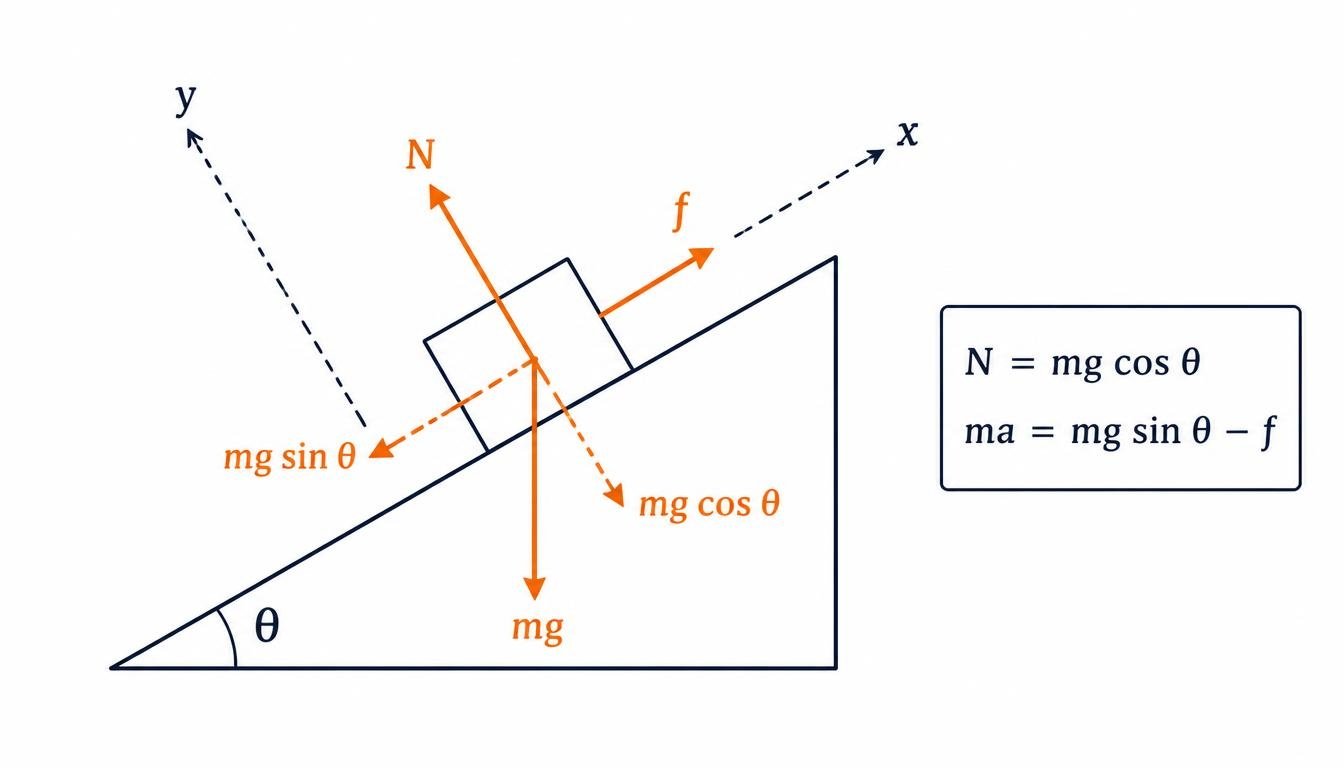
- Choose axes along and perpendicular to the acceleration; on an incline, take axes parallel and perpendicular to the plane.
- Apply ΣF = ma along each axis.
- Solve the equations and check the units and signs, keeping one positive direction throughout.
Inclined plane (angle θ):
Along the plane: ma = mg sin θ − f
Perpendicular to the plane: N = mg cos θ
Atwood machine (two masses over a frictionless pulley, m₁ > m₂):
a = (m₁ − m₂)g / (m₁ + m₂)
T = 2m₁m₂g / (m₁ + m₂)
Key insight: solve connected-body problems with one FBD per block; the shared acceleration and tension link the equations.
Conceptual Practice Questions
These questions test conceptual clarity on the chapter. Try each one before reading the short answer.
- A horse pulls a cart. By Newton’s Third Law, the cart pulls the horse back with an equal force. Why does the system move forward? The action–reaction pair acts on different bodies. The system moves because the ground pushes the horse forward (friction) with a force larger than the friction on the cart.
- Why is it easier to pull a lawn roller than to push it at the same angle? Pulling at an angle has an upward component that reduces the normal reaction and so the friction; pushing adds a downward component that increases both.
- Blocks of 3 kg and 5 kg hang over a frictionless pulley. Find the acceleration and tension (g = 10 m/s²). a = (5 − 3) × 10 / 8 = 2.5 m/s²; T = 2 × 5 × 3 × 10 / 8 = 37.5 N.
- A 10 kg block rests on a surface with μs = 0.4. What minimum horizontal force just starts it moving (g = 10 m/s²)? F = μs mg = 0.4 × 10 × 10 = 40 N.
- A ball is released inside a lift accelerating upward. Does it fall faster, slower or at the same rate relative to the floor? Faster: relative to the floor its acceleration is g + a (add the pseudo-force ma in the lift’s frame). In a lift accelerating downward it is g − a.
- Why does a cricket ball hurt less when caught on a grassy field than on concrete? The same change in momentum takes place over a longer time, so the average force is smaller.
Key insight: most conceptual traps in this chapter come from the third law and from friction direction, so revisit those two sections when you get one wrong.
How NEET Tests This Chapter
NEET questions on this chapter repeat a small set of patterns. The table lists the types to prepare.
| Question type | What it checks |
|---|---|
| Friction on an inclined plane | Acceleration, angle of repose, or minimum force to start or prevent sliding. |
| Impulse and momentum | F–t graphs with non-uniform force; impulse as area, then final velocity or Δp. |
| Circular motion | Maximum speed on a level road, banking angle, tension at different points of a vertical circle. |
| Connected bodies and pulleys | Atwood machine or blocks on a surface; tension and acceleration from separate FBDs. |
| Apparent weight | Normal reaction or weighing-scale reading in an accelerating lift. |
| Conservation of momentum | Gun recoil, explosions into fragments, and collisions. |
Friction problems (static, kinetic and inclined plane) are worth mastering completely before you move on, because they combine every other idea in the chapter.
Once you finish these notes, practise Laws of Motion NEET PYQs here, free and with answers.
Key insight: pair each PYQ set with the matching section of these notes; friction and pulleys first, then circular motion.
Common Mistakes and Misconceptions
| Misconception | The correct understanding |
|---|---|
| Heavier objects fall faster | Without air resistance, all objects fall with the same acceleration g. Mass does not affect free-fall acceleration. |
| Action and reaction cancel out | They act on different bodies and never cancel. Only forces on the same object can cancel to give equilibrium. |
| Mass = weight | Mass (kg) is the measure of inertia. Weight (N) = mg, a force that depends on gravity. They are different quantities with different units. |
| Centrifugal force is real | Centrifugal force is a pseudo-force in rotating frames. In inertial frames it does not exist; only the centripetal (net) force acts. |
| Friction always opposes motion | Friction opposes relative motion or its tendency. Static friction can act in the direction of motion, e.g. when walking it pushes you forward. |
| Normal force always equals mg | N = mg only on a horizontal surface with no vertical acceleration. On inclines or in lifts, the normal force changes. |
Key insight: read this table before every test; these six errors account for many lost marks in this chapter.
Laws of Motion Class 11 Notes: Quick Revision Summary
Use this formula sheet for quick revision before a test.
- Momentum: p = mv (vector)
- Newton’s second law: F = dp/dt = ma
- Impulse: J = FΔt = Δp = m(v − u)
- Conservation of momentum: m₁u₁ + m₂u₂ = m₁v₁ + m₂v₂ (no external force)
- Limiting friction: fs(max) = μs N; kinetic friction: fk = μk N
- Angle of repose = angle of friction: tan θ = μs
- Centripetal force: Fc = mv²/r = mω²r
- Inclined plane (smooth): a = g sin θ; (rough, sliding down): a = g(sin θ − μk cos θ)
- Atwood machine: a = (m₁ − m₂)g / (m₁ + m₂), T = 2m₁m₂g / (m₁ + m₂)
- Level road: vmax = √(μs r g); banked road (no friction): tan θ = v²/rg
- Apparent weight in a lift: N = m(g + a) going up, N = m(g − a) going down
Frequently Asked Questions – Laws of Motion Class 11
What is the difference between mass and inertia?
Why does a gun recoil when fired?
Why is it harder to stop a heavier vehicle moving at the same speed?
What is a pseudo-force and when do we use it?
How many questions from Laws of Motion appear in NEET each year?
Is centrifugal force real? Can I use it in NEET problems?
Where can I download laws of motion class 11 notes PDF?
Ready to Master Laws of Motion in NEET?
Sharpen your skills with expert-taught courses and chapter-wise practice sessions designed for NEET 2027.





[…] Go to page […]
[…] Go to page […]
[…] Laws of Motion notes […]