Chemistry is the subject where smart preparation pays off fastest in NEET, because most of it comes straight from NCERT. This NEET 2027 Chemistry syllabus guide gives you all 20 NMC units, the matching NCERT chapters, a free PYQ link for every chapter, and clear answers to the “is this topic in the syllabus?” questions students search for most.
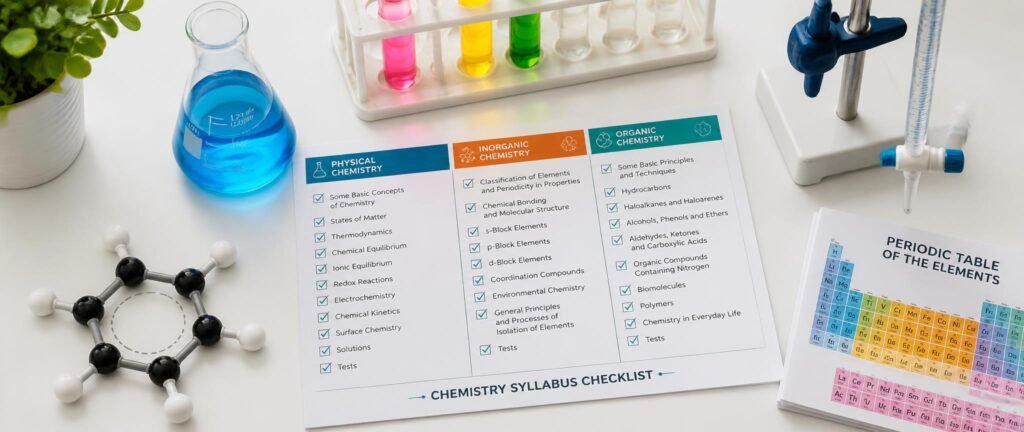
For subject strategy, read our complete physical chemistry guide. Use this page as your chapter checklist.
Every chapter in the tables below links straight to its previous year questions, starting with Some Basic Concepts of Chemistry PYQs, so you can move from syllabus to practice in one click.
Table of Contents
Has the NEET 2027 Chemistry Syllabus Been Released?
Not yet. The National Medical Commission (NMC) released the NEET 2026 syllabus on 23 December 2025, with no changes from 2025. Until the 2027 version is published, the NEET 2026 Chemistry syllabus is the one to follow.
Big changes are unlikely, because NCERT is keeping the same Class 11 and 12 textbooks for 2026–27. We explain why in our guide on what could change for 2027.
Chemistry Syllabus at a Glance
- Units: 20, grouped into Physical, Inorganic and Organic Chemistry
- NCERT chapters covered: 20, including p-Block Elements
- Questions in the paper: 45 Chemistry questions, 180 marks, based on the current pattern
- Special unit: Principles Related to Practical Chemistry, added in the 2024 revision
Is This Topic in the NEET 2027 Chemistry Syllabus?
These answers are based on the current NMC syllabus and its list of deleted topics.
| Topic | In the syllabus? | Note |
|---|---|---|
| Alcohols: preparation, properties and reactions | Yes | Part of “Organic Compounds Containing Oxygen” |
| p-Block Elements (Groups 13 to 18) | Yes | Still in NEET, even though rationalised NCERT removed it |
| Principles Related to Practical Chemistry | Yes | Added in 2024 |
| Purification and characterisation of organic compounds | Yes | Its own unit in the NMC syllabus |
| Hydrogen | No | Removed |
| Polymers | No | Removed |
| Chemistry in Everyday Life | No | Removed |
| Environmental Chemistry | No | Removed |
| States of Matter, Solid State, Surface Chemistry | No | Not in the current unit list |
| s-Block Elements, Metallurgy | No | Not in the current unit list |
p-Block is the one that catches students out. Many new NCERT books no longer have it, so study it from the older NCERT edition or a good reference book. The subject-wise list of removed topics is in our full deleted syllabus list.
Chemistry Chapter Wise Weightage: Where to Focus
Exact numbers change every year, but recent papers show a steady pattern. Use this chemistry chapter wise weightage as a priority guide, and see our NEET 2027 chapter weightage page for the full breakdown.
| Priority | Units |
|---|---|
| High | Chemical Bonding, Equilibrium, Coordination Compounds, Organic Compounds Containing Oxygen, Basic Principles of Organic Chemistry, Chemical Thermodynamics |
| Medium | Atomic Structure, Some Basic Concepts (Mole Concept), Redox and Electrochemistry, Chemical Kinetics, Solutions, p-Block, d- and f-Block, Hydrocarbons, Nitrogen Compounds, Biomolecules |
| Lower | Periodicity, Halogen Compounds, Purification and Characterisation, Practical Chemistry |
Organic reaction mechanisms reward understanding over memory, and our organic mechanisms guide shows how to learn them. For Inorganic, our inorganic memorisation guide helps with trends and exceptions. To pick one reference per branch, see the best Chemistry reference books.
Complete NEET Chemistry Chapter List With PYQs
This NEET chemistry chapter list maps each NMC unit to its NCERT chapter. Click any chapter to practise its PYQs.
Physical Chemistry
| Unit | NMC unit name | NCERT chapter (practise PYQs) |
|---|---|---|
| 1 | Some Basic Concepts in Chemistry | Some Basic Concepts of Chemistry |
| 2 | Atomic Structure | Structure of Atom |
| 3 | Chemical Bonding and Molecular Structure | Chemical Bonding and Molecular Structure |
| 4 | Chemical Thermodynamics | Thermodynamics |
| 5 | Solutions | Solutions |
| 6 | Equilibrium | Equilibrium |
| 7 | Redox Reactions and Electrochemistry | Redox Reactions, Electrochemistry |
| 8 | Chemical Kinetics | Chemical Kinetics |
Inorganic Chemistry
| Unit | NMC unit name | NCERT chapter (practise PYQs) |
|---|---|---|
| 9 | Classification of Elements and Periodicity in Properties | Classification of Elements and Periodicity |
| 10 | p-Block Elements | The p-Block Elements |
| 11 | d- and f-Block Elements | The d- and f-Block Elements |
| 12 | Coordination Compounds | Coordination Compounds |
Organic Chemistry
| Unit | NMC unit name | NCERT chapter (practise PYQs) |
|---|---|---|
| 13 | Purification and Characterisation of Organic Compounds | Organic Chemistry: Some Basic Principles and Techniques |
| 14 | Some Basic Principles of Organic Chemistry | Same NCERT chapter as Unit 13 |
| 15 | Hydrocarbons | Hydrocarbons |
| 16 | Organic Compounds Containing Halogens | Haloalkanes and Haloarenes |
| 17 | Organic Compounds Containing Oxygen | Alcohols, Phenols and Ethers, Aldehydes, Ketones and Carboxylic Acids |
| 18 | Organic Compounds Containing Nitrogen | Amines |
| 19 | Biomolecules | Biomolecules |
| 20 | Principles Related to Practical Chemistry | Lab-based questions (see below) |
Practical Chemistry: The Unit Many Students Skip
This unit tests NCERT lab work, and the questions are usually short and direct. Common areas include:
- Detection of elements (N, S and halogens) in organic compounds
- Tests for functional groups: alcohols, aldehydes, ketones, carboxylic acids and amines
- Preparation of simple inorganic and organic compounds
- Titrimetric exercises, such as acid–base titrations
- Qualitative salt analysis: identifying common cations and anions
- Enthalpy of solution and neutralisation, and reaction rate experiments
Spend one or two focused sessions here. These are some of the easiest marks in Chemistry.
How to Use This Syllabus With PYQs
- Print the three tables above and tick each chapter as you finish it.
- After each chapter, solve its PYQs using the links in the table. This shows exactly how NTA tests it.
- Revise Inorganic every week. It is pure memory, and it fades fastest.
- Practise Physical numericals daily so that speed builds over time.
- Learn Organic through mechanisms, not by memorising every reaction separately.
NEET chemistry PYQs are the most reliable guide to question style. Two rounds of chapter-wise PYQs usually improve Chemistry scores more than a new book.
Practise Every Chemistry Chapter
Every chapter in the NEET 2027 Chemistry syllabus has its previous year questions available chapter-wise, free:
👉 Solve every Chemistry chapter’s PYQs
Conclusion
The NEET 2027 Chemistry syllabus is expected to keep the same 20 units as 2026. Remember that p-Block is still in, skip the removed chapters, give extra time to the high-weightage units, and pair every chapter with its PYQs. When NMC releases the official document, compare it with this list, and you will know within minutes if anything has changed.
❓ FAQ
Q: How many units are in the NEET 2027 Chemistry syllabus? A: Based on the current NMC syllabus, there are 20 units across Physical, Inorganic and Organic Chemistry. These map to 20 NCERT chapters, including p-Block Elements.
Q: Is the preparation and reactions of alcohols in the NEET syllabus? A: Yes. Alcohols, phenols and ethers, including their preparation, properties and reactions, are part of the unit “Organic Compounds Containing Oxygen”.
Q: Is p-Block in the NEET syllabus even though NCERT removed it? A: Yes. The NMC syllabus still includes p-Block Elements (Groups 13 to 18). Study it from the older NCERT edition or a good reference book.
Q: Which Chemistry chapters have been removed from NEET? A: Hydrogen, Polymers, Chemistry in Everyday Life and Environmental Chemistry have been removed. States of Matter, Solid State, Surface Chemistry, s-Block and Metallurgy are also not in the current unit list.
Q: Has the 2027 Chemistry syllabus been officially released? A: Not yet. Follow the NEET 2026 syllabus, released by NMC on 23 December 2025, until the 2027 version is published.
Q: Where can I practise Chemistry previous year questions chapter-wise? A: Every chapter in the tables above links to its free previous year questions, so you can practise each one right after studying it.



[…] So a weak base here quietly costs marks across Physical Chemistry. See where the chapter sits in the NEET 2027 chapter weightage, and find every Chemistry unit in our full Chemistry chapter list. […]
[…] chapter sits in the unit “Redox Reactions and Electrochemistry”. See every unit in our full Chemistry chapter list, and check the NEET 2027 chapter weightage for its share of the […]
[…] GOC explains reactivity in Hydrocarbons, Haloalkanes, Alcohols and Amines. See every unit in our full Chemistry chapter list, and check the NEET 2027 chapter […]
[…] 18, with most questions from Groups 15 to 18 in Class 12 NCERT. It remains in the syllabus, as our full Chemistry chapter list […]