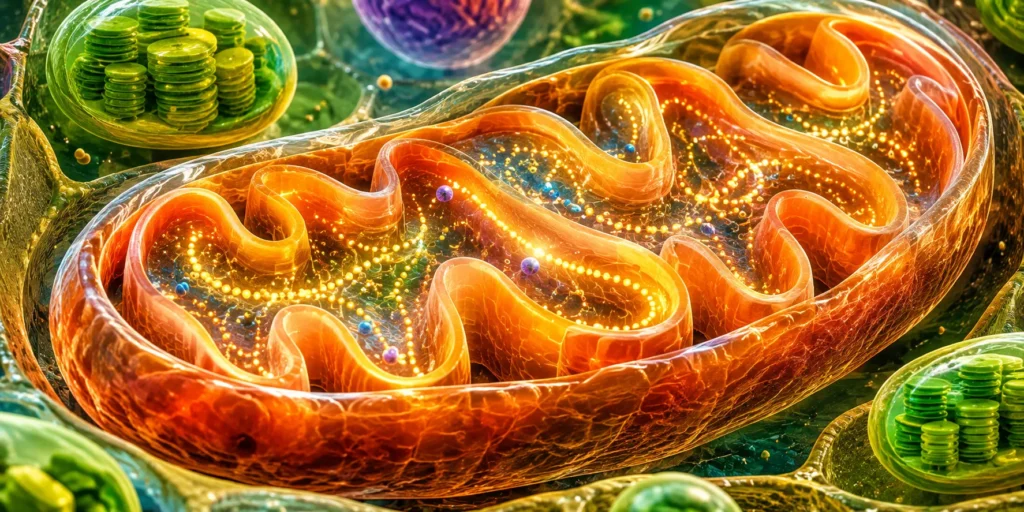
The Krebs cycle steps begin when acetyl CoA (2 carbons) joins oxaloacetic acid (4 carbons) to form citric acid (6 carbons). Citric acid then passes through isocitrate, α-ketoglutarate, succinyl CoA, succinate, fumarate and malate, and finally becomes oxaloacetic acid again, so the cycle can repeat. Each turn releases 2 CO₂ and makes 3 NADH, 1 FADH₂ and 1 GTP (ATP). The cycle runs in the mitochondrial matrix and turns twice for every glucose molecule.
This page covers the cycle step by step, carbon by carbon. It also counts the NADH, FADH₂ and ATP at every stage and works out the 38 ATP that NCERT gives per glucose. Practice questions are at the end. For the full chapter, see the Respiration in Plants Class 11 notes.
Krebs Cycle at a Glance
| Feature | Detail |
|---|---|
| Other names | Citric acid cycle, tricarboxylic acid (TCA) cycle |
| Discovered by | Hans Krebs |
| Site | Matrix of the mitochondria |
| Starts with | Acetyl CoA + oxaloacetic acid (OAA) |
| First product | Citric acid (6 carbons) |
| Enzyme of first step | Citrate synthase |
| Turns per glucose | 2 (one for each pyruvate) |
| Per turn | 2 CO₂, 3 NADH, 1 FADH₂, 1 GTP |
| Oxygen needed? | Not directly, but the cycle stops without it, because NAD⁺ and FAD are regenerated only when the ETS passes electrons to O₂ |
Before the Cycle: The Link Reaction
Glycolysis in the cytoplasm splits one glucose into two molecules of pyruvic acid. In aerobic respiration, each pyruvic acid enters the mitochondrial matrix and undergoes oxidative decarboxylation by the pyruvate dehydrogenase complex, which needs Mg²⁺:
Pyruvic acid + CoA + NAD⁺ → Acetyl CoA + CO₂ + NADH + H⁺
This step links glycolysis to the Krebs cycle. Per glucose, it gives 2 acetyl CoA, 2 CO₂ and 2 NADH.
Krebs Cycle Steps
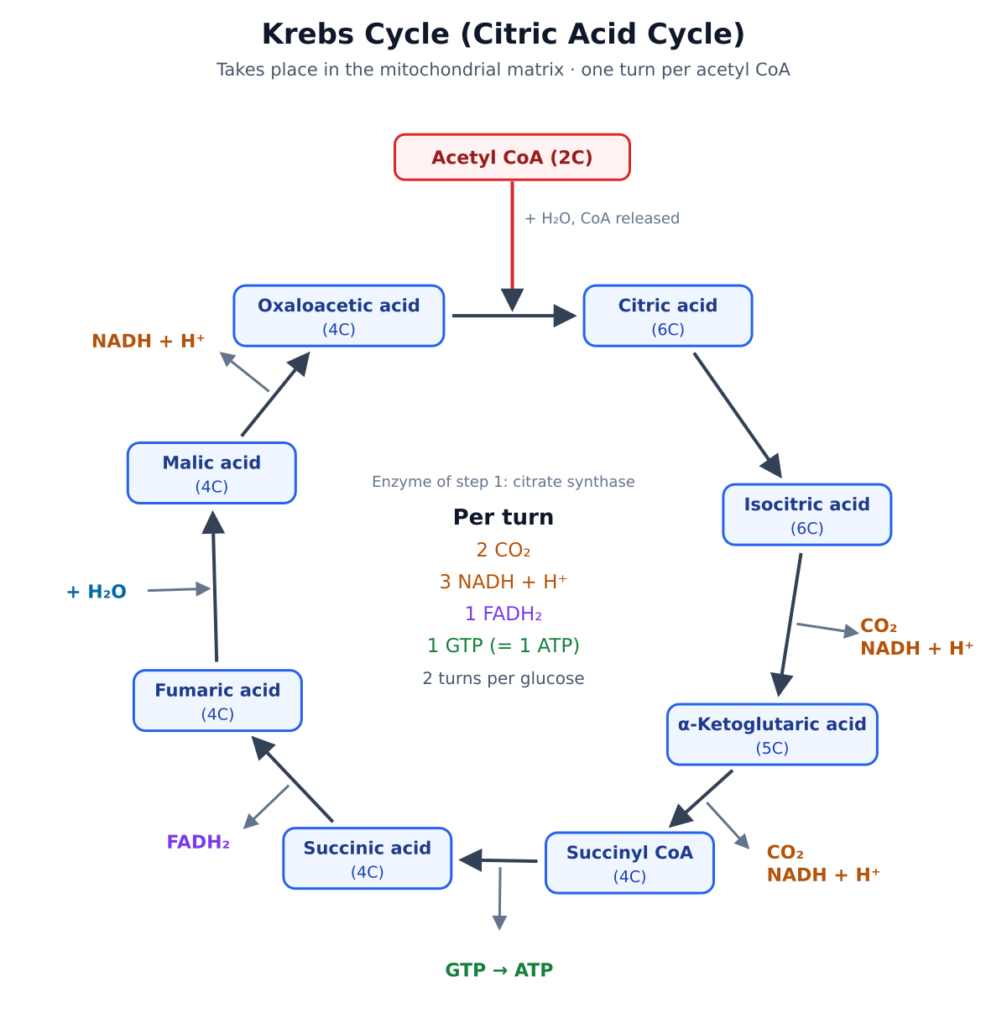
- Condensation: Acetyl CoA (2C) combines with oxaloacetic acid (4C) and water to form citric acid (6C). The enzyme is citrate synthase, and CoA is released.
- Isomerisation: Citric acid is rearranged into isocitric acid (6C).
- First decarboxylation: Isocitric acid loses one CO₂ and becomes α-ketoglutaric acid (5C). One NAD⁺ is reduced to NADH + H⁺.
- Second decarboxylation: α-ketoglutaric acid loses another CO₂ and joins CoA to form succinyl CoA (4C). A second NADH + H⁺ is formed.
- Substrate-level phosphorylation: Succinyl CoA is converted to succinic acid (4C). The energy released makes one GTP, which is converted to ATP in a coupled reaction.
- First dehydrogenation: Succinic acid is oxidised to fumaric acid (4C). FAD is reduced to FADH₂.
- Hydration: Water is added to fumaric acid to form malic acid (4C).
- Second dehydrogenation: Malic acid is oxidised back to oxaloacetic acid (4C). The third NADH + H⁺ is formed, and OAA is ready to accept the next acetyl CoA.
Tracking the carbons: 2C (acetyl) + 4C (OAA) → 6C → 6C → 5C → 4C → 4C → 4C → 4C → 4C. The two carbons that enter as acetyl CoA leave as the two CO₂ released in steps 3 and 4.
Memory trick for the order: “Citrate Is Krebs’ Starting Substrate For Making Oxaloacetate” gives Citrate, Isocitrate, α-Ketoglutarate, Succinyl CoA, Succinate, Fumarate, Malate, Oxaloacetate.
What One Turn and One Glucose Produce
| Product | Per turn of the Krebs cycle | Per glucose (2 turns) |
|---|---|---|
| CO₂ | 2 | 4 |
| NADH + H⁺ | 3 | 6 |
| FADH₂ | 1 | 2 |
| GTP (ATP) | 1 | 2 |
NCERT combines the link reaction and one turn of the cycle into one summary equation, per pyruvic acid:
Pyruvic acid + 4NAD⁺ + FAD⁺ + 2H₂O + ADP + Pi → 3CO₂ + 4NADH + 4H⁺ + FADH₂ + ATP
That is why the “per pyruvate” figures (3 CO₂, 4 NADH) are one higher than the “per turn of the cycle” figures (2 CO₂, 3 NADH). NEET often tests exactly this difference.
ATP Count: How NCERT Gets 38 ATP per Glucose
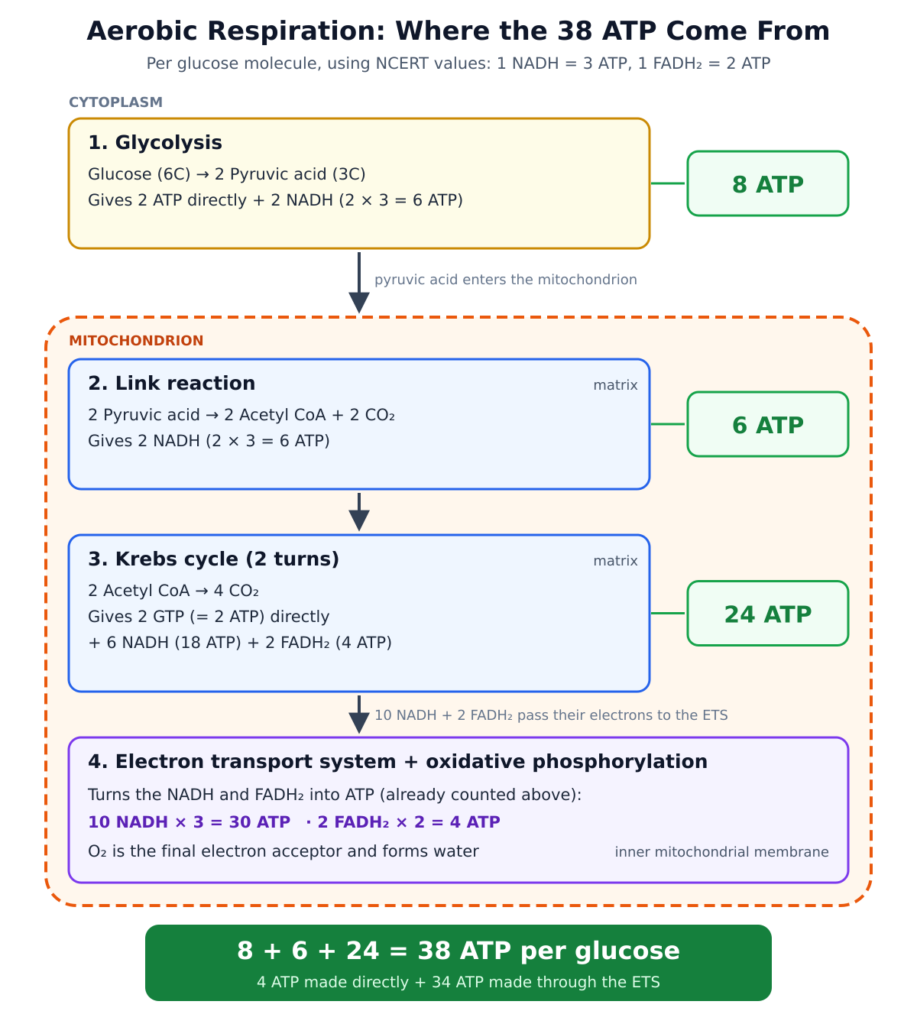
The NADH and FADH₂ give up their electrons in the electron transport system (ETS) on the inner mitochondrial membrane. NCERT takes 1 NADH = 3 ATP and 1 FADH₂ = 2 ATP.
| Stage | Direct ATP | NADH | FADH₂ | Total ATP |
|---|---|---|---|---|
| Glycolysis | 2 | 2 (= 6 ATP) | – | 8 |
| Link reaction (pyruvate → acetyl CoA) | – | 2 (= 6 ATP) | – | 6 |
| Krebs cycle (2 turns) | 2 | 6 (= 18 ATP) | 2 (= 4 ATP) | 24 |
| Total | 4 | 10 (= 30 ATP) | 2 (= 4 ATP) | 38 |
So the Krebs cycle alone accounts for 24 of the 38 ATP, mostly through the NADH and FADH₂ it feeds into the ETS. It makes only 2 ATP directly.
NCERT’s 38 ATP figure assumes:
- the pathways run in an orderly sequence, one substrate forming the next;
- the NADH made in glycolysis enters the mitochondria and undergoes oxidative phosphorylation;
- none of the intermediates is used to make other compounds;
- only glucose is being respired.
These conditions don’t all hold in a living cell, so 38 is a theoretical maximum. Newer textbooks give 30–32 ATP per glucose, because they take about 2.5 ATP per NADH and 1.5 per FADH₂. For NEET and board exams, use NCERT’s values: 38 ATP, with NADH = 3 and FADH₂ = 2.
Why the Krebs Cycle Is Amphibolic
Respiration is usually seen as a breaking-down (catabolic) process. But the Krebs cycle also supplies building blocks. For example, acetyl CoA can be withdrawn to make fatty acids, and the cycle’s intermediates can be used to make other molecules. Because it takes part in both breakdown and synthesis, the respiratory pathway is called amphibolic, not just catabolic.
Quick Revision Points for NEET
- Site: Krebs cycle and link reaction in the mitochondrial matrix; glycolysis in the cytoplasm; ETS on the inner mitochondrial membrane.
- First product: citric acid (6C), made by citrate synthase.
- Decarboxylations: isocitrate → α-ketoglutarate and α-ketoglutarate → succinyl CoA.
- Substrate-level phosphorylation: succinyl CoA → succinate, which gives GTP.
- FADH₂ step: succinate → fumarate.
- Per turn: 2 CO₂, 3 NADH, 1 FADH₂, 1 GTP. Double everything per glucose.
- ATP: 24 ATP from the Krebs cycle stage and 38 ATP in total per glucose (NCERT).
Practice Questions on the Krebs Cycle
1. The first product formed in the Krebs cycle is
- (A) oxaloacetic acid
- (B) α-ketoglutaric acid
- (C) citric acid
- (D) succinic acid
2. Substrate-level phosphorylation in the Krebs cycle occurs during the conversion of
- (A) citric acid to isocitric acid
- (B) succinyl CoA to succinic acid
- (C) malic acid to oxaloacetic acid
- (D) isocitric acid to α-ketoglutaric acid
3. How many NADH molecules are produced in one turn of the Krebs cycle?
- (A) 1
- (B) 2
- (C) 3
- (D) 4
4. FADH₂ is produced in the Krebs cycle when
- (A) succinic acid is oxidised to fumaric acid
- (B) malic acid is oxidised to oxaloacetic acid
- (C) citric acid is converted to isocitric acid
- (D) acetyl CoA combines with oxaloacetic acid
5. According to NCERT, the net gain of ATP from the complete aerobic respiration of one glucose molecule is
- (A) 2
- (B) 24
- (C) 36
- (D) 38
Answers
1. (C) Citric acid. Acetyl CoA condenses with oxaloacetic acid to form citric acid, catalysed by citrate synthase.
2. (B) Succinyl CoA to succinic acid. This step makes one GTP directly, which is converted to ATP.
3. (C) 3. One turn makes 3 NADH, 1 FADH₂ and 1 GTP. With the link reaction included, each pyruvate gives 4 NADH.
4. (A) Succinic acid to fumaric acid. This is the only step in the cycle where FAD, not NAD⁺, is reduced.
5. (D) 38. That is 8 from glycolysis, 6 from the link reaction and 24 from the Krebs cycle stage, using NADH = 3 ATP and FADH₂ = 2 ATP.
Keep Practising
After you learn the Krebs cycle steps, revise the full Respiration in Plants notes, including glycolysis, fermentation and the electron transport system. Then solve the Respiration in Plants NEET PYQs chapter-wise to see how NEET frames Krebs cycle questions. For other chapters, see all Class 11 and 12 Biology notes.
Frequently Asked Questions
What are the main Krebs cycle steps? Acetyl CoA joins oxaloacetic acid to form citric acid, which becomes isocitric acid. Two decarboxylations follow, giving α-ketoglutaric acid and then succinyl CoA. Succinyl CoA is converted to succinic acid (making GTP), then fumaric acid (making FADH₂), malic acid and finally oxaloacetic acid (making NADH).
How many ATP are produced in the Krebs cycle? Directly, only 1 GTP (ATP) per turn, or 2 per glucose. Counting the ATP made later from its 6 NADH and 2 FADH₂ in the ETS, the Krebs cycle stage gives 24 ATP per glucose, using NCERT’s values.
Why does the Krebs cycle turn twice for one glucose molecule? Glycolysis splits one glucose into two pyruvic acid molecules. Each pyruvic acid forms one acetyl CoA, and each acetyl CoA drives one turn of the cycle.
Is 38 ATP or 36 ATP correct for NEET? Use 38 ATP, the figure NCERT gives. Older and newer textbooks quote 36 or 30–32 ATP because they use different assumptions about NADH from glycolysis and the ATP yield per NADH, but NEET follows NCERT.