These Ecosystem Class 12 important questions cover every topic in the current board syllabus for this chapter: the structure of an ecosystem, productivity, decomposition, energy flow, food chains and ecological pyramids. They are arranged by marks: 1-mark MCQs and assertion–reason, then 2-mark, 3-mark, case-based and 5-mark questions, each with a model answer written the way CBSE examiners expect. Ecological succession, nutrient cycling and ecosystem services were removed from the rationalised NCERT book, so they are not included. If any topic feels shaky, revise the Ecosystem Class 12 notes first.
How to Use These Ecosystem Class 12 Important Questions
- Try to answer each question yourself before reading the model answer.
- Match your answer length to the marks: about 30 words for 2 marks, 50–60 words for 3 marks and 100–120 words for 5 marks.
- Use the key terms examiners look for, such as GPP, NPP, detritus, humification, standing crop, 10 per cent law and inverted pyramid.
- Draw labelled pyramids wherever a question asks about them; a neat diagram earns marks.
- If you are also preparing for NEET, practise the Ecosystem NEET previous year questions after this.
1-Mark Questions (MCQs)
1. The vertical distribution of different species occupying different levels in an ecosystem is called
- (A) stratification
- (B) succession
- (C) zonation
- (D) food web
Answer: (A) Stratification. In a forest, trees occupy the top vertical stratum, shrubs the second, and herbs and grasses the bottom layers.
2. Net primary productivity (NPP) is equal to
- (A) GPP + R
- (B) GPP − R
- (C) GPP × R
- (D) R − GPP
Answer: (B) GPP − R. NPP is what remains of gross primary productivity after the plants’ own respiration losses (R). NPP is the biomass available to heterotrophs.
3. The annual net primary productivity of the whole biosphere is about
- (A) 55 billion tons of organic matter (dry weight)
- (B) 17 billion tons of organic matter (dry weight)
- (C) 170 billion tons of organic matter (dry weight)
- (D) 1700 billion tons of organic matter (dry weight)
Answer: (C) 170 billion tons. Of this, the oceans produce only about 55 billion tons, even though they cover about 70% of the Earth’s surface.
4. The process by which water-soluble inorganic nutrients go down into the soil and get precipitated as unavailable salts is
- (A) fragmentation
- (B) catabolism
- (C) humification
- (D) leaching
Answer: (D) Leaching.
5. Decomposition is slower when the detritus is rich in
- (A) nitrogen and sugars
- (B) lignin and chitin
- (C) water-soluble substances
- (D) proteins
Answer: (B) Lignin and chitin. Detritus rich in nitrogen and water-soluble substances such as sugars decomposes faster.
6. Of the incident solar radiation, the photosynthetically active radiation (PAR) is
- (A) less than 50%
- (B) about 75%
- (C) about 90%
- (D) 100%
Answer: (A) Less than 50%. Plants capture only 2–10% of the PAR, and this small amount sustains the entire living world.
7. The pyramid of energy is
- (A) always inverted
- (B) inverted in the sea
- (C) always upright
- (D) spindle-shaped in a forest
Answer: (C) Always upright. Some energy is always lost as heat at each step, so a higher trophic level can never have more energy than the level below it.
8. The detritus food chain (DFC) begins with
- (A) producers
- (B) herbivores
- (C) dead organic matter
- (D) top carnivores
Answer: (C) Dead organic matter. Decomposers (saprotrophs) such as fungi and bacteria break down the dead organic matter to get energy and nutrients.
1-Mark Assertion–Reason Questions
For each question, choose:
- (A) Both A and R are true, and R is the correct explanation of A.
- (B) Both A and R are true, but R is not the correct explanation of A.
- (C) A is true, but R is false.
- (D) A is false, but R is true.
9. Assertion (A): The pyramid of biomass in the sea is generally inverted.
Reason (R): The biomass of fishes far exceeds that of phytoplankton.
Answer: (A). Phytoplankton multiply very fast but have a small standing biomass at any moment. The fish they support have a larger biomass, so the pyramid of biomass is inverted.
10. Assertion (A): In terrestrial ecosystems, a much larger fraction of energy flows through the detritus food chain than through the grazing food chain.
Reason (R): In aquatic ecosystems, the grazing food chain is the major conduit of energy flow.
Answer: (B). Both statements are true and both come from NCERT, but the reason is about aquatic ecosystems. It does not explain why the detritus food chain dominates on land.
11. Assertion (A): Decomposition is faster in warm and moist environments.
Reason (R): Low temperature and anaerobiosis inhibit decomposition.
Answer: (B). Both are true. Warmth and moisture favour the microbes that decompose detritus, while cold and lack of oxygen slow them down. The reason states the opposite case rather than explaining the assertion directly.
2-Mark Questions
12. Differentiate between gross primary productivity and net primary productivity.
| Gross primary productivity (GPP) | Net primary productivity (NPP) |
|---|---|
| The rate of production of organic matter during photosynthesis | GPP minus the respiration losses (R) of the plants |
| Includes what the plant uses for its own respiration | The part available to heterotrophs (herbivores and decomposers) |
NPP = GPP − R.
13. What is secondary productivity?
Secondary productivity is the rate of formation of new organic matter by consumers. It is measured, like primary productivity, as weight per unit area per unit time.
14. What is humus? Give two of its features.
Humus is a dark-coloured, amorphous substance formed by humification during decomposition. It is highly resistant to microbial action and decomposes extremely slowly. Being colloidal in nature, it serves as a reservoir of nutrients.
15. Why is the flow of energy in an ecosystem unidirectional?
Energy flows from the sun to producers and then to consumers, and it cannot pass back to the sun or from herbivores back to plants. At every step some energy is lost as heat, as the second law of thermodynamics requires. So energy moves in one direction only.
16. State the 10 per cent law of energy transfer.
Only about 10% of the energy at one trophic level is transferred to the next higher trophic level. The rest is used for the organisms’ own life processes or lost as heat. This limits the number of trophic levels in a food chain.
17. What is standing crop? How is it measured?
Standing crop is the mass of living material present at each trophic level at a particular time. It is measured as the biomass of living organisms or as their number in a unit area.
3-Mark Questions
18. Explain the steps of decomposition.
- Fragmentation: Detritivores such as earthworms break detritus down into smaller particles.
- Leaching: Water-soluble inorganic nutrients go down into the soil and get precipitated as unavailable salts.
- Catabolism: Bacterial and fungal enzymes degrade the detritus into simpler inorganic substances.
- Humification: A dark, amorphous, colloidal substance called humus accumulates. It decomposes very slowly.
- Mineralisation: Some microbes further degrade humus, releasing inorganic nutrients.
Decomposition is largely an oxygen-requiring process.
19. Describe the factors that affect the rate of decomposition.
The rate depends on the chemical composition of the detritus and on climatic factors.
- Chemical composition: Decomposition is faster when the detritus is rich in nitrogen and water-soluble substances such as sugars. It is slower when the detritus is rich in lignin and chitin.
- Climate: Temperature and soil moisture are the most important climatic factors, because they regulate the activity of soil microbes. Warm and moist conditions favour decomposition, while low temperature and anaerobiosis inhibit it, so organic matter builds up.
20. Differentiate between the grazing food chain and the detritus food chain.
| Grazing food chain (GFC) | Detritus food chain (DFC) |
|---|---|
| Begins with producers (green plants) | Begins with dead organic matter |
| Energy comes directly from the sun through producers | Energy comes from detritus |
| The major conduit of energy in aquatic ecosystems | Carries a much larger fraction of energy in terrestrial ecosystems |
The two chains are connected: some organisms of the DFC are prey to animals of the GFC.
21. Describe the components of a pond ecosystem.
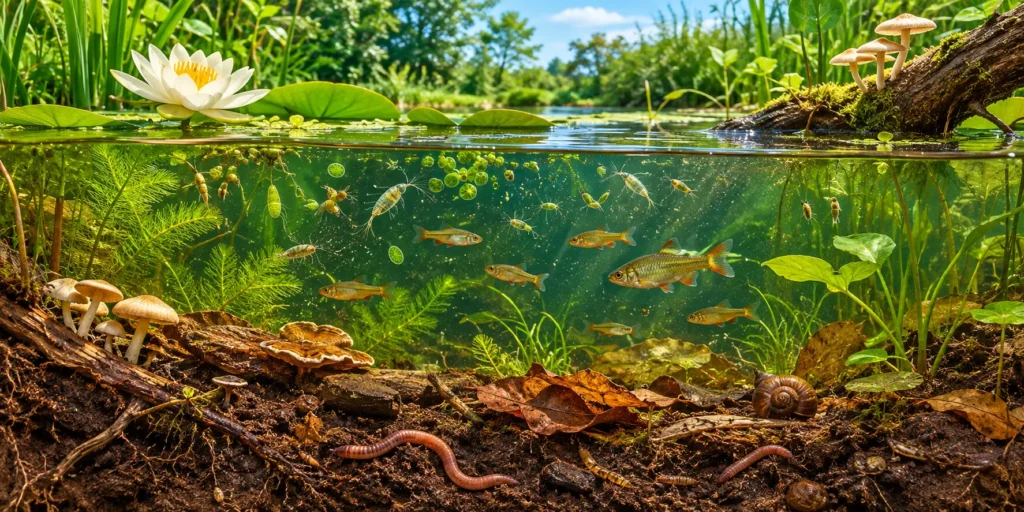
- Abiotic components: water with dissolved inorganic and organic substances, and the rich soil deposit at the bottom. The solar input, the cycle of temperature, day length and other climatic conditions regulate the rate of function of the whole pond.
- Autotrophs (producers): phytoplankton, some algae, and floating, submerged and marginal plants.
- Consumers: zooplankton, and free-swimming and bottom-dwelling animals.
- Decomposers: fungi, bacteria and flagellates, especially abundant at the bottom of the pond.
22. What are the limitations of ecological pyramids?
- They do not take into account the same species belonging to two or more trophic levels.
- They assume a simple food chain, something that almost never exists in nature, and do not account for a food web.
- Saprophytes are given no place in ecological pyramids, even though they play a vital role in the ecosystem.
Case-Based Question (4 Marks)
23. Read the passage and answer the questions.
A student studied a large banyan tree in a village. She counted one tree, several thousand insects feeding on its leaves, and a few dozen small birds feeding on the insects. In a nearby pond, she found that the total weight of the phytoplankton at any moment was much less than the total weight of the small fish feeding on them.
(a) Draw or describe the pyramid of numbers for the banyan tree. What is its shape? (1 mark)
The base has one tree, the middle level has thousands of insects, and the top level has a few dozen birds. The pyramid of numbers is inverted at the base.
(b) What will be the shape of the pyramid of biomass for the pond? Why? (2 marks)
It will be inverted. Phytoplankton reproduce very fast but have a small standing biomass at any given time, while the fish that feed on them accumulate a larger biomass.
(c) Which ecological pyramid can never be inverted? (1 mark)
The pyramid of energy. Energy is lost as heat at every trophic level, so each higher level always has less energy than the one below.
5-Mark Questions
24. What is productivity? Explain primary and secondary productivity, and the factors that affect primary productivity.
A constant input of solar energy is the basic requirement for any ecosystem to function and sustain itself.
- Primary production is the amount of biomass or organic matter produced per unit area over a time period by plants during photosynthesis. It is expressed as weight (g m⁻²) or energy (kcal m⁻²). The rate of biomass production is called productivity, expressed as g m⁻² yr⁻¹ or kcal m⁻² yr⁻¹.
- Gross primary productivity (GPP) is the rate of production of organic matter during photosynthesis. A considerable part of it is used by plants in respiration.
- Net primary productivity (NPP) = GPP − R (respiration losses). It is the biomass available to heterotrophs.
- Secondary productivity is the rate of formation of new organic matter by consumers.
Primary productivity depends on the plant species inhabiting an area, on environmental factors, on the availability of nutrients and on the photosynthetic capacity of plants. So it varies between different types of ecosystems. The annual NPP of the whole biosphere is about 170 billion tons (dry weight), of which the oceans, despite covering about 70% of the surface, produce only about 55 billion tons.
25. Explain energy flow in an ecosystem.
- Source: Except for the deep-sea hydrothermal ecosystem, the sun is the only source of energy for all ecosystems on Earth.
- Capture: Less than 50% of incident solar radiation is photosynthetically active radiation (PAR). Plants capture only 2–10% of the PAR, and this small amount sustains the entire living world.
- Flow: Energy flows in one direction, from the sun to producers and then to consumers. Ecosystems obey the second law of thermodynamics: they need a constant supply of energy to synthesise the molecules they require and to counteract the universal tendency towards increasing disorder.
- Food chains: Energy moves through the grazing food chain (beginning with producers) and the detritus food chain (beginning with dead organic matter). Many food chains interconnect to form a food web.
- Trophic levels: Organisms occupy specific places in the food chain, called trophic levels. Each trophic level has a certain mass of living material at a particular time, called the standing crop.
- 10 per cent law: Only about 10% of the energy is transferred from one trophic level to the next, so the number of trophic levels is limited.
26. What are ecological pyramids? Explain the three types with examples.
An ecological pyramid shows the relationship between organisms at different trophic levels in terms of number, biomass or energy. The base of each pyramid is formed by the producers (first trophic level), and the apex by the top-level consumers.
- Pyramid of numbers: shows the number of individuals at each trophic level. In a grassland it is upright. It can be inverted, as when many insects feed on one big tree.
- Pyramid of biomass: shows the total biomass at each trophic level. On land it is usually upright. In the sea it is generally inverted, because the biomass of fishes far exceeds that of phytoplankton.
- Pyramid of energy: shows the energy at each trophic level. It is always upright, because some energy is lost as heat at every step.
Draw all three pyramids with labelled trophic levels in the exam.
Topics Students Lose Marks On in This Chapter
- GPP vs NPP. NPP is GPP minus respiration (R), not plus. NPP is what reaches the heterotrophs.
- Order of decomposition steps. Fragmentation, leaching, catabolism, humification, mineralisation. Learn the order and one line for each.
- Fast vs slow decomposition. Nitrogen and sugars speed it up; lignin and chitin slow it down.
- Which pyramid inverts. Numbers can invert (tree and insects), biomass can invert (sea), energy never inverts.
- Food chain dominance. The grazing food chain dominates in water; the detritus food chain carries more energy on land.
- Deleted topics. Don’t waste time on ecological succession, nutrient cycling or ecosystem services; they are no longer in the rationalised NCERT book.
Keep Revising
After you finish these Ecosystem Class 12 important questions, go back to the Ecosystem notes for any answer you could not write fully. NEET aspirants should also solve the Ecosystem NEET PYQs chapter-wise. For other chapters, see all Class 11 and 12 Biology notes.
Frequently Asked Questions
Are these Ecosystem Class 12 important questions enough for the board exam? They cover every topic in the current syllabus for this chapter, at every mark level the board uses. Learn the model answers, then practise writing them in your own words within the time limit.
Which topics in Ecosystem are most important for the Class 12 board exam? The steps of decomposition, GPP and NPP, energy flow and the 10 per cent law, the difference between the grazing and detritus food chains, and the three ecological pyramids are asked most often.
Are ecological succession and nutrient cycling still in the Class 12 syllabus? No. Ecological succession, nutrient cycling and ecosystem services were removed from the rationalised NCERT Class 12 Biology book, so they are not part of the current board or NEET syllabus.