There’s one Chemistry chapter that keeps showing up long after you think you’re done with it. It’s hiding inside organic mechanisms, inside coordination compounds, inside half the inorganic questions you’ll ever attempt. That chapter is Chemical Bonding — and how well you know it quietly sets the ceiling on your entire Chemistry score, as the chapter-wise weightage data makes clear.
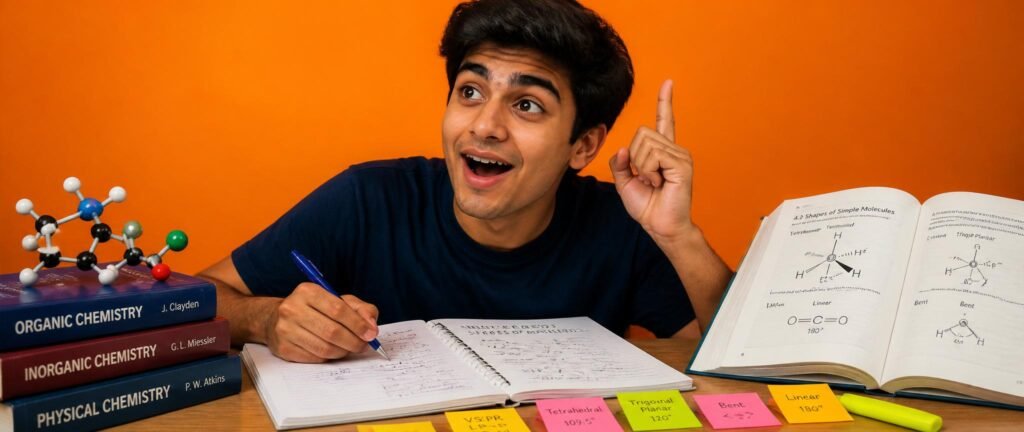
Most aspirants read it once, memorise a few shapes, and move on. Then they wonder why organic reasoning feels shaky and p-block questions keep tripping them up. Here’s the reality: chemical bonding for NEET 2027 isn’t just another chapter to clear — it’s the backbone that holds the other two branches together. It scores directly on its own, and a strong grip here makes cracking organic reaction mechanisms far less painful.
Table of Contents
Why Chemical Bonding Punches Above Its Weight
On paper, Chemical Bonding and Molecular Structure is a single Class 11 chapter. In practice, it’s a toolkit you reuse constantly:
- Organic Chemistry leans on hybridization, geometry, resonance, and bond polarity to explain reactivity.
- Inorganic Chemistry uses bonding theories to explain the shapes and behaviour of p-block and coordination compounds — so a solid base here strengthens your inorganic chemistry prep too.
- Physical Chemistry ties in through bond energies and molecular structure, complementing your physical chemistry problem-solving.
Get bonding right and three branches ease up at once. Get it wrong and you’ll spend the year patching holes.
The Core Topics You Cannot Skip
A complete grip on chemical bonding for NEET 2027 means being fluent across these areas.
Bond Types and Lewis Structures
Ionic, covalent, and coordinate bonds; drawing Lewis structures; the octet rule and its exceptions (incomplete octet, expanded octet, odd-electron species); and formal charge.
VSEPR Theory and Molecular Shapes
VSEPR theory predicts geometry from electron pairs. You must be able to assign shapes and bond angles on sight and know how lone pairs distort them. This is one of the most directly tested ideas in the chapter.
Hybridization
Hybridization for NEET is a guaranteed scorer once you learn the steric-number shortcut. Map each hybridization to its shape:
| Hybridization | Shape | Bond Angle | Example |
|---|---|---|---|
| sp | Linear | 180° | BeCl₂ |
| sp² | Trigonal planar | 120° | BF₃ |
| sp³ | Tetrahedral | 109.5° | CH₄ |
| sp³d | Trigonal bipyramidal | 90° / 120° | PCl₅ |
| sp³d² | Octahedral | 90° | SF₆ |
Valence Bond and Molecular Orbital Theory
Molecular orbital theory is where students either bank easy marks or freeze. Learn the MO energy order, calculate bond order, and predict magnetic behaviour — the paramagnetism of O₂ is a classic, repeat-worthy question.
Bond Parameters and the “Small” Topics
Bond length, bond angle, bond enthalpy, dipole moment and polarity, Fajans’ rules, resonance, and hydrogen bonding. Individually small, collectively a steady stream of questions. That’s a lot to hold in your head, so make concise revision notes for each sub-topic as you learn it.
The Right Way to Study Chemical Bonding for NEET 2027
Don’t treat this as a read-once chapter. Fold it into a steady NCERT revision loop and build it in layers.
- Start with NCERT. The chemical bonding NCERT text covers the theory and standard examples most direct questions are built from — read it closely before opening any reference book.
- Turn theory into tables. Hybridization–shape–angle, MO diagrams, and dipole-moment comparisons all belong on quick-reference sheets.
- Drill shapes and bond order. These are pattern-based — the more molecules you assign, the faster and more accurate you get.
- Practise previous-year questions. The same ideas recur almost verbatim: O₂ magnetism, bond-angle order, the hybridization of a given molecule.
- Keep looping back. You’ll reuse this chapter all year, so revisit it briefly and often instead of relearning it before every dependent topic.
Common Mistakes That Cost Bonding Marks
- Memorising shapes without VSEPR logic — you’ll blank on any molecule you haven’t seen before.
- Skipping MOT — students avoid it as “hard,” then lose a near-guaranteed question on bond order or magnetism.
- Ignoring Fajans’ rules and dipole moment — small topics, but frequent one-mark questions.
- Reading passively — bonding rewards drawing and problem-solving, not highlighting.
The Bottom Line
Chemical bonding isn’t a chapter you finish once and forget — it’s the lens you’ll look through for the rest of Chemistry. Master the shapes, the theories, and the bond-order logic, and organic, inorganic, and physical all start making sense together.
Treat chemical bonding for NEET 2027 as the score-defining chapter it truly is, give it the depth it deserves early, and you’ll feel the payoff in every Chemistry section that follows. Nail the base, and the rest of the subject stops fighting you.
FAQ
Q: How many questions come from chemical bonding in NEET? A: You can expect a few direct questions from the chapter each year, but its real value is indirect — it powers a large share of organic and inorganic questions. Counting both, it influences far more marks than its single-chapter status suggests.
Q: Is chemical bonding important for NEET 2027? A: Extremely. Chemical bonding for NEET 2027 is foundational to all three branches of Chemistry. A weak grip here quietly limits your accuracy in organic reactivity, coordination compounds, and p-block chemistry.
Q: Which topics in chemical bonding are most important? A: Molecular shapes (VSEPR), hybridization, and MO theory (bond order and magnetic behaviour) are the heaviest hitters. Fajans’ rules, dipole moment, resonance, and hydrogen bonding round out the frequently tested list.
Q: Is NCERT enough for chemical bonding? A: NCERT is essential for the theory, and the chemical bonding NCERT content covers most direct questions. For MOT and problem-based questions, pair it with steady previous-year practice to build speed and accuracy.
Q: How do I remember hybridization and molecular shapes? A: Learn the steric-number method rather than memorising each molecule. Once you can count bonding and lone pairs, hybridization for NEET becomes a quick, reliable calculation that gives you the shape and bond angle in seconds.
Q: Why does MOT feel so confusing? A: Usually because it’s rushed. Memorise the MO energy order, apply the bond-order formula, and practise a handful of standard molecules like O₂ and N₂. Once the pattern clicks, it becomes one of the easiest scorers in the chapter.
[…] chemical bonding fundamentals make all four of these exceptions far easier to actually understand rather than memorise, since […]
[…] concept building, pair this with our chemical bonding strategy guide. This article focuses on what past papers actually […]