
Any serious NEET 2027 difficulty analysis has to begin with an honest look at what NEET 2026 revealed — because the National Testing Agency doesn’t change its paper philosophy randomly. There are patterns, shifts, and signals buried in every year’s question paper, and aspirants who read them correctly gain a preparation edge that no amount of generic grinding can replicate. If you’re preparing for NEET 2027, understanding how the exam is evolving isn’t optional. It’s foundational.
Why Comparing NEET Papers Year-on-Year Actually Matters
Many aspirants treat each NEET paper as an isolated event. That’s a mistake. NTA operates within a framework — difficulty calibration targets, subject weightage norms, and question design philosophies that shift gradually but consistently across cycles.
A year-on-year comparison doesn’t just tell you what was hard last year. It tells you which direction the exam is moving — and that directional insight is what a proper NEET 2027 difficulty analysis is built on.
What NEET 2026 Told Us About the Exam’s Direction
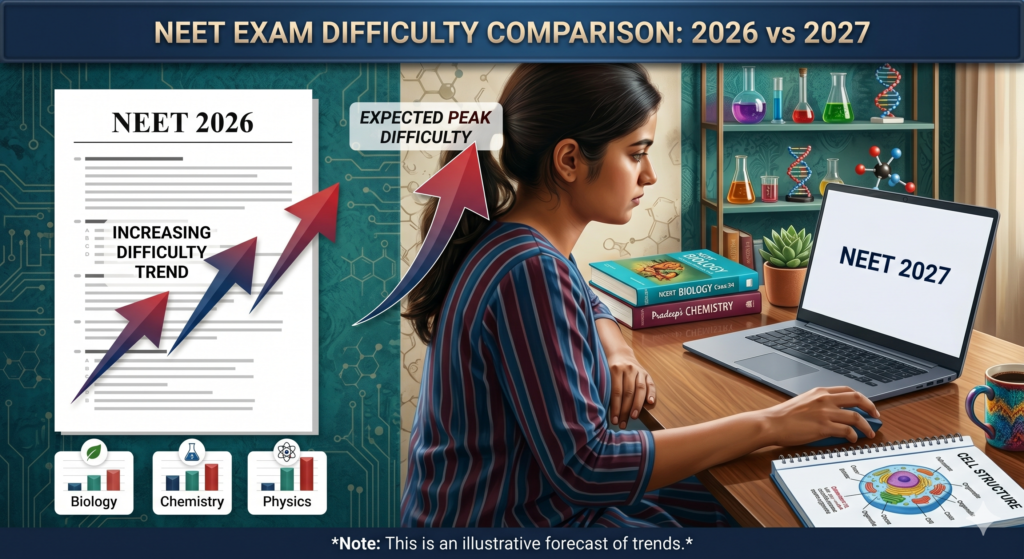
NEET 2026 continued a trend that began building post-2023 — a gradual but unmistakable move away from pure memorisation toward application-based and assertion-reasoning style questions, particularly in biology and chemistry.
Several patterns stood out clearly:
Biology became less predictable. For years, biology was the subject where disciplined NCERT revision reliably produced high scores. NEET 2026 introduced more inference-based questions — where knowing the fact wasn’t enough; students had to apply it in an unfamiliar context. Direct-line NCERT questions still dominated, but the proportion of application-layer biology questions increased noticeably.
Physical chemistry held its difficulty ceiling. Electrochemistry, thermodynamics, and chemical kinetics continued to be the most time-consuming section of the paper. Students who hadn’t drilled numerical problem-solving under timed conditions struggled disproportionately here.
Physics remained the great differentiator. This hasn’t changed in years and NEET 2026 confirmed it again. Physics is the subject where the gap between prepared and underprepared students is widest. The paper consistently rewards conceptual clarity over formula memorisation — and that distinction becomes more pronounced each year.
Organic chemistry saw increased complexity. Reaction mechanism questions and multi-step conversion problems appeared with higher frequency than in NEET 2024 and 2025. Students who had treated organic chemistry as a memorisation exercise rather than a logic-based subject paid for it.
The NEET 2027 Difficulty Analysis: What’s Likely to Shift
Based on observable trends across recent papers and NTA’s stated direction toward competency-based assessment, here is what a realistic NEET 2027 difficulty analysis projects:
Biology: Application Layer Will Grow Further
Expect the assertion-reasoning and case-based question formats to expand in NEET 2027. NTA has been piloting these formats across other national exams and NEET biology is the logical next frontier. Students who only read NCERT lines without understanding the why behind each concept will find these questions harder than they expect.
The implication for preparation: read NCERT actively, not passively. Ask what each diagram, table, and example is actually illustrating — not just what it says.
Chemistry: Inorganic Might Surprise You
Inorganic chemistry has been relatively predictable in recent years — largely NCERT-based, largely factual. There are signals in NEET 2026 that this may shift slightly toward more application-based questions on coordination compounds, d-block elements, and qualitative analysis. Don’t treat inorganic as a free scoring zone without testing yourself under pressure.
Physics: Difficulty Likely Remains High, Format May Shift
The broader NEET 2027 difficulty analysis for physics points toward continued high difficulty, with a possible increase in multi-concept questions — problems that require applying two or three different principles simultaneously rather than one formula in isolation. Students who practise problem-solving across chapter boundaries will be significantly better positioned.
Overall Paper: Time Pressure Is the Real Test
One of the clearest trends across NEET 2025 and 2026 is that the paper isn’t dramatically harder in isolation — it’s harder under 3-hour conditions. Questions that seem manageable with unlimited time become genuinely difficult when you’re at question 140 and the clock is pressing. Time management under fatigue is increasingly the deciding variable.
What This Means for Your NEET 2027 Preparation Strategy
A good NEET 2027 difficulty analysis is only useful if it changes how you prepare. Here’s what the trends above translate into practically:
Prioritise understanding over memorisation, especially in biology. The exam is rewarding students who can think with their knowledge, not just retrieve it.
Start timed mock tests early. The time-pressure problem only gets solved through repeated exposure to full-length papers under real conditions. There’s no shortcut.
Don’t neglect organic chemistry mechanics. Treat every reaction as a logical process, not a fact to memorise. Understanding electron movement and reaction patterns will serve you better than a list of named reactions.
Revise NCERT biology at least three times, differently each time. First read for facts. Second read for relationships and processes. Third read for application — asking yourself how each concept could be tested in an unfamiliar context.
Drill physics across chapter boundaries. Solve problems that combine optics with electrostatics, or mechanics with thermodynamics. Multi-concept problems are where NEET 2027 will likely pull rank separation.
The Bigger Picture: NEET Is Maturing as an Exam
The broader trend visible across any honest NEET 2027 difficulty analysis is that the exam is maturing. NTA is moving — gradually, but deliberately — toward an assessment that tests medical readiness rather than just academic performance. That means students who can think clinically, reason from first principles, and stay composed under pressure are increasingly the ones the paper rewards.
This is actually good news for aspirants who are willing to prepare differently. The student who understands why the mitochondria functions the way it does will always outperform the student who memorised the diagram without processing it.
The exam is getting smarter. The preparation needs to match.
Frequently Asked Questions
Q1. Is NEET 2027 expected to be harder than NEET 2026? Based on current trajectory, NEET 2027 is unlikely to see a dramatic jump in raw difficulty — but the continued shift toward application-based and multi-concept questions means the effective difficulty will feel higher for students who rely on rote preparation. A thorough NEET 2027 difficulty analysis suggests the paper will reward deeper understanding more than any recent year has.
Q2. Which subject is expected to be the toughest in NEET 2027? Physics has historically been the most differentiating subject, and that’s unlikely to change in NEET 2027. However, biology’s increasing shift toward inference-based questions means it can no longer be treated as a guaranteed high-scorer without genuine conceptual clarity. Chemistry’s organic section is also trending harder.
Q3. Will NEET 2027 follow the same 180-question, 720-mark format? As of current NTA guidelines, the format remains 180 questions across physics, chemistry, and biology for 720 marks. Any structural changes would be announced officially well in advance — always verify through the official NTA notification before adjusting your preparation strategy around format assumptions.
Q4. How should NEET 2027 aspirants use previous year papers? Previous year papers from 2022 onwards are the most relevant for trend analysis. Solve them under timed conditions, then categorise every question by type — factual, application, assertion-reasoning, calculation. The distribution you find is the closest approximation of what NEET 2027 will ask.
Q5. How much has biology changed in recent NEET papers? Significantly, in terms of question design. While NCERT remains the primary source, the way NCERT content is tested has shifted — from direct retrieval to contextual application. This trend is central to any realistic NEET 2027 difficulty analysis and should directly influence how you revise biology from this point forward.
Q6. Should NEET 2027 aspirants change their study material based on these difficulty shifts? Not necessarily — NCERT remains the core. What should change is how you engage with that material. More active reading, more self-questioning, more cross-chapter problem solving, and significantly more timed mock practice than previous generations of aspirants relied on.