
Deciding to drop a year for NEET is not easy. But if you have made that call, the next question matters more than the decision itself — what exactly are you going to do for the next 12 months?
Most droppers fail not because they are not smart enough, but because they have no structure. They study hard in bursts, lose momentum mid-year, panic in the final months, and repeat the same mistakes from the previous attempt. A solid NEET 2027 dropper study plan fixes all of that before it starts.
This guide gives you a complete month-by-month strategy — what to study, when to shift gears, how to handle mock tests, and how to stay mentally sharp across a full year of preparation. If you follow this, you will walk into NEET 2027 as one of the most prepared students in the room.
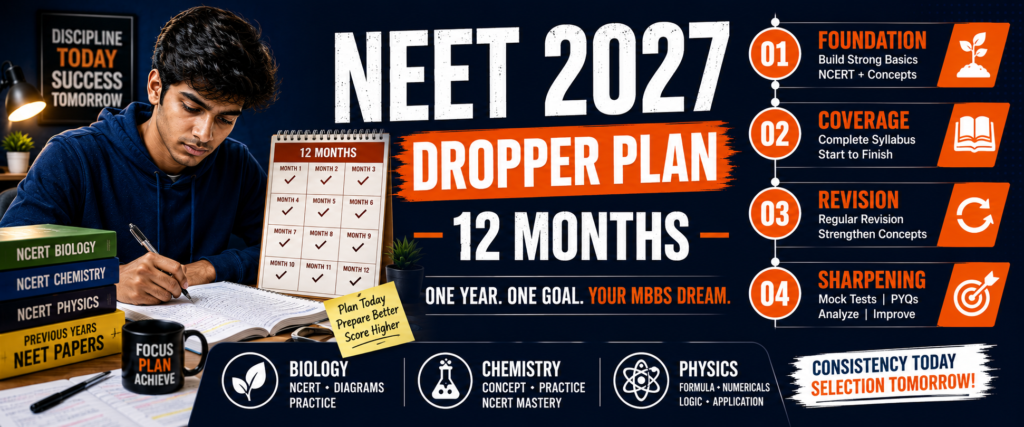
NEET 2027 Dropper Study Plan: Why Most Drop Years Fail
Before getting into the plan, understand why the average drop year does not work.
The three dropper traps:
Trap 1 — The false start: Droppers often take 2–4 weeks off after their previous attempt “to recover.” This is fine. But many stretch it to 2–3 months without realising it, destroying the early momentum that makes a drop year successful.
Trap 2 — Covering everything, mastering nothing: With a full year ahead, droppers feel they have time to cover every chapter perfectly. They spend months on syllabus coverage and leave almost no time for revision and mock tests — the two things that actually convert preparation into marks.
Trap 3 — Ignoring the mental game: A drop year is psychologically harder than a first attempt. Isolation, comparison with peers who moved on, and the pressure of “this has to work” are real challenges that derail many serious students.
A good dropper plan accounts for all three. This one does.
The 12-Month Framework: Four Phases
The year is divided into four phases, each with a distinct goal:
| Phase | Months | Goal |
|---|---|---|
| Phase 1 — Foundation Reset | Month 1–3 | Rebuild concepts from scratch, eliminate weak areas |
| Phase 2 — Full Syllabus Coverage | Month 4–6 | Complete the entire NEET syllabus with depth |
| Phase 3 — Revision + Mock Tests | Month 7–10 | Intensive revision cycles, full mock test integration |
| Phase 4 — Final Sharpening | Month 11–12 | Lock in high-weightage topics, exam-day readiness |
Phase 1: Foundation Reset (Months 1–3)
What This Phase Is About
This is not revision. This is rebuilding. Most droppers made mistakes in their first attempt because their conceptual foundation had gaps — topics they memorised without understanding, chapters they skipped, or subjects they were weak in.
Phase 1 is about fixing those gaps permanently.
Month 1 — Diagnosis and Restart
Week 1–2: Honest self-assessment Before opening a single book, analyse your previous NEET attempt:
- Which chapters did you consistently get wrong?
- Which subjects pulled your score down?
- Were your mistakes conceptual or careless?
Make a written list of your top 10 weak chapters across all three subjects. This list drives your Phase 1 priority.
Week 3–4: Restart with NCERT Begin with Biology NCERT — cover Class 11 and 12 from scratch. Do not use shortcuts or summaries at this stage. Read every line, highlight key terms, note diagrams.
Daily study hours in Month 1: 6–7 hours. Do not push for 10+ hours in the first month — burnout in Month 3 is a real risk.
Month 2 — Chemistry Foundation
Focus: Physical Chemistry and Inorganic Chemistry concepts from scratch.
Physical Chemistry is often the biggest dropper weakness. Go back to Class 11 basics — mole concept, thermodynamics, equilibrium, electrochemistry. Solve numericals daily, not just theory.
For Inorganic Chemistry, the NCERT is your only book. Read it three times this month. Write out reactions and properties by hand — don’t just read passively.
Organic Chemistry: Begin only after Physical and Inorganic are solid. Start with General Organic Chemistry (GOC) — this is the gateway to all organic reactions.
Month 3 — Physics Foundation
Physics is where most droppers have the deepest gaps. The reason is usually the same: they tried to memorise formulas without understanding the underlying concepts.
Approach for Month 3:
- Start with Mechanics — it is the backbone of Physics and appears in multiple questions
- For every concept, understand the derivation once, then focus entirely on application
- Solve 5–10 numericals per chapter — not more at this stage
Chapters to cover in Month 3:
- Kinematics, Laws of Motion, Work-Energy, Rotational Motion
- Gravitation, Properties of Matter
- Thermodynamics (Physics)
End of Phase 1 checkpoint: By Month 3, you should have a solid conceptual base in all three subjects and your weak chapters list should be significantly shorter.
Phase 2: Full Syllabus Coverage (Months 4–6)
What This Phase Is About
Phase 2 is systematic, chapter-by-chapter coverage of the complete NEET syllabus. The goal is not just reading — it is understanding and being able to solve questions from every chapter.
Month 4 — Biology Deep Dive
Biology is 50% of your NEET score. It deserves a full month of focused coverage.
Class 11 Biology chapters to cover:
- Diversity of Living Organisms
- Structural Organisation in Plants and Animals
- Cell Structure and Function
- Plant Physiology
- Human Physiology
Class 12 Biology chapters to cover:
- Reproduction
- Genetics and Evolution
- Biology in Human Welfare
- Biotechnology
- Ecology
Method: NCERT first, always. After each chapter, solve 20–30 previous year MCQs from that chapter specifically. This tells you exactly how questions are framed.
Refer to the Re-NEET 2026 Biology high-weightage chapters — the same chapters dominate NEET year after year.
Month 5 — Chemistry Complete Coverage
Physical Chemistry (revisit and deepen):
- Thermodynamics, Chemical Equilibrium, Ionic Equilibrium
- Electrochemistry, Chemical Kinetics, Surface Chemistry
- Daily numerical practice — minimum 10 per day
Organic Chemistry (this month is crucial):
- Complete all reaction mechanisms
- Named reactions — write and memorise at least 25
- Biomolecules, Polymers, Chemistry in Everyday Life — pure NCERT
Inorganic Chemistry:
- P-Block, D-Block, F-Block elements
- Coordination Compounds
- Metallurgy
For chapter-wise priority, the Re-NEET 2026 Chemistry priority topics is a useful reference — these patterns hold for NEET 2027.
Month 6 — Physics Complete Coverage
Remaining chapters from Phase 1 + new chapters:
- Electrostatics, Current Electricity, Magnetic Effects
- Electromagnetic Induction, Alternating Current
- Optics (Ray and Wave)
- Modern Physics — Photoelectric Effect, Nuclear Physics, Semiconductors
- Communication Systems (low weightage but easy marks)
Physics strategy: Quality over quantity. 5 well-understood numericals per chapter beats 20 rushed ones. For theory-based Physics questions (Modern Physics, Semiconductors), NCERT is again the primary source.
End of Phase 2 checkpoint: By Month 6, your entire NEET syllabus should be covered at least once with active problem solving. You should be ready to start full mock tests.
Phase 3: Revision + Mock Tests (Months 7–10)
What This Phase Is About
This is the phase that separates good droppers from great ones. Four months of intensive revision cycles combined with increasing mock test frequency.
The Revision Cycle Method
Do not revise randomly. Use a structured revision cycle:
Cycle 1 (Month 7): Revise all Biology → take a Biology sectional test → identify weak areas → revise those Cycle 2 (Month 8): Revise all Chemistry → Chemistry sectional test → weak area revision Cycle 3 (Month 9): Revise all Physics → Physics sectional test → weak area revision Cycle 4 (Month 10): Full subject revision + full mock tests 3x per week
Mock Test Integration
Start full-length mock tests from Month 8 onwards. Here is the schedule:
| Month | Mock Frequency | Focus |
|---|---|---|
| Month 7 | Sectional tests only | Subject-wise weak areas |
| Month 8 | 1 full mock per week | Getting used to 3.5-hour paper |
| Month 9 | 2 full mocks per week | Score improvement, error analysis |
| Month 10 | 3 full mocks per week | Speed, accuracy, time management |
The mock analysis rule: Every mock must be followed by a full analysis session. Categorise every wrong answer:
- Conceptual error → add to weak topics list, revise that chapter
- Careless error → note the pattern, work on slowing down in that section
- Attempted and got wrong → this is the most dangerous category, identifies overconfidence areas
Handling Score Fluctuations
Your mock scores will fluctuate throughout Phase 3. This is normal and expected. Do not make major strategy changes based on one bad mock. Look at your 4-week average instead.
If your average is not improving after Month 9, the issue is almost always one of two things: insufficient NCERT revision for Biology, or weak numerical practice for Physics and Chemistry.
Phase 4: Final Sharpening (Months 11–12)
Month 11 — Consolidation
No new topics. No new books. This month is about locking in what you know.
Daily structure:
- Morning: Revise your personal weak topics list (built from mock analysis across Phase 3)
- Afternoon: One full mock test
- Evening: NCERT Biology — diagrams, tables, assertion-reason practice
High-value activities in Month 11:
- Previous year paper analysis (last 5 years) — identify repeating question patterns
- Inorganic Chemistry daily 20-minute fast revision — these are easy marks that droppers often neglect late in the year
- Organic reactions revision — one reaction type per day
Month 12 — Final 30 Days
The Re-NEET 2026 last month strategy applies equally to NEET 2027 — week-by-week plan, mock frequency, subject priorities, and the final 2-day game plan are all directly relevant.
Key rules for the final month:
- Sleep 7 hours minimum every night — non-negotiable
- 3 full mocks per week until Day 28
- Day 29: Light revision only, no mock
- Day 30 (Exam day): Reach centre early, stay calm
Subject-Wise Annual Strategy
Biology — Give It the Most Time, Always
Biology is 360 marks. It should receive 40–45% of your total study time across the year.
The single most important thing a NEET 2027 dropper can do for Biology: read NCERT at least 5 times across the year. Every read reveals something you missed before.
High-priority chapters that appear every year without exception: Human Physiology, Genetics, Ecology, Reproduction, Cell Biology.
Chemistry — Balance Is Everything
Chemistry has three distinct sections that require different approaches:
- Physical Chemistry rewards numerical practice
- Organic Chemistry rewards reaction mastery
- Inorganic Chemistry rewards NCERT memorisation
The dropper who is strong in all three wins Chemistry. Most droppers are weak in Inorganic because it feels boring — do not make that mistake.
Physics — Concepts First, Always
The most common Physics mistake among droppers: jumping straight to numericals without understanding the concept. This creates a fragile preparation that breaks under unfamiliar question framing.
For every Physics chapter: understand the concept first, derive the key formula once, then solve numericals. The Re-NEET 2026 Physics important topics breakdown is a strong reference for chapter prioritisation — the same chapters dominate NEET year after year.
The Mental Game: Surviving a Drop Year
A drop year is a marathon, not a sprint. The mental challenges are real and need to be managed proactively.
Stay off social media comparisons. Friends who went to college are posting hostel life and fests. That is their path. Yours leads somewhere different. Comparison kills focus — limit social media to 20 minutes per day maximum.
Build a daily routine and protect it. The structure of school or college kept you disciplined. In a drop year, you have to create that structure yourself. Fix your wake-up time, study slots, and sleep time — and treat them as non-negotiable.
Talk to someone when it gets hard. It will get hard — usually around Month 4–5 when the novelty wears off, and again around Month 9 when exam anxiety starts building. Talk to a mentor, a parent, or a friend who understands what you are going through. Keeping it bottled up is how droppers quit.
Track your progress, not just your failures. Keep a simple weekly log of chapters revised, mocks completed, and scores. Seeing progress on paper counters the feeling that “nothing is working.”
For deeper guidance on managing the psychology of a drop year, refer to NEET dropper strategy and mindset — the principles apply directly to a full-year drop.
Recommended Resources for NEET 2027 Droppers
Biology: NCERT Class 11 and 12 (primary), MTG Fingertips (MCQ practice)
Chemistry:
- Physical: NCERT + Narendra Awasthi for numericals
- Organic: NCERT + MS Chauhan for practice
- Inorganic: NCERT only — no other book needed
Physics: NCERT + DC Pandey or HC Verma for numericals
Mock Tests: NTA official mock tests + any reputed test series (Allen, Aakash, or KSquare)
One important note: Do not buy 10 books. Buy 2–3 and master them completely. Droppers who switch books frequently waste time and create confusion.
Final Word
A drop year done right is one of the most powerful things a NEET aspirant can do. You have something most first-attempt students do not — you know the exam, you know your weaknesses, and you have 12 full months to fix them.
The students who crack NEET 2027 after a drop year will not be the ones who studied the most hours. They will be the ones who followed a structured plan, took their mock tests seriously, and stayed consistent when it got difficult.
You have the plan. Now execute it.