
You have given Re-NEET 2026. Results are out. Now comes the part that confuses most students more than the exam itself — MBBS admission counseling.
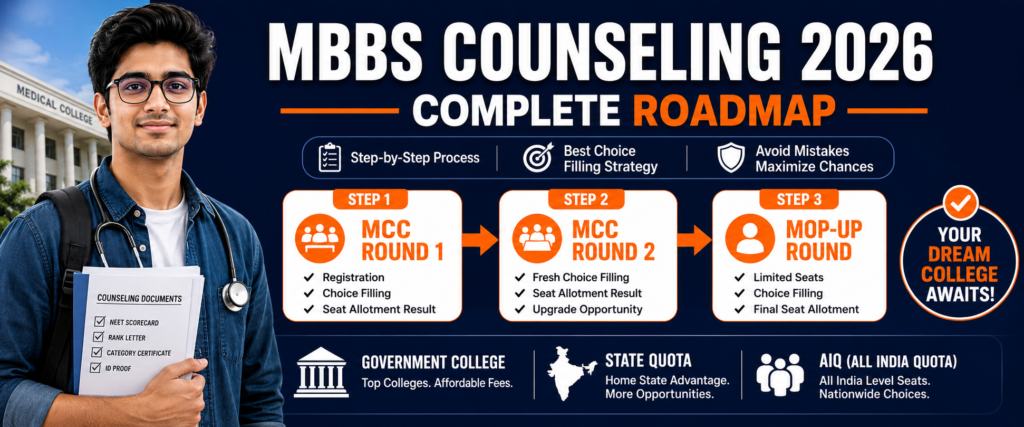
MBBS admission after Re-NEET 2026 is a multi-round, multi-authority process. There is MCC counseling for AIQ and deemed universities, state counseling for state quota seats, and management quota admissions running in parallel. Miss a deadline or misunderstand a round, and you could lose a seat you deserved.
This guide breaks the entire Re-NEET 2026 counseling schedule down into a clear roadmap — who conducts which counseling, what the rounds look like, what documents you need, and how to make smart college choices based on your score.
MBBS Admission After Re-NEET 2026: Understanding the Two-Track Counseling System
Before anything else, understand that MBBS counseling after NEET runs on two parallel tracks:
Track 1 — MCC Counseling (Medical Counseling Committee) Conducted by the Directorate General of Health Services (DGHS) under MCC. Covers:
- 15% All India Quota (AIQ) seats in government medical colleges
- 100% seats in Central Universities (AIIMS, JIPMER, AFMC, etc.)
- 100% seats in Deemed and Central universities
- ESI and ESIC colleges
Track 2 — State Counseling Conducted by individual state counseling authorities. Covers:
- 85% state quota seats in government medical colleges
- Government seats in state-run deemed universities
- Private medical college seats (varies by state)
You can — and should — participate in both simultaneously. They are independent processes and you do not have to choose between them upfront.



MCC Counseling: Round-by-Round Breakdown
MCC counseling for Re-NEET 2026 will follow the standard structure of multiple rounds. Here is what each round involves:
Round 1 — Registration and Choice Filling
What happens:
- Register on the MCC portal (mcc.nic.in)
- Pay the registration fee (refundable security deposit)
- Fill your college and course choices in order of preference — you can add up to 300 choices
- Lock your choices before the deadline
Key tips for choice filling:
- Add as many colleges as possible — more choices means higher chance of allotment
- Do not only add dream colleges at the top — be realistic with your score range
- Use the Re-NEET 2026 expected cut off marks as a reference while filling choices
- Order matters — rank your genuine preference, not just what looks prestigious
Seat allotment: MCC releases the Round 1 allotment result. If you get a seat, you must report to the allotted college within the reporting window.
Reporting options after allotment:
- Accept and join — Pay fees, report to college, and exit further MCC rounds (but can still participate in state counseling)
- Upgrade — Accept the current seat but remain in the system for a better seat in Round 2
- Reject — Give up the seat and try for a better one in Round 2 (risky — no guarantee you get anything better)
Round 2 — Upgrading or Fresh Allotment
Students who chose “upgrade” in Round 1, students who got no allotment in Round 1, and fresh registrations all participate in Round 2.
The process is identical — revised choice filling, seat allotment, and reporting.
Important: After Round 2 reporting, if you join a college, you are locked into that seat for MCC purposes. The security deposit is forfeited if you leave after this point without valid reason.
Mop-Up Round — Last Chance for Vacant Seats
After Round 1 and Round 2, seats that remain vacant go into the Mop-Up round. This round is open to:
- Students who did not get any seat in previous rounds
- Students who did not participate earlier but are still eligible
The Mop-Up round often has seats in less-preferred colleges or in private deemed universities. However, occasionally good government college seats appear here due to candidates dropping out.
Do not ignore the Mop-Up round if you haven’t secured a seat — it is a legitimate pathway.
Stray Vacancy Round — Final Opportunity
After the Mop-Up round, any remaining vacant seats go into the Stray Vacancy round. This is the absolute last round of MCC counseling. Seats here are limited and highly competitive relative to the seats available.
State Counseling: What You Need to Know
State counseling runs parallel to MCC and covers 85% of government medical college seats in your state. This is often where most MBBS admissions happen — especially for students targeting government colleges in their home state.
How State Counseling Works
Every state has its own counseling authority. Examples:
- Maharashtra — DMER Maharashtra
- Tamil Nadu — TNMGRMU / MCC Tamil Nadu
- Uttar Pradesh — DGME UP
- Karnataka — KEA (Karnataka Examinations Authority)
- West Bengal — WBMCC
General structure (varies slightly by state):
- Register on the state counseling portal
- Upload documents and pay registration fee
- Fill college and course choices
- Receive allotment
- Report to allotted college
State Quota vs AIQ — Which Is Better for You?
This depends entirely on your score and state. Here is how to think about it:
| Situation | Better Route |
|---|---|
| Score is strong, targeting top government colleges | AIQ (MCC) gives access to top colleges across India |
| Score is moderate, targeting government seat in home state | State quota often has lower cutoffs than AIQ for the same college |
| Targeting private medical colleges | State counseling usually covers these |
| Targeting deemed universities | MCC counseling only |
The smartest move is to participate in both and evaluate allotments as they come.
Category-Wise Seat Reservation — Know Your Category
Seats in both AIQ and state quota are divided by category. Knowing your category correctly can significantly change your college options.
| Category | AIQ Reservation |
|---|---|
| General (UR) | 40.5% |
| OBC (Non-Creamy Layer) | 27% |
| SC | 15% |
| ST | 7.5% |
| EWS | 10% |
State quota reservations vary by state — some states have additional reservations for NRI, PH (Persons with Disability), and in-state domicile candidates.
Make sure your category certificate is current and valid before counseling begins. An outdated OBC or EWS certificate is one of the most common reasons students lose seats they were eligible for.
Documents You Must Prepare Right Now
Do not wait for counseling to start to gather documents. Prepare these now:
Academic Documents
- Class 10 marksheet and certificate (for date of birth proof)
- Class 12 marksheet and passing certificate
- Re-NEET 2026 admit card
- Re-NEET 2026 scorecard / rank letter (once released)
Identity Documents
- Aadhaar card
- Passport-size photographs (at least 10 copies)
Category Certificates (if applicable)
- OBC-NCL certificate (must be issued in the current financial year for central institutions)
- SC/ST certificate
- EWS certificate (issued after April 1 of the current year for central institutions)
- PwD certificate (if applicable)
Domicile / Nativity
- State domicile certificate (required for state quota counseling in most states)
Other
- Migration certificate (required at time of joining, not always at counseling stage)
- Transfer certificate from school
Scan and keep digital copies of all documents. Most portals require PDF uploads under specific file sizes.
How to Make Smart College Choices Based on Your Score
This is where most students make costly mistakes. Here is a score-based framework:
If You Scored 600–720
You are in contention for top government medical colleges through AIQ. Your priority list should be:
- AIIMS (separate counseling — check AIIMS portal directly)
- Top government medical colleges via AIQ (MAMC, GMC Chandigarh, BHU, etc.)
- State government colleges via state counseling as backup
If You Scored 500–599
Government college via state quota is realistic. Strategy:
- Fill maximum state quota choices — government college seats are your primary target
- In MCC, focus on less-competitive government colleges and central university colleges
- Add a few private deemed universities as safety options in MCC
If You Scored 400–499
Government seats will be tough but not impossible depending on your category and state. Strategy:
- Check your state’s previous year cutoffs by category — some states have lower cutoffs
- Private medical colleges via state counseling become more realistic in this range
- Deemed universities through MCC Mop-Up round are worth exploring
Refer to Re-NEET 2026 cut off marks for category-wise qualifying benchmarks as a starting reference point.
If You Scored Below 400
Options narrow significantly for government seats. However:
- Check your state quota cutoffs carefully — some states and categories have lower thresholds
- Private medical colleges remain accessible
- Consider whether a drop year after NEET 2026 is the right move if your target is a government seat
Common Counseling Mistakes to Avoid
1. Not registering for both MCC and state counseling These are independent processes. Register for both from Day 1. Missing either registration is a seat you cannot recover.
2. Filling too few choices Students who fill only 10–15 choices drastically reduce their allotment probability. Fill every realistic option — up to the maximum allowed.
3. Ignoring round deadlines MCC and state counseling have hard deadlines for registration, choice filling, fee payment, and reporting. One missed deadline can eliminate you from an entire round.
4. Upgrading carelessly in Round 2 If you have a decent government seat from Round 1, think carefully before upgrading. Upgrading means your Round 1 seat is gone — if Round 2 gives you nothing better, you could end up with a worse outcome.
5. Not verifying document validity Especially for OBC-NCL and EWS certificates — central institutions require these to be issued in the current financial year. Many students discover their certificates are outdated only after allotment, causing them to lose the seat.
Counseling Timeline: What to Expect After Results
While official dates will be released by MCC and state authorities after Re-NEET 2026 results, here is the typical sequence based on previous NEET counseling cycles:
| Stage | Approximate Timeline After Results |
|---|---|
| MCC registration opens | 2–3 weeks after result |
| Round 1 choice filling | 1 week after registration opens |
| Round 1 seat allotment | 1–2 weeks after choice filling closes |
| Round 1 reporting deadline | 3–5 days after allotment |
| Round 2 | 1–2 weeks after Round 1 reporting closes |
| Mop-Up Round | 2–3 weeks after Round 2 |
| State counseling (varies by state) | Runs parallel to MCC from Round 1 onwards |
Bookmark the official MCC portal (mcc.nic.in) and your state counseling authority’s website. Set reminders for every stage.
Final Word
MBBS admission after Re-NEET 2026 is a process that rewards students who are organised, informed, and strategic — not just those with the highest scores. Students with moderate scores get government seats every year because they participated in both tracks, filled maximum choices, and did not miss a single deadline.
Start preparing your documents today. The moment results are out, counseling timelines move fast.
FAQ Section:
Q: When will MBBS counseling start after Re-NEET 2026? A: MCC counseling typically begins 2–3 weeks after NEET results are declared. State counseling starts around the same time and runs parallel to MCC. Bookmark mcc.nic.in and your state counseling authority’s portal to stay updated on exact dates.
Q: Can I participate in both MCC and state counseling simultaneously? A: Yes, and you should. MCC counseling covers AIQ seats and deemed universities, while state counseling covers the 85% state quota seats. Both run independently — participating in both maximises your chances of getting a seat.
Q: What documents are needed for NEET 2026 counseling? A: You will need your Class 10 and 12 marksheets, Re-NEET 2026 scorecard and admit card, Aadhaar card, category certificates (OBC-NCL, SC/ST, EWS if applicable), state domicile certificate, and passport-size photographs. Prepare scanned digital copies in advance.
Q: What happens if I don’t report after seat allotment in MCC Round 1? A: If you are allotted a seat in Round 1 and do not report within the reporting window, your allotment is cancelled and you lose your security deposit. You may still participate in subsequent rounds, but you will not recover that specific seat.
Q: Is it better to accept a seat in Round 1 or wait for Round 2? A: If you receive a good government college seat in Round 1, accepting it while choosing the “upgrade” option is the safest move — it keeps your seat secured while still allowing you to try for a better one in Round 2. Rejecting a seat entirely in Round 1 is risky.
Q: What is the Mop-Up round in NEET counseling? A: The Mop-Up round is conducted after Round 1 and Round 2 to fill seats that remain vacant. It is open to students who did not get allotted in previous rounds. While seats are limited, it is a legitimate last chance and should not be ignored.