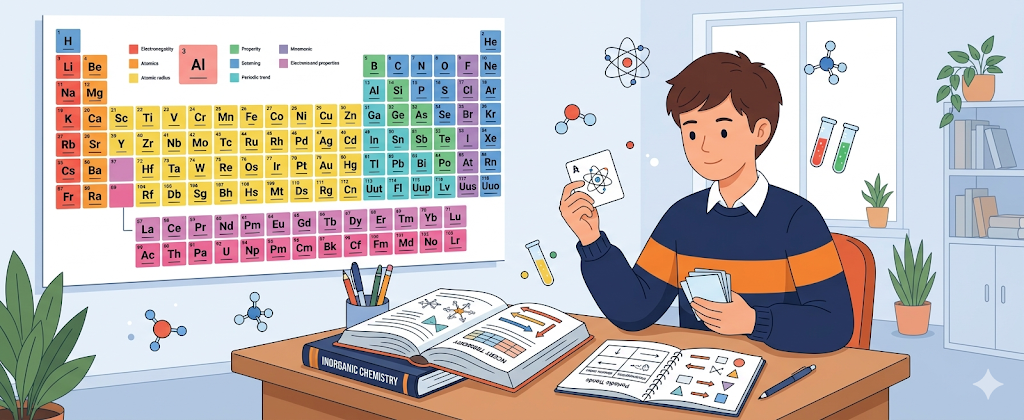
Inorganic chemistry has a reputation for being boring and forgettable — a pile of reactions, colours, and exceptions that slip out of your head the moment you close the book. Yet it’s quietly one of the highest-scoring sections of the paper. The key insight is simple: inorganic chemistry for NEET 2027 is a memory game, not a reasoning game, and memory games can be won with the right system. You don’t need to be naturally good at “remembering things”; you need a method that beats forgetting. This guide gives you exactly that. First, get your foundation right by understanding NCERT vs reference books, and if you’re planning your timeline, see when to start NEET 2027 so you have enough revision cycles ahead.
Table of Contents
Why Inorganic Chemistry for NEET 2027 Is Easy Marks
Unlike physics, inorganic chemistry rarely asks you to calculate anything. Questions are mostly direct, factual, and lifted straight from concepts you’ve already read. That means high accuracy is genuinely achievable — once a fact is locked in memory, it stays a reliable mark.
It’s also less time-hungry than numerical-heavy subjects. A focused student can cover the entire inorganic syllabus in far fewer hours than physics. Check the NEET 2027 syllabus weightage and you’ll see why ignoring this section is a costly mistake — it’s high return for relatively low effort.
Make NCERT Your Single Source of Truth
For inorganic chemistry, NCERT isn’t just recommended — it’s the exam. Many questions are framed almost word-for-word from its lines, including small factual statements students skip. So read every line, including captions, examples, and those easy-to-miss boxed notes.
Don’t drown yourself in five reference books. One thorough NCERT pass, repeated, beats scattered reading every time. Build a habit of structured NCERT revision for NEET 2027 so the facts move from short-term cramming into long-term memory where the exam needs them.
High-Yield Inorganic Topics for NEET 2027
Spend your memory effort where the questions actually come from. These areas are consistently rewarding:
- Periodic Table & Periodicity — trends in size, ionisation energy, electronegativity
- Chemical Bonding — shapes, hybridisation, exceptions
- Coordination Compounds — nomenclature, isomerism, colour and magnetism
- p-Block Elements — properties, anomalies, key compounds
- d- and f-Block Elements — oxidation states, colour, catalytic behaviour
- Metallurgy & s-Block — extraction methods and reactive metals
Repeaters and droppers can boost their NEET 2027 score significantly by mastering these blocks first, since they offer the fastest accuracy gains in the whole chemistry section.



Memory Techniques That Actually Work
This is where you win the inorganic game. Reading the same page ten times doesn’t work — these methods do:
- Mnemonics for sequences and trends. A silly phrase you invent yourself sticks better than one you borrow.
- Comparison tables. Put related elements or compounds side by side — your brain remembers contrasts far better than isolated facts.
- Active recall. Close the book and write down everything you remember. The struggle to retrieve is what builds memory; rereading only feels productive.
- Spaced revision. Revisit a topic after 1 day, 3 days, a week, then a fortnight. Inorganic facts fade fast, so schedule reviews before you forget, not after.
- Flashcards for colours, exceptions, and reagents — perfect for quick daily drills.
- Teach it aloud. Explaining a trend to an imaginary student instantly exposes what you don’t actually know.
Fold a short daily inorganic slot into your daily routine for NEET 2027 — fifteen consistent minutes beats a panicked three-hour session before the exam. Then prove your recall under pressure with a regular NEET 2027 mock test strategy, because a fact you can recall in a test is the only fact that counts.
A Simple Weekly Inorganic Routine
Inorganic chemistry rewards little-and-often over long, rare sessions. A workable rhythm:
- Daily: 15–20 minutes of flashcard recall and one previous-year set
- Twice a week: learn or relearn one full chapter using comparison tables
- Weekly: a spaced-revision sweep of everything covered so far
The exact schedule matters less than the principle — touch the subject frequently, and never let a topic go more than a week without a quick review.
Common Mistakes to Avoid
- Treating inorganic like physics and trying to “understand” everything instead of memorising
- Reading NCERT once and assuming it’s done — without revision, it’s gone in weeks
- Leaving the whole section for the last month before the exam
- Using too many books and never finishing any
- Passive rereading instead of active recall and self-testing
Final Thoughts
Mastering inorganic chemistry for NEET 2027 isn’t about a sharper memory — it’s about a smarter method. Lean fully on NCERT, target the high-yield blocks, and replace mindless rereading with active recall and spaced revision. Do that consistently, and the section that most students dread quietly becomes one of your most dependable scorers. Start early, revise often, and let repetition turn facts into reflexes.
FAQ Section
Q: Is inorganic chemistry hard for NEET 2027? A: It isn’t conceptually hard — it’s memory-heavy. With mnemonics, comparison tables, and spaced revision, it becomes one of the most scoring and reliable sections of the paper.
Q: How do I memorise inorganic chemistry for NEET? A: Read NCERT line by line, use mnemonics and comparison tables, practise active recall instead of rereading, and revise on a spaced schedule so facts don’t fade.
Q: Which inorganic chemistry topics are most important for NEET 2027? A: Periodic Table and periodicity, Chemical Bonding, Coordination Compounds, p-block, d- and f-block elements, and Metallurgy are consistently high-yield areas.
Q: Is NCERT enough for inorganic chemistry in NEET? A: For inorganic chemistry, NCERT is largely sufficient — most questions are framed directly from its content. Master it fully before adding any reference material.
Q: How often should I revise inorganic chemistry? A: Revise on a spaced schedule — after a day, a few days, a week, then a fortnight. Inorganic facts fade quickly, so frequent short reviews work better than rare long ones.
Q: How much time should I give chemistry daily for NEET 2027? A: Around 1.5–2 hours across the three branches works well, with inorganic getting short, frequent recall sessions rather than one long block.
[…] chapters for NEET 2027 in Chemistry are inorganic, and most of that is pure NCERT recall. Tips for memorising inorganic chemistry trends can turn these into some of the fastest marks in the […]
[…] over memory, and our organic mechanisms guide shows how to learn them. For Inorganic, our inorganic memorisation guide helps with trends and exceptions. To pick one reference per branch, see the best Chemistry […]
[…] questions lead every year. Many of these trends are pure memory, and our inorganic memorisation guide shows how to retain them. For a quick warm-up before the full set, try these five quick bonding […]
[…] pair this with our coordination compounds strategy guide, and see how the chapter fits into our Inorganic Chemistry preparation plan. This article focuses on what past papers actually […]
[…] the overall plan, see our Inorganic Chemistry preparation plan. This article focuses on what past papers actually […]
[…] This guide lists what NTA repeats, the exceptions you must know, and PYQ-pattern questions with answers. For the full Inorganic plan, see our NEET 2027 Inorganic Chemistry guide. […]