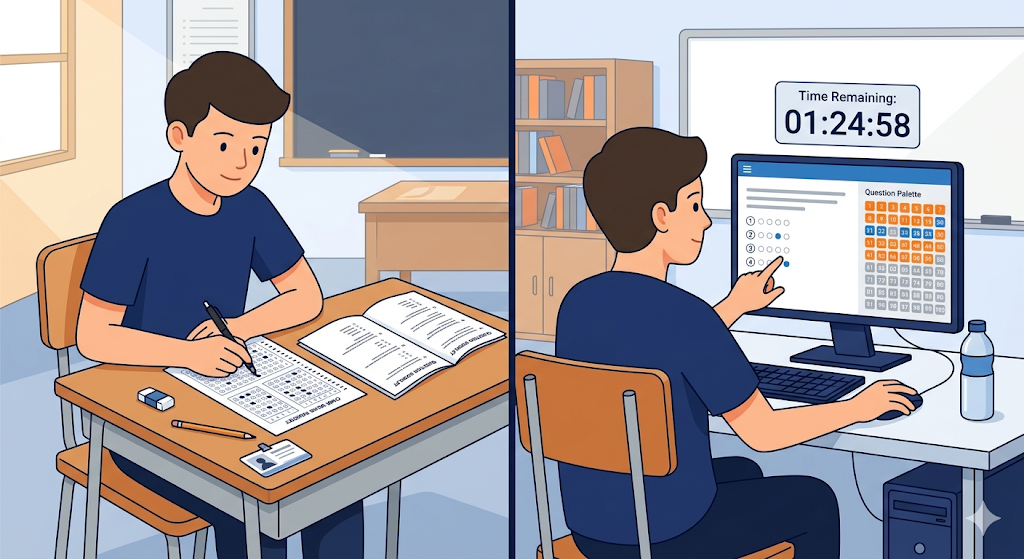
For years, NEET meant the same exam-day ritual: a sealed question booklet, an OMR answer sheet, and a ballpoint pen for bubbling in responses. That era is ending. With NTA set to move the exam online, understanding NEET 2027 OMR vs CBT is now essential for every serious aspirant. This is not a minor tweak — it changes how you mark answers, how you navigate questions, and how you should practise. Before the breakdown, it helps to know that the Re-NEET 2026 exam pattern stayed stable even as NTA’s proposed NEET UG reforms began reshaping the bigger picture.
Table of Contents
What Is Actually Changing for NEET 2027?
The headline change is the exam mode. The Education Minister has confirmed that NEET UG will shift to a computer-based test (CBT) from 2027, replacing the long-standing OMR pen-and-paper format. In other words, the OMR sheet is being removed, and you’ll answer questions on a computer screen instead.
The reason is security. After the 2026 paper leak that led to the exam’s cancellation, a digital format makes question delivery harder to tamper with, lowers leak risk, and speeds up result processing.
Here’s the reassuring part: this is a change in medium, not in content. The NEET 2027 exam mode is going digital, but the syllabus, question style, and marking scheme are expected to stay the same. That’s why your NEET 2027 mock test strategy should now move on-screen rather than staying on paper.
NEET 2027 OMR vs CBT — The Key Differences
When you compare NEET 2027 OMR vs CBT side by side, the contrast is clear. The good news is that adapting is mostly about familiarity, not extra studying — so the when to start NEET 2027 question matters even more now.
| Aspect | OMR (Old Format) | CBT (NEET 2027) |
|---|---|---|
| Answering | Bubble the circle with a pen | Click the option on screen |
| Question paper | Physical printed booklet | Displayed on the monitor |
| Navigation | Flip pages back and forth | Next/Previous buttons + question palette |
| Changing answers | Risky — smudges, wrong bubbles | One click, fully reviewable |
| Rough work | Booklet margins | Separate scratch sheet provided |
| Result speed | Slower OMR scanning | Faster digital processing |
| Security | Paper handling, leak-prone | Encrypted digital delivery |
The single biggest practical gain is that the OMR sheet removed a lot of avoidable errors — no more half-filled bubbles or misaligned rows. In CBT mode, a marked answer is recorded instantly, and you can revisit it any time before submitting. Keep prioritising the NEET 2027 syllabus weightage exactly as before — the format change doesn’t touch what’s important to study.


How Your Exam Day Will Change
On exam day, you’ll be assigned a computer terminal instead of a desk with a booklet. A timer runs in the corner of your screen, and a question palette shows which questions you’ve answered, skipped, or marked for review. You move with a mouse or keyboard, jump to any question instantly, and there’s a clear “mark for review” option for ones you want to return to.
Two new skills matter here: reading comfortably on a screen for three hours, and navigating efficiently without losing time. There’s no bubbling, no erasing, and no worry about smudged sheets — but screen fatigue is real if you’ve only ever practised on paper. The fix is simple: rehearse full-length tests under the same conditions, ideally inside a steady daily routine for NEET 2027.
Will the Syllabus or Difficulty Change?
No — and this is worth repeating. Droppers especially should fold CBT practice into their NEET 2027 dropper plan without changing what they study. The NEET exam pattern 2027 keeps the NCERT Class 11 and 12 syllabus, and difficulty is decided by NTA each year regardless of mode. Do not wait for a “new CBT syllabus” — it isn’t coming. The reforms aimed at security don’t make the paper harder; they make it fairer for honest students.
How to Prepare for the NEET 2027 OMR vs CBT Shift
You don’t need a different brain for CBT — you need different practice habits. Here’s how to adapt without disrupting your core preparation:
- Practise on a screen. Take at least one mock test a week on a laptop or computer so the interface feels natural, not new.
- Master the navigation. Learn the question palette, the mark-for-review button, and how to move between sections quickly.
- Build screen stamina. Train your eyes and focus for three continuous hours on a monitor, not just on paper.
- Watch the on-screen clock. Practise glancing at the timer without breaking concentration.
- Keep concepts first. The NEET 2027 CBT mode changes the wrapper, not the content — your NCERT mastery still decides your score.
Treat the computer like a tool you’ve already mastered before exam day. Familiarity removes the small frictions that cost marks under pressure.
Final Thoughts
The move to a NEET 2027 online exam is one of the biggest format shifts in years, but it favours exactly the students who prepare seriously. Once you’ve done a handful of computer-based mocks, the NEET 2027 OMR vs CBT difference stops feeling intimidating and starts feeling like an advantage. Start screen-based practice early, keep your fundamentals strong, and follow only official NTA notifications for the final details. The format is changing — your hard work is what still wins.
FAQ Section
Q: Is NEET 2027 going to be a computer-based test? A: Yes. The Education Minister has announced that NEET UG will move to CBT mode from 2027, replacing OMR sheets. Final operational details will be confirmed through NTA’s official notification.
Q: Will OMR sheets be removed in NEET 2027? A: Yes. The OMR-based pen-and-paper format is being phased out. In CBT mode you answer on a computer screen instead of bubbling responses on a physical sheet.
Q: Does the NEET 2027 syllabus change with CBT? A: No. The syllabus stays NCERT Class 11 and 12. Only the exam medium changes — the content, question style, and marking scheme are expected to remain the same.
Q: How is CBT different from OMR for NEET? A: In CBT you read questions on screen, click to answer, navigate using a question palette, and can review or change answers easily. OMR required manual bubbling on a printed sheet, which was slower and error-prone.
Q: How should I prepare for NEET 2027 CBT mode? A: Practise mock tests on a computer, get comfortable with on-screen navigation and the timer, and build screen stamina — while keeping your concept preparation exactly the same.
Q: Why is NTA shifting NEET to CBT? A: The move follows the 2026 paper leak and exam cancellation. A digital format improves security, reduces the risk of leaks, and speeds up result processing.
[…] is building comfort with a new interface. For a deeper breakdown of exactly what’s shifting, the shift from OMR to digital format is worth reading alongside this […]
[…] some practice on a screen so that neither format surprises you. We explain the differences in our OMR and CBT comparison, and track each announcement in the latest NEET 2027 CBT […]
[…] question is the mode, because the shift to computer-based testing is still under consideration; our OMR vs CBT comparison explains what each would […]
[…] of May; our NEET 2027 exam date page tracks the schedule. If it moves online, see our comparison of NEET 2027 OMR vs CBT and our guide on attempting NEET on a […]