One of the first decisions every NEET aspirant has to make — and one of the most consequential — is choosing the right coaching batch. Pick a batch that’s too advanced and you spend the year playing catch-up. Pick one that’s too basic and you lose twelve months of accelerated preparation. Knowing how to choose a NEET coaching batch 2027 that genuinely matches where you are right now is the starting point for everything else.
This guide breaks down the three main batch types — Foundation, Advanced, and Repeater — and gives you a clear framework for deciding which one is the right fit for your current level, timeline, and goals.
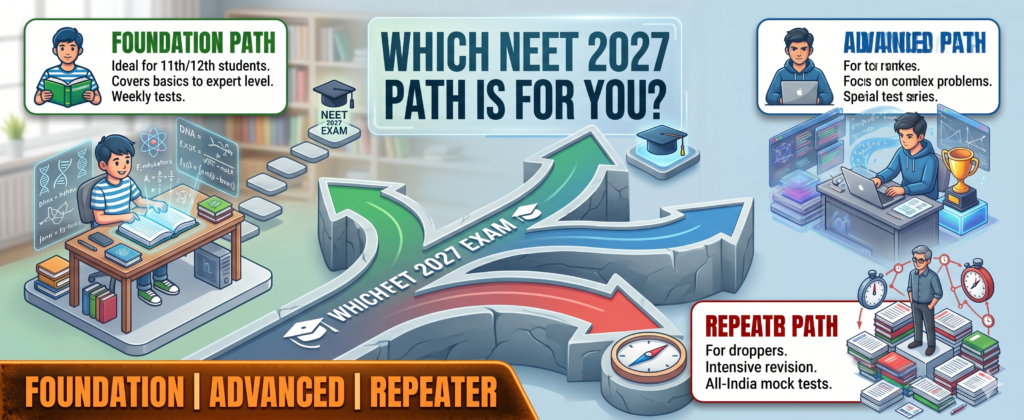
Table of Contents
Why Batch Selection Matters More Than Most Students Think
Most students pick a coaching batch based on what their friends are joining or what sounds most impressive. Neither is a good reason.
The right batch does three things:
- It teaches at a pace your current foundation can absorb.
- It challenges you enough to grow, without leaving you consistently lost.
- It prepares you for the specific version of NEET you’re targeting — 2027.
A student with weak Class 11 fundamentals sitting in an Advanced batch will fall behind within weeks. A student who already has solid concepts wasting time in a Foundation batch will get bored, coast, and under-prepare. Batch fit is a genuine academic decision, not a prestige one.
The Three Batch Types: What Each One Actually Means
Foundation Batch — Built for Early Starters
Who it’s for: Students currently in Class 11 who are starting NEET preparation early, or Class 12 students who are beginning their preparation for the first time with limited prior exposure to competitive exam-level content.
A Foundation batch builds from the ground up. The teaching pace is deliberate, concepts are introduced before being applied, and the course timeline assumes you are learning this material for the first time at a competitive level. NCERT mastery is central to the Foundation batch experience.
You’re likely a Foundation batch fit if:
- You’re in Class 11 and targeting NEET 2027 with roughly 18–24 months of prep time ahead.
- Your Class 10 Science and Math foundation is solid but you haven’t studied Biology or Physics at competitive exam depth.
- You prefer a structured, step-by-step approach over an accelerated one.
- You want to build strong fundamentals rather than rushing to MCQ practice.
What to expect: A slower initial pace that accelerates as the course progresses. The first few months focus heavily on NCERT, concept clarity, and chapter-by-chapter consolidation. Mock tests are introduced later in the course, once a foundation is in place.
For Class 11 students especially, starting your NEET 2027 preparation for Class 11 in the right batch makes a measurable difference to where you stand when the exam arrives.



Advanced Batch — For Students With a Solid Base
Who it’s for: Students in Class 12, or early Class 11 students who already have strong conceptual clarity in all three NEET subjects and want an accelerated, high-intensity preparation experience.
An Advanced batch assumes you already understand the fundamentals. Teaching moves faster, questions are harder, and the focus shifts quickly from concept-building to application and problem-solving. Students in Advanced batches are expected to keep up with a demanding schedule and do significant self-study alongside coaching sessions.
You’re likely an Advanced batch fit if:
- You’ve already covered the Class 11 NEET syllabus and have reasonable conceptual clarity in Physics, Chemistry, and Biology.
- You’re scoring consistently above 450–480 in diagnostic tests or internal assessments.
- You can handle a fast-paced environment without getting overwhelmed.
- Your target is 600+ in NEET 2027 and you want to be pushed toward that benchmark.
What to expect: High-velocity teaching, harder problem sets, more frequent testing, and greater emphasis on analysis and application. Students in Advanced batches typically move through the syllabus faster and spend more time on MCQ practice and previous year paper analysis.
Knowing which NEET 2027 chapters carry the highest weightage becomes especially important in Advanced batches, where selective depth — not just breadth — determines your final score.
Repeater Batch — Designed Specifically for Droppers
Who it’s for: Students who have already appeared for NEET (2025 or 2026) and are taking a drop year to improve their score for NEET 2027.
A Repeater batch — also called a Dropper batch — is structurally different from Foundation and Advanced batches. It assumes you’ve seen the entire syllabus at least once. The focus is on identifying and fixing specific weaknesses, not re-teaching everything from scratch. Revision cycles are faster, mock test frequency is higher, and the emotional and motivational dynamics are different from a first-attempt batch.
You’re likely a Repeater batch fit if:
- You’ve already appeared for NEET 2025 or NEET 2026 (or Re-NEET 2026) and didn’t get the score or college you wanted.
- You have a working knowledge of the full syllabus but have identifiable gaps in specific subjects or chapters.
- You’re motivated to put in a focused, high-intensity year to improve your rank meaningfully.
- You want a batch environment where other students understand the dropper experience — the pressure, the second-chance mindset, and the specific challenges of a repeat year.
What to expect: Faster syllabus coverage, earlier introduction of full mock tests, and a strong focus on previous year paper analysis. Repeater batches also tend to have more personalised attention to individual score profiles — where you scored last year and what specific improvements will get you to your target.
A structured 12-month dropper plan for NEET 2027 is the backbone of a Repeater batch experience. The batch structure and your personal study plan need to work together.
The Honest Self-Assessment: Four Questions to Find Your Batch
Before you commit to a batch, answer these four questions honestly:
1. Where Is Your Current Score?
Take a diagnostic test — a timed, full-length NEET-pattern mock — before making any batch decision. Your score tells you more than anything else:
| Diagnostic Score | Likely Best Fit |
|---|---|
| Below 300 or no attempt yet | Foundation Batch |
| 300–450 (first-time student) | Foundation or Advanced depending on subject profile |
| 450–550 (first-time student) | Advanced Batch |
| Any score (repeater) | Repeater Batch |
| 550+ (repeater targeting 650+) | Advanced or Repeater depending on programme design |
2. How Much Time Do You Have?
Timeline is a major factor. A Class 11 student with 20+ months has the luxury of building from a Foundation. A Class 12 student with 10–12 months needs a faster-paced programme. A dropper with one year needs maximum efficiency.
Knowing when to start NEET 2027 preparation and how much runway you actually have should directly inform which batch structure makes sense.
3. What Is Your Weakest Subject?
Batch fit also depends on subject profile. A student who is strong in Biology but weak in Physics may struggle in an Advanced batch even if their overall diagnostic score qualifies them. Be honest about where your floor is — your weakest subject will determine how comfortably you keep up with the batch pace.
4. Are You a Self-Driven Studier or Do You Need Structure?
Advanced batches reward self-driven students who can manage their own revision alongside coaching. Foundation batches provide more scaffolding. Repeater batches assume self-awareness and prior experience. Knowing your own working style is as important as knowing your score.
Common Batch Selection Mistakes
Choosing based on peer pressure. Your best friend getting into an Advanced batch is not a reason for you to join one if you’re not ready for it. Batch fit is individual.
Picking the batch name that sounds best. “Advanced” sounds better than “Foundation.” That doesn’t make it the right choice for you. A student who builds strong fundamentals in a Foundation batch and executes well will outperform an underprepared student struggling in an Advanced batch every time.
Ignoring the subject-level mismatch. Overall score isn’t the only metric. If your Chemistry is 120 but your Physics is 60, your batch decision needs to account for that gap — not just average it out.
Waiting too long to decide. Batch selection delays cost preparation time. Every week of uncertainty is a week where your peers have already started structured preparation. Make the decision based on honest self-assessment and start.
What KSquare Career Institute Offers for NEET 2027
KSquare Career Institute runs structured batches across all three categories for NEET 2027 aspirants — Foundation, Advanced, and Repeater — each designed with specific syllabus timelines, mock test schedules, and mentoring structures suited to that student profile.
The coaching vs self-study question is a real one for many students and parents. If you’re still weighing that decision, the NEET 2027 coaching vs self-study guide covers both sides honestly so you can make an informed call.
And regardless of which batch you join, integrating a smart NEET 2027 mock test strategy into your schedule from the beginning will determine how effectively your batch preparation translates into exam performance.
Quick Decision Guide
Still unsure? Use this final summary:
Join a Foundation Batch if: You’re in Class 11, new to competitive-level preparation, and want a structured start with 18–24 months of runway.
Join an Advanced Batch if: You have solid fundamentals, scoring 450+ on diagnostics, are in Class 12, and want a high-intensity programme that pushes toward 600+.
Join a Repeater Batch if: You’ve appeared for NEET before, know the syllabus, and need a focused drop year to close specific gaps and improve your score for 2027.
The right batch isn’t the most impressive one — it’s the one where you’ll grow the fastest.
FAQ
Q: What is the difference between a Foundation and Advanced NEET coaching batch? A: A Foundation batch is designed for students starting competitive-level preparation for the first time, with a focus on building concepts from the ground up. An Advanced batch assumes prior conceptual clarity and moves faster, with more emphasis on application, MCQ practice, and high-difficulty problem sets. The right choice depends on your diagnostic test score and subject-level preparation.
Q: Can a Class 11 student join an Advanced NEET batch? A: Yes, if their foundational knowledge in Physics, Chemistry, and Biology is already strong. Some Class 11 students who have prepared rigorously through Olympiads, Foundation courses, or self-study are ready for an Advanced batch pace. Take a diagnostic test first — your score is a better guide than your class.
Q: Is a Repeater batch necessary for dropper students, or can they join an Advanced batch? A: It depends on the coaching institute’s programme design. Repeater batches are specifically built for the dropper experience — faster revision cycles, higher mock test frequency, and peer groups who share the same preparation context. Many droppers find this environment more effective than an Advanced batch designed for first-timers, even if their score qualifies them for either.
Q: How do I know if I’m ready for an Advanced batch? A: Take a full-length diagnostic NEET mock test under timed conditions. If you score above 450 consistently and have reasonable conceptual clarity across all three subjects, you’re likely ready for an Advanced batch. If your score is lower, or if one subject is significantly weaker than the others, a Foundation batch will serve you better.
Q: What if I choose the wrong batch? A: Most good coaching institutes allow batch changes within the first few weeks if there’s a clear mismatch. If you find yourself consistently unable to keep up or consistently unchallenged, speak to your academic counsellor early — don’t wait until you’re too far behind to recover.
Q: Does batch type affect how I should prepare at home? A: Yes. Foundation batch students should prioritise completing NCERT thoroughly alongside coaching. Advanced batch students need to match the coaching pace with aggressive self-study and MCQ practice. Repeater batch students should supplement coaching with a rigorous mock test schedule and a personalised weak-chapter revision system.
[…] Use this table as a checklist while you compare batches. Many NEET 2027 droppers also repeat the same study habits from their first attempt; our list of common NEET dropper mistakes shows what to change. For the wider question of how to choose any coaching programme, read our guide to choosing a NEET coaching batch. […]