
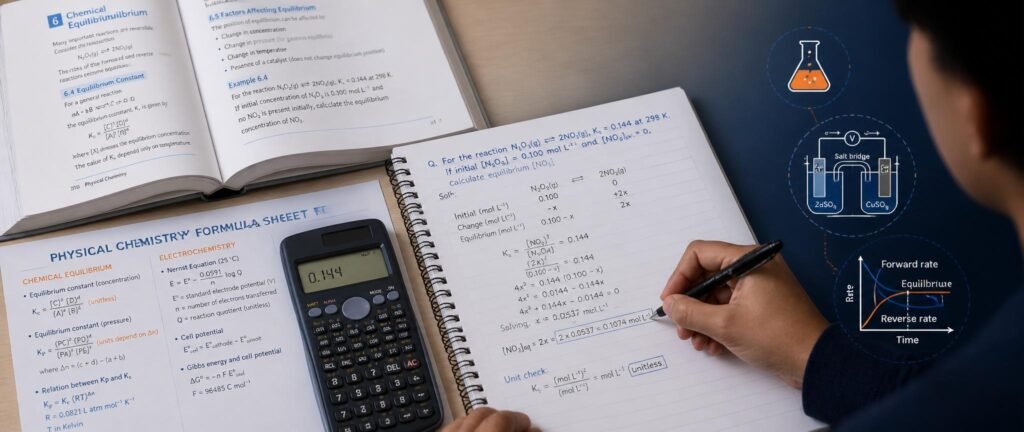
Of the three branches of chemistry, physical chemistry is the one that most often separates high scorers from the rest. Organic chemistry tests mechanisms, inorganic tests memory — but physical chemistry for NEET 2027 tests whether you can set up a formula, manage units, and execute a calculation under pressure. That combination trips up students who know the concept but stumble at the calculation, or who have the formula memorised but don’t understand where it comes from. The good news is that physical chemistry is deeply pattern-driven: the same question types repeat year after year, and a systematic approach turns even the most feared chapter into a reliable scorer. Start by mapping your effort to the NEET 2027 syllabus weightage so you know exactly which chapters deserve the most practice, and set your prep calendar with this guide on when to start NEET 2027.
Table of Contents
Why Physical Chemistry Feels Different
Unlike inorganic facts or organic reaction mechanisms, physical chemistry requires a three-step chain to work under time pressure: recall the right formula, convert units correctly, and execute the calculation without error. Breaking any one link loses the mark. Students who mug formulas without understanding them break the first link under exam stress. Students who rush past unit conversion break the second. Students who substitute correctly but make arithmetic errors break the third.
The fix for all three is the same: a structured method practised repeatedly until it becomes automatic.
High-Yield Physical Chemistry for NEET 2027 Chapters
Not all physical chemistry chapters carry equal weight. Focus your deepest practice here:
- Chemical Equilibrium — Kc, Kp, their relationship, Le Chatelier’s principle, degree of dissociation
- Ionic Equilibrium — pH calculations, buffer solutions, Ksp, common ion effect
- Electrochemistry — cell EMF, Nernst equation, relationship between ΔG and EMF, electrolysis and Faraday’s laws
- Chemical Kinetics — rate law, order of reaction, half-life, Arrhenius equation
- Thermodynamics — ΔH, ΔS, ΔG, Hess’s law, bond enthalpy calculations
- Solutions — colligative properties, vapour pressure lowering, osmotic pressure, molarity and molality interconversions
- Mole Concept and Stoichiometry — foundational for every other chapter
NCERT alone is often not enough for physical chemistry numericals — understanding what NCERT vs reference books each contributes helps you use NCERT for concepts while using a dedicated problem bank for calculation practice. Since physical chemistry questions repeat with high fidelity year after year, this is also one of the best areas for repeaters to boost their NEET 2027 score — familiar numerical types become quick, guaranteed marks.
Approach: Understand Formulas, Don’t Just Mug Them
A formula you understand is one you can reconstruct when you blank out under pressure. A formula you’ve only mugged is gone the moment your stress rises.
For every formula, learn three things: what physical relationship it expresses, what each symbol represents, and what units the answer comes out in. The Nernst equation, for instance, becomes far less scary when you understand it as a correction to standard EMF for non-standard conditions — you no longer need to remember it as a random string of symbols. Build a formula sheet per chapter with the formula, its meaning, units, and one worked example. Revising this alongside structured NCERT revision for NEET 2027 keeps conceptual and numerical knowledge in sync rather than siloed.
A Step-by-Step Method for Any Physical Chemistry Numerical
Apply this sequence to every problem, without exception:
Step 1 — Read and identify. Note every given value and exactly what the question is asking for. Underline units.
Step 2 — Select the formula. Write it out explicitly — don’t keep it in your head.
Step 3 — Convert units before substituting. This is where most marks are lost. Convert everything to the consistent unit set your formula requires before any substitution happens.



Step 4 — Substitute and solve. Plug in values in the correct positions. Keep units alongside numbers through each calculation step.
Step 5 — Verify the answer unit. The unit your calculation produces should match what the question asks for. If it doesn’t, you’ve either used the wrong formula or skipped a conversion.
Step 6 — Sanity check. Does the magnitude make physical sense? A negative pH or an EMF of 400V signals an error before you commit to a wrong answer.
Practise this sequence until it takes less than 30 seconds to run through — speed comes from habit, not rushing. Build it into your daily routine for NEET 2027 so physical chemistry gets a dedicated daily slot for formula practice and problem sets.
The Unit Management Trap
Unit errors are the single most common source of avoidable wrong answers in physical chemistry. NEET questions frequently supply values in non-standard units — pressure in atm when your formula expects Pa, energy in kJ when J is required, volume in mL when L is needed — and students who substitute directly without converting lose marks they fully understood the concept for.
The habit to build: every time a value appears in the question, immediately note its unit and flag whether it needs conversion. Dimensional analysis — tracking units through every algebraic step — catches conversion errors before they reach the final answer.
Build Accuracy With PYQs and Mocks
Physical chemistry’s pattern repetition makes previous-year questions uniquely valuable here. After covering a chapter, solve its complete PYQ bank before moving to external problem sets. You’ll quickly notice that NEET recycles the same question types with changed values — once you’ve solved the archetype, variants become automatic.
A consistent NEET 2027 mock test strategy then tests this under timed conditions. Track which chapter your physical chemistry errors come from, not just that you got a chemistry question wrong — this precision makes your revision targeted rather than general.
Common Mistakes to Avoid
- Using a formula without checking whether its conditions apply to the question
- Skipping unit conversion because “it probably won’t matter”
- Practising only straightforward substitution problems, then encountering multi-step questions unprepared
- Memorising answers to specific numerical values rather than the method
- Leaving electrochemistry or kinetics entirely because they feel complex — these chapters appear in almost every paper
Final Thoughts
Physical chemistry for NEET 2027 is not as difficult as it first appears — it is systematic. Understand formulas at the derivation level, follow a five-step numerical method, never skip unit conversion, and drill the high-yield chapters with PYQs until the patterns feel familiar. Do that consistently, and physical chemistry shifts from a source of dropped marks to a reliable, repeatable scorer on exam day.
FAQ Section
Q: Is physical chemistry hard for NEET 2027? A: It’s the most formula and calculation-heavy chemistry branch, but very scorable once you understand formulas properly and follow a consistent step-by-step numerical method.
Q: Which physical chemistry chapters are most important for NEET 2027? A: Chemical Equilibrium, Ionic Equilibrium, Electrochemistry, Chemical Kinetics, Thermodynamics, and Solutions — these carry the highest weightage and repeat most consistently in previous years.
Q: Is NCERT enough for physical chemistry in NEET? A: NCERT covers the concepts well. For numerical practice, supplement it with a dedicated problem bank and previous-year questions — calculation fluency requires far more practice than reading alone provides.
Q: How do I avoid unit errors in physical chemistry? A: Always note units alongside given values, convert to the formula’s required unit set before substituting, and track units through every algebraic step using dimensional analysis.
Q: How do I memorise physical chemistry formulas for NEET? A: Understand what physical relationship each formula expresses and what each symbol represents — then build a formula sheet per chapter with meaning, units, and one worked example.
Q: How many physical chemistry questions appear in NEET? A: Typically eight to twelve questions, largely numerical or concept-application based, making it a significant and highly consistent contributor to your chemistry score.