
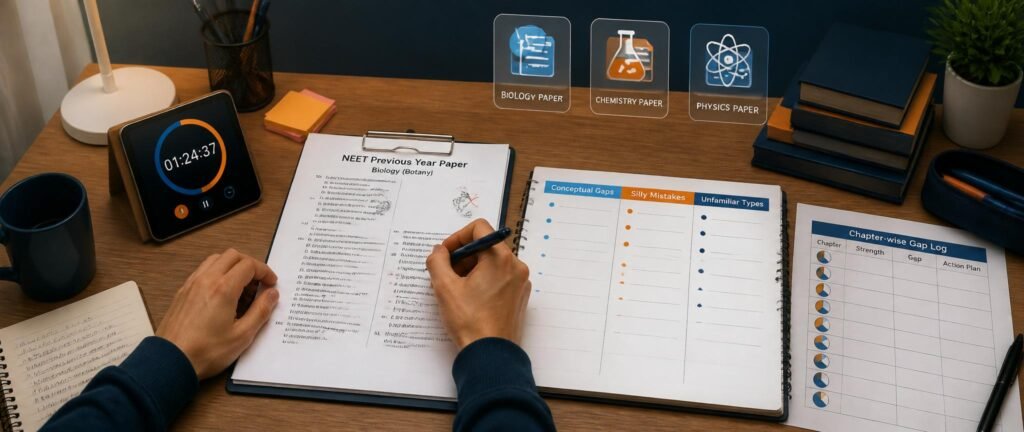
Ask any NEET topper what single resource contributed most to their score, and previous year papers will appear in almost every answer. Yet most students solve PYQs the wrong way — answering questions casually, checking answers immediately, moving on without analysis, and wondering why their scores aren’t improving. The difference between students who extract maximum value from previous year papers for NEET 2027 and those who don’t isn’t which paper collection they bought. It’s the method they use. This guide gives you that method, from when to start and how to structure each session, to what to do with the gaps each paper reveals. Use it alongside a strong NEET 2027 mock test strategy and anchor your timeline with this guide on when to start NEET 2027 so PYQs land at the right point in your preparation arc.
Table of Contents
Why Previous Year Papers for NEET 2027 Are Non-Negotiable
PYQs do three things no textbook or mock series can replicate. First, they show you exactly how NEET frames questions — the specific language, trap options, and assertion-reason structures that the exam uses. Second, they reveal which topics genuinely recur year after year versus which appear rarely. Third, they function as the most precise measure of exam-readiness available before the real test.
The pattern repetition alone makes PYQs extraordinary. NEET frequently revisits the same concepts, sometimes with near-identical phrasing, sometimes with changed values but identical method. A student who has solved the last ten years of papers has already encountered most of the question archetypes the exam knows how to ask. Cross-reference your PYQ work against the NEET 2027 syllabus weightage and you’ll see the overlap is striking — high-weightage chapters consistently dominate PYQ frequency.
The Wrong Way to Use PYQs
The most common approach: open the paper, answer questions at your own pace, check the answer key, move on. This feels productive but extracts a fraction of the available value.
The specific mistakes that waste PYQ potential:
- Checking the answer immediately after each question instead of completing the full section
- Not timing yourself, so the session gives you no information about exam-pace readiness
- Reviewing only wrong answers without categorising why they were wrong
- Solving papers from a single year repeatedly instead of covering a range
- Using PYQs only in the final month rather than chapter by chapter throughout prep
Each of these turns a diagnostic tool into passive practice. The fix is a structured three-stage process.
The Right Way: A Three-Stage Process
Stage 1 — Attempt under conditions. Solve the paper or chapter section timed, without notes, as close to exam conditions as possible. No peeking at the answer key between questions. This stage generates honest performance data.
Stage 2 — Analyse every error. After completing the section, go through every wrong and guessed answer. Categorise each into one of three types: conceptual gap (you didn’t know the underlying idea), silly mistake (you knew but chose incorrectly), or unfamiliar question type (the framing was new to you). This categorisation is the most valuable step in the entire process. Also note the chapter source of every error.
Stage 3 — Close the loop with targeted revision. Take your conceptual gap list directly to the source — NCERT first, then a focused look at NCERT vs reference books if additional depth is needed — and revise only the specific topics that failed you. Skipping this stage means making the same errors in the next paper.
After Analysis: Turn Gaps Into Revision
The error analysis is only as valuable as the revision it triggers. Build a running gap log — a simple list of chapters and concepts that have appeared in your wrong answers more than once. These recurring gaps are your highest-priority revision targets.
Feed this list directly into your NCERT revision for NEET 2027 cycles so targeted PYQ revision and spaced chapter revision run in parallel rather than separately. A conceptual gap found in a PYQ should be fully resolved before you see that chapter type in a mock exam.



Schedule PYQ Sessions Into Your Routine
PYQs work best when integrated throughout preparation, not saved for the end. The most effective approach:
- After completing each chapter’s first study pass, solve its complete PYQ bank before moving on — this immediately tests your understanding and reveals gaps while the topic is fresh
- As chapters accumulate, begin solving full mixed-subject sections under timed conditions
- In the final months, solve complete previous papers as full exam simulations
Build this into your daily routine for NEET 2027 as a fixed session type — PYQ practice should be as scheduled and protected as concept study. Repeaters especially, who may feel they’ve “already done” previous papers, can boost their NEET 2027 score significantly by reworking papers from the analysis angle rather than the passive-solving one they used before.
Subject-Wise PYQ Approach
Each subject rewards a slightly different focus:
Biology — PYQs reveal the specific NCERT lines that NEET loves to directly quote or rephrase. Annotate your NCERT copy wherever a PYQ question traces to a specific line or diagram. Over time, your NCERT becomes a map of exactly where the exam has drawn from.
Chemistry — Physical chemistry PYQs repeat numerical types with high fidelity; solve enough archetypes and variants become automatic. Organic chemistry PYQs test mechanism logic; inorganic PYQs test specific NCERT facts and exceptions.
Physics — PYQs reveal which concepts appear as direct formula applications versus which require multi-step reasoning. Build a chapter-by-chapter sense of which type dominates, and practise accordingly.
How Many Years to Cover
Aim for the last ten years at minimum. Solve the most recent three papers under full timed exam conditions. Older papers can be solved chapter by chapter rather than as full exams. If time is limited, the last five years solved properly — with the three-stage process — outperforms ten years solved casually.
Final Thoughts
Previous year papers for NEET 2027 are not just practice — they are the closest available preview of the actual exam. Solve them timed, analyse every error by type, revise the gaps they reveal, and repeat. Done systematically throughout your preparation rather than crammed at the end, PYQs compound into one of the most powerful advantages available to any aspirant. Start chapter by chapter, today.
FAQ Section
Q: Are previous year papers important for NEET 2027? A: Essential. PYQs reveal how NEET frames questions, which topics recur year after year, and give the most accurate measure of exam readiness available before the actual test.
Q: How many years of PYQs should I solve for NEET 2027? A: Aim for the last ten years. At minimum, cover the last five thoroughly using the three-stage process and solve the most recent three as full timed exam simulations.
Q: When should I start solving PYQs for NEET 2027? A: After completing each chapter’s first study pass — not after the full syllabus is done. Chapter-wise PYQ solving throughout prep is far more effective than a last-minute paper marathon.
Q: How do I analyse a NEET PYQ paper after solving it? A: Categorise every wrong answer into conceptual gap, silly mistake, or unfamiliar question type. Note the chapter source of each error and revise only those specific gaps.
Q: Do NEET PYQ questions actually repeat? A: Yes, very often. NEET revisits the same concepts regularly, sometimes with near-identical phrasing, making PYQ mastery one of the highest-leverage preparation activities available.
Q: Should I solve PYQs timed or untimed? A: Timed for exam simulation and pace readiness; untimed chapter-by-chapter when a topic is newly covered. Both serve different purposes in a complete preparation plan.
[…] pair your reading with a real physics preparation strategy, and once theory is solid, work through past NEET physics papers and a structured mock test routine to convert reading into a real […]
[…] Most students solve past papers the wrong way. They finish a paper, check the score, and move on without learning much. If you want NEET previous year questions for 2027 to raise your marks, treat them as a map of how NTA thinks. Timed practice is covered in our guide to solving full-length past papers. […]
[…] about content. The other two are about matching the exam, and they’re often the faster wins. Solving previous year papers exposes all four faster than any syllabus […]