
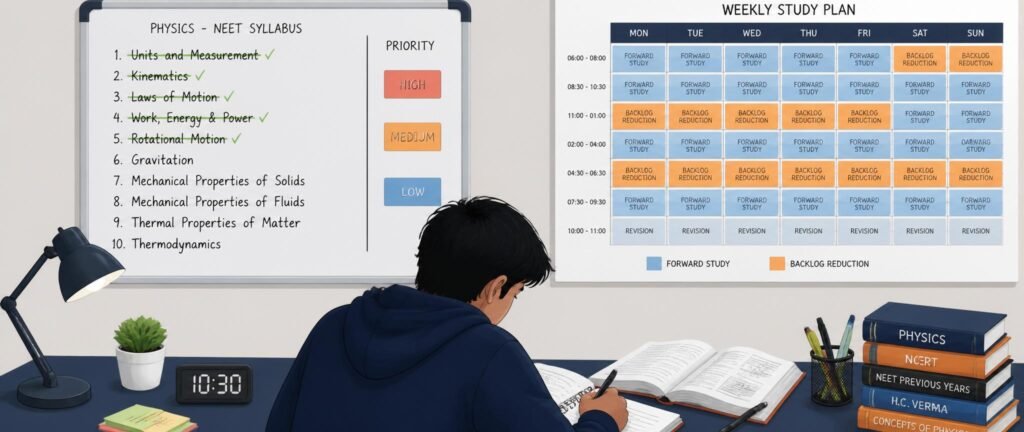
Every NEET aspirant reaches a point where the gap between what they’ve covered and what they should have covered quietly becomes a list. A chapter skipped here, a revision missed there, a subject deprioritised for two weeks — and suddenly there’s a backlog of pending topics staring back from the timetable. Knowing how to clear backlog for NEET 2027 without disrupting forward progress is a specific skill that most study guides skip entirely. This guide doesn’t. Whether your backlog is three chapters or thirty, the same tactical approach applies: audit, prioritise, build a parallel system, and move. Building this into your daily routine for NEET 2027 as a dedicated slot is the structural fix — and if you’re early in prep, this guide on when to start NEET 2027 shows how enough runway prevents a manageable gap from becoming a crisis.
Table of Contents
What Kind of Backlog Do You Have?
Backlogs aren’t all the same, and the fix depends on the type:
Never-started chapters — topics you haven’t touched at all. These need a first-pass treatment: NCERT read, key summary, PYQs.
Poorly-covered chapters — topics you technically studied but never consolidated. The concepts feel vague and the questions feel uncertain. These need a focused revision pass, not a full re-study.
Revision backlog — chapters you covered well once but haven’t revisited in weeks or months. Memory decay, not a knowledge gap. These need a spaced recall session, not a new study session.
PYQ backlog — chapters you’ve studied but never practised questions from. Conceptual understanding without application testing. These need a fast PYQ sprint, not re-reading.
Identifying which type you have determines how long clearing it actually takes — and stops you from treating a revision-backlog chapter like a never-started one and wasting hours you don’t have. Use the NEET 2027 syllabus weightage alongside your backlog audit to immediately flag which pending chapters are high-yield emergencies versus low-yield notes.
Step 1 — Audit and Prioritise
Open a blank page and write every chapter you consider backlogged. Be honest — not ruthlessly thorough. Then apply two filters:
Filter 1 — Yield. Mark each chapter as high, medium, or low weightage. High-weightage chapters are cleared first regardless of how they ended up in the backlog. Low-weightage chapters may not need clearing at all.
Filter 2 — Type. Label each as never-started, poorly-covered, revision-only, or PYQ-only. This sets the time estimate for each chapter.
The result is a prioritised repair list rather than an anxiety-inducing pile. You’re not clearing everything — you’re clearing the right things first. For never-started chapters, commit upfront to NCERT vs reference books — there is no time for supplementary material in backlog clearing. NCERT lines and PYQs only.



How to Clear Backlog for NEET 2027: The Chapter Method
For each backlog chapter, use this lean sequence:
Never-started: Read NCERT thoroughly once, create a one-page summary of key facts, formulas, or diagrams. Solve 10–15 PYQs from that chapter. This first pass takes 2–3 hours per chapter and gives you enough to attempt questions confidently.
Poorly-covered: Skip the full re-read. Identify the specific concepts that felt uncertain, return to those NCERT sections only, then solve PYQs. 60–90 minutes per chapter.
Revision-only: Closed-book recall of the chapter — write everything you remember on a blank page. Check against NCERT for gaps. Solve 5–8 PYQs. 30–45 minutes per chapter.
PYQ-only: Solve the full chapter PYQ bank timed. Review errors and trace gaps to NCERT. 45–60 minutes per chapter.
This tiered approach turns a list of fifteen backlog chapters into a quantified time commitment — manageable rather than abstract. Pair each cleared chapter with your wider NCERT revision for NEET 2027 system so it enters the spaced revision cycle immediately rather than becoming backlog again in six weeks.
Build Clearing Into Your Schedule Without Falling Further Behind
The critical mistake students make is stopping forward progress to attack the backlog. This trades one problem for another. The correct approach is a dual-track system:
- Track 1 — Forward progress: Continue your normal daily study covering new chapters on schedule.
- Track 2 — Backlog reduction: Add a dedicated 1.5–2 hour slot each day exclusively for backlog chapter clearing, working down the prioritised list.
The two tracks run simultaneously. Forward study doesn’t stop; backlog clears in parallel. This is non-negotiable discipline — the backlog slot is protected from “I’ll skip it today” the same way a study session is. The best measure of whether the system is working is a regular NEET 2027 mock test strategy session: uncovered chapters show up in wrong answers immediately, which tells you whether your backlog reduction is actually landing before exam day does.
The Class 11 Backlog: A Special Case
Class 11 chapters form a large, common backlog for students now in Class 12 who deprioritised the earlier content. This is one of the costliest backlogs to carry because Class 11 contributes nearly half of all NEET questions. If your Class 11 foundation is genuinely weak, treat it as a parallel track of its own — not something to patch in a week. Systematically apply the chapter method above to the highest-yield Class 11 chapters before attempting to consolidate Class 12.
When to Accept a Strategic Gap
Not every backlog chapter needs to be fully cleared. A chapter with consistently low PYQ frequency and low syllabus weightage may not justify the same investment as a high-yield one. If your time is genuinely limited, consciously choosing to skim a low-weightage chapter rather than never-starting a high-weightage one is strategic, not lazy. The key is making that choice deliberately after the audit — not by default because a chapter felt difficult.
How to Prevent the Next Backlog
A cleared backlog can rebuild faster than it cleared if the underlying habit doesn’t change. Prevention is structural:
- Never let more than a week pass without revisiting covered chapters
- Treat a skipped day as a one-day delay to reschedule, not permission to permanently skip
- Run a weekly five-minute audit: which chapters have I not touched this week that should have been revised?
Final Thoughts
Knowing how to clear backlog for NEET 2027 is not about working harder — it’s about working with a system. Audit your backlog, sort by type and yield, use the lean chapter method, and run the dual-track schedule so clearing never comes at the cost of forward progress. A backlog is not a crisis. It’s a list. Work the list, and the gap closes faster than the anxiety suggests.
FAQ Section
Q: How do I clear my NEET backlog without falling further behind? A: Use a dual-track system — continue forward study on schedule while running a separate daily 1.5–2 hour backlog reduction slot working through prioritised chapters.
Q: Which backlog chapters should I clear first for NEET 2027? A: Highest-yield chapters first, identified using the syllabus weightage. Clear what scores most before what feels familiar or easiest.
Q: How long does it take to clear a backlog chapter for NEET? A: Depends on the type — never-started takes 2–3 hours, poorly-covered 60–90 minutes, revision-only 30–45 minutes, PYQ-only 45–60 minutes. Identify the type before estimating time.
Q: How do I know what’s in my NEET backlog? A: A full diagnostic mock reveals uncovered chapters reliably through wrong answers. Also audit your notes and progress tracker against the complete chapter list.
Q: Is it possible to clear a large NEET backlog before 2027? A: Yes, with a structured priority plan started early enough. Even partial coverage using NCERT and PYQs for high-yield chapters is significantly better than leaving them untouched.
Q: What is the fastest way to cover a backlog chapter for NEET? A: Read NCERT once for the key concepts, create a one-page summary, then solve 10–15 PYQs from that chapter. This lean sequence takes 2–3 hours and gives enough foundation to attempt exam questions.