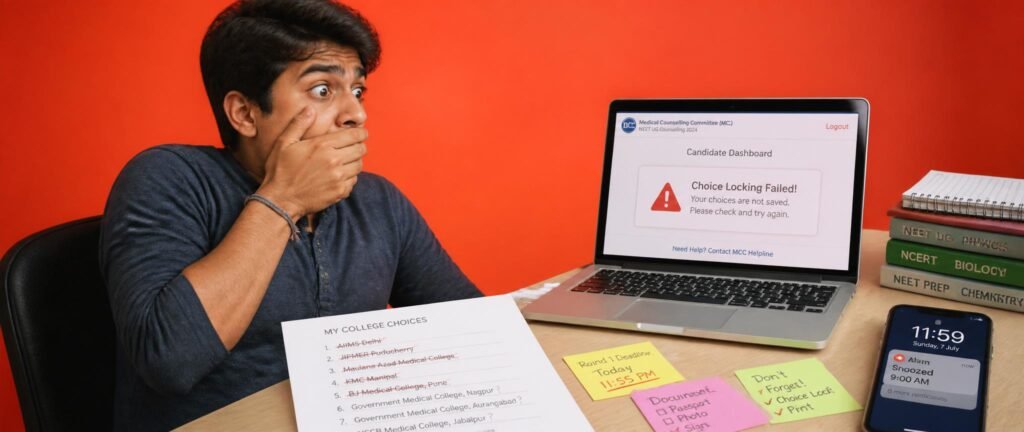
The cruelest part of NEET isn’t the exam — it’s watching a solid rank go to waste because of a counselling blunder. Every cycle, students who studied hard enough to earn a seat lose it to a process error they didn’t see coming. Not low marks. Not bad luck. Just a missed deadline, a short choice list, or a button they clicked without reading the fine print.
These NEET counselling mistakes are avoidable, every single one of them. But these NEET counselling mistakes have to be understood before the process begins, because once a round closes, there’s no rewind. Pair this with the full round-by-round breakdown and MCC registration dates, and you’ll go in armed instead of anxious.
Table of Contents
The Most Costly NEET Counselling Mistakes (and How to Avoid Each One)
Mistake 1: Filling Too Few Choices
This is the single biggest reason students with good ranks walk away without an allotment. One of the top NEET choice filling mistakes is listing five or six “dream” colleges and leaving it at that, assuming their rank will do the rest. Then the algorithm runs, their preferences are all exhausted by higher-ranked candidates, and the system has nowhere to place them.
The fix is simple: fill every college and course combination you’d actually accept. A long, honest list isn’t a sign of desperation — it’s a safety net. It gives the allotment engine room to work in your favour rather than returning an empty result. If you need data to build that list, use a college predictor to see what’s realistic at your rank before you start filling.
Mistake 2: Misunderstanding Freeze and Float
The Freeze vs Float decision is where confusion peaks. Here’s what each actually does:
| Option | What Happens | When to Use It |
|---|---|---|
| Freeze | You accept the seat and exit the process | When you’re satisfied with the allotment |
| Float | You keep the seat but stay in for upgrades | When better preferences above still have a real chance |
The mistake is Floating blindly — hoping for an upgrade without checking whether realistic options exist above you. If the colleges above your allotment had higher cut-offs than your rank, Floating just adds stress without changing the outcome. Worse, some students Float, lose the upgrade gamble, and then panic.
Before choosing, review how your rank maps and decide with data, not hope.
Mistake 3: Missing Registration or Reporting Deadlines
Counselling windows are brutally short. A choice-filling deadline missed by an hour is a deadline missed. A reporting date ignored means the allotted seat goes to someone else — and in later rounds, it can also trigger penalties.
One of the simplest NEET counselling tips: set phone alarms for every single counselling date. Better yet, build a personal calendar the moment the schedule drops and cross off each step as you complete it. Treat every deadline as a hard wall, because it is. Have your documents ready early so paperwork never becomes the bottleneck.
Mistake 4: Not Registering for Both AIQ and State Counselling
Many students register for only one system — usually MCC for the All India Quota — and miss the state counselling that covers 85% of all seats. These are parallel processes with separate portals, separate fees, and separate timelines. Skipping one cuts your options dramatically.
If you’re eligible for state counselling (check your domicile), register for both. Use the full counselling roadmap to understand how the AIQ and state systems run in parallel. The effort is small; the opportunity cost of skipping it is enormous.
Mistake 5: Ignoring the Exit Rules and Security Deposit
The security deposit NEET counselling charges is split into two parts: a non-refundable registration fee plus a refundable deposit. But “refundable” comes with conditions. If you exit mid-process after being allotted a seat — especially in the mop-up or stray vacancy stages — you can forfeit the entire deposit and, in some cases, face debarment from the next cycle.
The security deposit NEET counselling forfeiture rules are strict, so read the exit terms in full before you commit to any round. If you’re not willing to join whatever you’re allotted in the stray vacancy round, don’t enter it.
Mistake 6: Ordering Choices by “Safety” Instead of Preference
The allotment engine processes your list top to bottom and gives you the first available match. Some students list “safe” lower-preference colleges at the top, thinking this guarantees a seat, and push their actual preferences further down. The result? They’re allotted a college they didn’t really want while a seat they’d have gotten sits unclaimed below it.
Among the most underrated NEET choice filling mistakes is ordering by safety rather than desire. Always order choices in true preference order — the college you’d most want to attend goes first. The algorithm is designed to reward honest ordering.
Mistake 7: Relying on Unofficial Cut-Off Data
Dozens of websites publish “expected cut-offs” before official data is out. Students use these to shortlist colleges, skip choices that look “out of reach,” and end up with a thinner list built on guesswork. Official cut-offs shift year to year based on difficulty, seat count, and candidate pool — a 2025 number is not a 2026 guarantee.
Use unofficial data directionally, not as gospel. Always keep a margin of error when deciding which colleges to include.
Mistake 8: Forgetting to Keep Documents Ready
Document verification happens fast. Students scramble for domicile certificates, category proofs, or gap-year affidavits at the last minute and either miss the deadline or show up with incomplete files. Know what’s needed — and have hard copies, scanned copies, and backups ready well before the process opens.
The Bottom Line
None of these NEET counselling mistakes require brilliance to avoid. They require attention, preparation, and a refusal to leave anything to the last minute. Fill a long choice list, understand the Freeze vs Float rules before you’re forced to choose, register for both systems, read every exit rule, and treat every deadline like it’s the exam itself.
Your rank earned you a seat somewhere. Don’t let a preventable error give it away. If there’s a single thread running through all NEET counselling tips, it’s this: the students who handle the process calmly and methodically are the ones who end up exactly where their rank says they belong — and avoiding these NEET counselling mistakes is how you join them.
FAQ
Q: What is the biggest NEET counselling mistake students make? A: Filling too few choices. It’s the single most common reason for “no allotment” despite a decent rank. List every college-course combination you’d realistically accept so the allotment engine has room to place you.
Q: Should I choose Freeze or Float after seat allotment? A: Choose Freeze if you’re satisfied with your seat. Choose Float only if there are genuinely realistic higher-preference colleges above your allotment. Floating without a data-backed reason adds risk for little gain.
Q: Do I need to register for both MCC and state counselling? A: If you’re eligible (based on domicile), yes — strongly recommended. MCC covers 15% of seats (AIQ plus central institutes), while state counselling covers 85%. Skipping one dramatically narrows your options.
Q: Can I lose my security deposit during counselling? A: Yes. If you exit after being allotted a seat — particularly in the mop-up or stray vacancy rounds — you can forfeit the refundable deposit and potentially face debarment. Always read the exit rules before entering a round.
Q: How should I order my college preferences? A: In true preference order, not by perceived “safety.” The allotment engine gives you the first available match from the top of your list, so putting your most preferred college first is always the correct strategy.
Q: When should I start preparing documents for counselling? A: Immediately after the result is declared — don’t wait for the schedule. Gather hard copies and scans of your scorecard, admit card, identity proof, domicile, category certificate, and gap-year affidavit (if applicable) well before registration opens.