
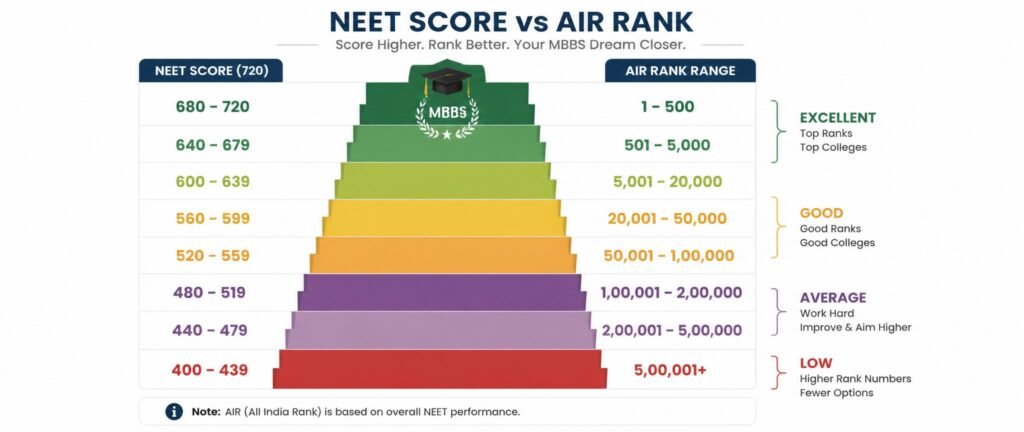
The moment the Re-NEET 2026 result drops in mid-to-late July, the first thing every student will do is look up their score and ask one question: what rank does this give me? The Re-NEET 2026 score vs rank mapping is what determines whether you get a government MBBS seat, a private seat, BDS, AYUSH — or nothing at all.
This article gives you the data-backed expected rank for every major score band, explains why Re-NEET 2026 ranks may shift from previous years, and tells you exactly what each rank means for your admission chances.
Table of Contents
Why This NEET 2026 Expected Rank Predictor Uses 2025 as the Reference
Before jumping to the table, one important context: the Re-NEET 2026 score vs rank picture is not identical to NEET 2025. Three factors push the rank curve differently this year:
1. All 22.79 lakh students had 7 extra weeks to prepare. More competition in the high-score band means the same raw score maps to a higher rank number (worse rank) compared to a normal year where students had standard prep time.
2. The May 3 paper was reportedly easier. If June 21 is moderate-to-tough (as expected for re-exams historically), scores may cluster lower — which paradoxically compresses ranks at the 500–600 range.
3. No new seats. Supply is unchanged. Any increase in competition intensity directly pushes admission cutoffs higher.
This NEET 2026 expected rank predictor uses NEET 2025 as the primary reference — it is the most recent verified data, with the most comparable difficulty profile.
Re-NEET 2026 Score vs Rank: Expected Table
The Re-NEET 2026 marks vs rank table below is built from official NTA NEET 2025 data — the most accurate proxy available before the June 21 result.
Based on official NTA NEET 2025 marks vs rank data and five-year trend analysis:
| Score (Out of 720) | Expected AIR (General) | Score Band Label |
|---|---|---|
| 700–720 | 1–100 | Elite |
| 680–699 | 100–500 | Top Rankers |
| 660–679 | 500–2,500 | Very High |
| 640–659 | 2,500–6,000 | High |
| 620–639 | 6,000–12,000 | Above Average |
| 600–619 | 12,000–20,000 | Competitive |
| 580–599 | 20,000–35,000 | Moderate |
| 560–579 | 35,000–55,000 | Below Competitive |
| 540–559 | 55,000–80,000 | Average |
| 520–539 | 80,000–1,10,000 | Low Average |
| 500–519 | 1,10,000–1,50,000 | Below Average |
| 480–499 | 1,50,000–2,00,000 | Borderline |
| 450–479 | 2,00,000–2,80,000 | Qualifying Band |
| 400–449 | 2,80,000–4,50,000 | Below Qualifying Target |
| Below 400 | 4,50,000+ | Risk Zone |
Note on Re-NEET 2026 marks vs rank estimates: These are based on NEET 2025 official data. Actual Re-NEET 2026 ranks depend on paper difficulty, overall score distribution, and the total number of qualified candidates.
What Your Rank Means for Admission
The Re-NEET 2026 score vs rank table only tells half the story. What matters is what that rank gets you.
AIR 1 – 700 (Score: 660+)
AIIMS Delhi, AIIMS Jodhpur, Maulana Azad Medical College (MAMC) Delhi, and other top government colleges under AIQ. These seats go exclusively within this rank band.
AIR 700 – 5,000 (Score: ~630–660)
Top government medical colleges across India under AIQ — KGMU Lucknow, Grant Medical College Mumbai, Lady Hardinge Medical College Delhi. Premium government seats are largely filled within this range.
AIR 5,000 – 15,000 (Score: ~600–630)
Mid-tier government MBBS colleges under AIQ and good government colleges under state quota in competitive states. This is the most searched range in the Re-NEET 2026 score vs rank analysis.
AIR 15,000 – 50,000 (Score: ~550–600)
State quota government MBBS in less competitive states, or private MBBS in reputed colleges. BDS government college seats in top institutes also fall in this range.



AIR 50,000 – 1,00,000 (Score: ~500–550)
Private MBBS (management or NRI quota in mid-tier colleges), government BAMS/BHMS/BUMS seats. Government MBBS becomes very difficult beyond AIR 50,000 for General category.
AIR 1,00,000 – 2,50,000 (Score: ~430–500)
Private MBBS in lower-tier private colleges, government AYUSH seats in several states. For General category, government MBBS is effectively closed at this range.
AIR 2,50,000+ (Score: below 430)
Private AYUSH colleges, private nursing, paramedical programmes. MBBS in India is not realistic at this rank for General category.
Students wanting to understand what specific colleges match their expected rank should read the Re-NEET MBBS seat process which explains how AIQ and state quota rounds work.
The Rank Range That Matters Most: 550–650
The 550–650 score band is where the Re-NEET 2026 score vs rank analysis — and any Re-NEET 2026 marks vs rank table — has the highest stakes — and the most volatility. Here is why:
- At 600 marks, approximately 15,000–20,000 candidates cluster in NEET 2025 data
- Every 5-mark difference in this band can mean a 5,000–8,000 rank difference
- The difference between a government MBBS seat and no government seat can be as small as 15–20 marks
- In Re-NEET 2026, with better-prepared students, this band is even more competitive
If your target is a government MBBS seat, the Re-NEET 2026 NEET marks rank predictor tells you one thing clearly: every single mark counts in the 580–640 range. There is no “safe margin.”
The Re-NEET 2026 cutoff comparison article gives a detailed breakdown of exact score thresholds by category for government MBBS seats.
Category-Wise NEET Score to AIR Mapping 2026
The table above is for General category under the All India Merit List. Reserved category candidates get separate merit lists with lower effective cutoffs:
| Category | Government MBBS Safe Score | Approximate Rank Threshold |
|---|---|---|
| General / EWS | 620–640 | AIR ~8,000–12,000 |
| OBC | 590–610 | OBC rank ~25,000–35,000 |
| SC | 490–520 | SC rank ~15,000–25,000 |
| ST | 460–490 | ST rank ~10,000–18,000 |
The NEET score to AIR mapping 2026 works differently for reserved categories. Counselling uses category-specific merit lists — your General AIR doesn’t determine your chances as much as your category rank does.
When Will You Know Your Actual Rank?
The official Re-NEET 2026 result — which will include your exact AIR — is expected in mid-to-late July 2026. The moment it is declared, your scorecard on neet.nta.nic.in will show your marks, percentile, and All India Rank simultaneously.
Until then, use this NEET 2026 expected rank predictor by applying your self-calculated score to the table above. You can use the provisional answer key (expected June 24–27) to self-calculate your expected score and map it against this table. Check the Re-NEET 2026 result date article for the full post-exam timeline.
What to Do With This Information
If your expected score is 620+: Start researching AIQ counselling registration at mcc.nic.in immediately after results. Seat availability in your range moves fast. The Re-NEET MBBS counselling roadmap covers the full process.
If your expected score is 500–620: Focus on state quota options — 85% of MBBS seats are in state quota, and cutoffs vary significantly by state. Research states where your rank band is competitive.
If your expected score is below 500: BDS, BAMS, and private MBBS remain realistic. The BDS vs BAMS 2026 guide will help you evaluate the right path.
If the result is not what you needed: NEET 2027 is 10–11 months away. The NEET 2026 drop year guide covers how to use that time well.
❓ FAQ Section
Q: What is the Re-NEET 2026 rank for 600 marks? A: The Re-NEET 2026 rank for 600 marks is estimated at approximately AIR 12,000–20,000 for General category. In Re-NEET 2026, with more competition in higher score bands, the actual rank at 600 marks may be slightly higher (worse) than 2025 data suggests.
Q: What is the Re-NEET 2026 rank for 600 marks vs 620 marks — does it matter much? A: Significantly. At 600 marks, expect AIR ~12,000–20,000. At 620, expect AIR ~6,000–12,000. That 20-mark gap can mean the difference between a government MBBS seat and no government seat. This is the sharpest part of the Re-NEET 2026 marks vs rank curve.
Q: What score do I need for a government MBBS seat in Re-NEET 2026? A: For AIQ government MBBS, General category students typically need 620–640+ marks (AIR ~8,000–12,000). For state quota government MBBS, 590–615 marks is the safe range, varying by state.
Q: How many marks difference changes rank significantly in NEET? A: In the 580–650 range, every 5 marks can change your rank by 5,000–8,000 positions. This is the most volatile band in the NEET score vs rank relationship — small score differences have outsized rank consequences.
Q: Will Re-NEET 2026 ranks be different from NEET 2025 ranks for the same score? A: Likely yes. With 22.79 lakh students having had 7 extra weeks of preparation, competition in the high-score band is more intense. The same raw score may translate to a slightly higher (worse) rank in Re-NEET 2026 compared to NEET 2025. This is the key factor that makes Re-NEET 2026 marks vs rank estimates lean toward the conservative (higher rank number) end.
Q: When will my official AIR be available? A: Your All India Rank will appear on your scorecard the moment the Re-NEET 2026 result is declared on neet.nta.nic.in — expected mid-to-late July 2026. Before that, you can estimate your rank using the provisional answer key and the table in this article.
Q: Does a good General AIR help reserved category students? A: Yes, in the sense that a better General AIR usually also means a better category rank. However, counselling for OBC, SC, and ST uses separate category merit lists — your category rank, not your General AIR, determines your admission chances for reserved seats. The NEET score to AIR mapping 2026 for reserved categories is fundamentally a category-rank exercise.
[…] how score converts to rank helps make sense of this volatility, since a fixed mark total can correspond to a meaningfully […]