If you open your NCERT textbook right now, you’ll find over 600 pages of Biology content. But for Re-NEET 2026 Biology quick revision, you don’t need all of it. You need the 100 lines that NTA has pulled questions from, year after year after year.
This list is drawn directly from Class 11 and Class 12 NCERT Biology — structured to complement your Re-NEET 2026 19-day plan — no outside sources, no guesswork. These are the NEET Biology NCERT important lines — every single one has appeared in NEET at least once in the last 5 years. Read slowly, revise daily, and revise again on June 20. This is your Re-NEET 2026 Biology last minute revision tool — use it consistently.
Before you start, make sure you’ve also locked in your Biology last 15 days plan chapter priorities alongside these lines.
Table of Contents
Class 11 NCERT Biology — 50 Re-NEET 2026 Biology Quick Revision Lines
The Living World & Biological Classification
This section of the Re-NEET 2026 Biology quick revision list targets the most directly-tested NCERT lines from Class 11 Chapters 1 and 2.
- Taxonomy is the science of identification, nomenclature, and classification of organisms.
- The basic unit of classification is species.
- Binomial nomenclature was introduced by Carolus Linnaeus.
- In binomial nomenclature, the generic name starts with a capital letter; the species epithet starts with a small letter.
- Whittaker (1969) proposed the Five Kingdom Classification: Monera, Protista, Fungi, Plantae, Animalia.
- Bacteria are the most abundant microorganisms on Earth.
- Cyanobacteria (blue-green algae) are photosynthetic prokaryotes.
- Viruses are non-cellular, containing either DNA or RNA, never both.
- Viroids are infectious RNA molecules without a protein coat — they cause plant diseases.
- Lichens are symbiotic associations between algae and fungi.
Plant Kingdom
For Re-NEET 2026 Biology quick revision, the plant kingdom lines below are the ones NTA pulls options from most directly.
- Algae are thallophytes — they lack well-differentiated plant body, vascular tissue, and embryo.
- Bryophytes are called amphibians of the plant kingdom — they need water for sexual reproduction.
- The plant body in bryophytes is the gametophyte (haploid); the sporophyte is dependent on it.
- Pteridophytes are the first vascular plants; they have true roots, stems, and leaves.
- In gymnosperms, seeds are naked (not enclosed in a fruit).
- Angiosperms have seeds enclosed within a fruit — they are the most evolved plant group.
- Monocots have one cotyledon; dicots have two cotyledons.
- Alternation of generations refers to the alternation between the haploid gametophyte and diploid sporophyte phases.
Morphology of Flowering Plants
- The root is the underground part that absorbs water and minerals; it shows positive geotropism.
- A tap root system arises from the radicle; a fibrous root system replaces the primary root in monocots.
- The stem is the ascending axis of the plant with nodes and internodes.
- A leaf with a single lamina is simple; a leaf with a lamina divided into leaflets is compound.
- Racemose inflorescence: main axis continues to grow; flowers are borne laterally in acropetal order.
- A fruit develops from the ovary after fertilisation; a false fruit (pseudocarp) develops from parts other than ovary (e.g., apple from thalamus).
- The flower is the reproductive unit in angiosperms.
Anatomy of Flowering Plants
- Meristematic tissue consists of cells that actively divide; it is responsible for growth.
- Permanent tissue consists of cells that have lost the capacity to divide — they are differentiated.
- Parenchyma cells are living, thin-walled, and perform storage and photosynthesis.
- Collenchyma cells have unevenly thickened walls — they provide mechanical support with flexibility.
- Sclerenchyma cells have uniformly thick, lignified walls — they are dead at maturity and provide rigidity.
- Xylem conducts water and minerals; phloem conducts food (primarily sucrose).
- The vascular bundle in dicot stems is open (has cambium); in monocot stems it is closed (no cambium).



Cell Biology
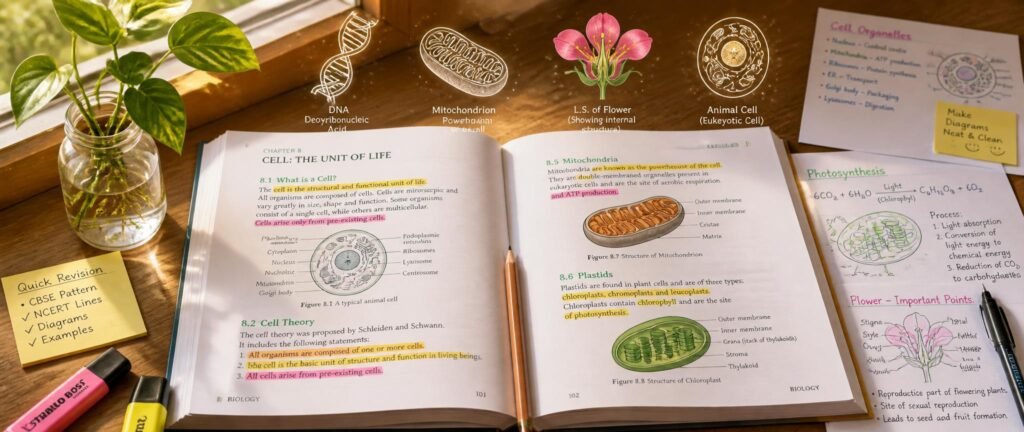
Cell biology is a high-yield zone in any Re-NEET 2026 Biology quick revision session — expect 4–6 direct questions.
- The cell theory states: (1) all living organisms are made of cells, (2) the cell is the basic structural and functional unit, (3) all cells arise from pre-existing cells.
- Prokaryotic cells lack a membrane-bound nucleus and membrane-bound organelles.
- The plasma membrane is selectively permeable — it regulates entry and exit of substances.
- The fluid mosaic model (Singer and Nicolson, 1972) describes the plasma membrane as a bilayer of phospholipids with embedded proteins.
- Osmosis is the diffusion of water across a semi-permeable membrane from higher to lower water potential.
- The nucleus is the control centre of the cell; it contains the DNA (genetic material).
- Mitochondria are the sites of aerobic respiration — they are called the powerhouse of the cell.
- Chloroplasts are the sites of photosynthesis; they contain the green pigment chlorophyll.
- Ribosomes are the sites of protein synthesis (translation).
- The Golgi apparatus (Golgi body) is involved in packaging, processing, and transport of proteins.
- Lysosomes contain hydrolytic enzymes — they are called the suicidal bags of the cell.
- Centrosomes are found only in animal cells and lower plants — they form the spindle fibres during cell division.
- Meiosis I is the reductional division (chromosome number halves); Meiosis II is the equational division.
Biomolecules & Enzymes
- Carbohydrates are the primary source of energy; they are made of C, H, and O in the ratio 1:2:1.
- The most abundant organic compound on Earth is cellulose.
- Fats are esters of glycerol and fatty acids — they yield more energy per gram than carbohydrates.
- Enzymes are biological catalysts — they are mostly proteins (except ribozymes, which are RNA).
- The active site of an enzyme is the specific region where the substrate binds.
Class 12 NCERT Biology — 50 More Re-NEET 2026 Biology Quick Revision Lines
Reproduction in Organisms
- Vegetative propagation is a form of asexual reproduction in plants — runners, rhizomes, and bulbs are examples.
- Sporulation (spore formation) is the most common asexual reproduction method in fungi and lower plants.
- In sexual reproduction, gametes fuse to form a zygote — it introduces genetic variation.
- Syngamy is the fusion of male and female gametes; triple fusion is unique to angiosperms.
- In humans, spermatogenesis produces four haploid spermatozoa from one spermatogonium; oogenesis produces one egg and three polar bodies.
Sexual Reproduction in Flowering Plants
- The anther produces pollen grains (male gametophyte); the ovary contains ovules with the female gametophyte (embryo sac).
- Pollination is the transfer of pollen from the anther to the stigma.
- Self-pollination (autogamy) occurs within the same flower or plant; cross-pollination (allogamy) occurs between different plants.
- Double fertilisation is unique to angiosperms: one sperm fuses with the egg (syngamy → zygote), another fuses with the two polar nuclei (triple fusion → primary endosperm nucleus → 3n).
- The endosperm (formed from triple fusion) provides nutrition to the developing embryo.
- The seed develops from the ovule; the fruit develops from the ovary.
- Parthenocarpy is the development of fruit without fertilisation — e.g., banana.
Human Reproduction
- The testes are located in the scrotum — outside the abdominal cavity — because spermatogenesis requires a temperature 2–2.5°C lower than body temperature.
- The acrosome of the sperm head contains enzymes that help penetrate the egg during fertilisation.
- Fertilisation in humans occurs in the fallopian tube (ampullary-isthmic junction).
- The implantation of the blastocyst occurs in the uterine wall (endometrium) — approximately 7 days after fertilisation.
- hCG (human Chorionic Gonadotropin) is secreted by the trophoblast — it maintains the corpus luteum during early pregnancy. It is the basis of pregnancy tests.
- The normal gestation period in humans is 9 months (approximately 280 days).
- Parturition (childbirth) is triggered by a complex hormonal interplay — oxytocin plays the key role in uterine contractions.
Reproductive Health
- MTP (Medical Termination of Pregnancy) is legally permitted up to 20 weeks of pregnancy in India (amended to 24 weeks for specific categories).
- IUDs (Intrauterine Devices) — copper-T, multiload — prevent implantation by making the uterus unsuitable.
- Oral contraceptive pills contain synthetic estrogen and progesterone — they prevent ovulation.
- STIs (Sexually Transmitted Infections) include gonorrhoea, syphilis, genital herpes, chlamydia, and HIV/AIDS.
- ZIFT (Zygote IntraFallopian Transfer) — the zygote is transferred to the fallopian tube.
- IUI (Intrauterine Insemination) — semen is artificially introduced into the uterus.
Genetics & Evolution
Genetics carries the highest single-chapter weightage in NEET. Every line here is Re-NEET 2026 Biology quick revision priority.
- Mendel’s Law of Segregation: two alleles of a gene separate during gamete formation — each gamete carries only one allele.
- Mendel’s Law of Independent Assortment: genes for different traits assort independently during gamete formation (applies to genes on different chromosomes).
- The test cross is a cross between an individual of unknown genotype and a homozygous recessive individual.
- Incomplete dominance produces an intermediate phenotype in F1 (e.g., Antirrhinum — snapdragon — red × white = pink).
- Co-dominance: both alleles are fully expressed (e.g., ABO blood group — I^A I^B = AB type).
- Linked genes are located on the same chromosome and tend to be inherited together.
- Chromosomal theory of inheritance: genes are located on chromosomes (Sutton and Boveri).
- Sex determination in humans: females are XX, males are XY — the Y chromosome carries the SRY gene that triggers male development.
- Haemophilia is an X-linked recessive disorder — it primarily affects males.
- Sickle cell anaemia is an autosomal recessive disorder caused by a point mutation in the β-globin gene — valine replaces glutamic acid at position 6.
- Down syndrome (Trisomy 21) — 47 chromosomes instead of 46 — caused by non-disjunction of chromosome 21.
- DNA (deoxyribonucleic acid) is the genetic material in most organisms; RNA is the genetic material in some viruses.
- The DNA double helix was proposed by Watson and Crick in 1953; the helix is right-handed with a pitch of 3.4 nm.
- In DNA, A pairs with T (2 hydrogen bonds); G pairs with C (3 hydrogen bonds) — Chargaff’s rule.
- Transcription is the synthesis of mRNA from the DNA template; translation is the synthesis of protein from mRNA at ribosomes.
- The genetic code is a triplet code — each codon codes for one amino acid; it is universal, non-overlapping, degenerate, and comma-less.
- AUG is the start codon (codes for methionine); UAA, UAG, UGA are stop codons (they do not code for any amino acid).
- Lac operon (Jacob and Monod) — the classic example of gene regulation in prokaryotes. In the presence of lactose, the repressor is inactivated and the structural genes are expressed.
Biology in Human Welfare
- Penicillin — the first antibiotic — was discovered by Alexander Fleming from the fungus Penicillium notatum.
- Biofortification is the breeding of crops with higher nutritional quality — e.g., Golden Rice (enriched with Vitamin A precursor).
- Biocontrol agents: Bacillus thuringiensis (Bt) produces a protein toxic to insect larvae — used in Bt cotton and Bt brinjal.
Biotechnology
Biotechnology is compact but highly scoring — these 4 NCERT Biology lines for NEET 2026 from this section appear almost every year.
- Restriction enzymes (restriction endonucleases) cut DNA at specific palindromic sequences — they are the molecular scissors of genetic engineering.
- PCR (Polymerase Chain Reaction) amplifies a specific DNA segment in vitro — invented by Kary Mullis.
- Recombinant DNA technology involves cutting DNA from two different sources and joining them using DNA ligase to produce recombinant DNA.
- Insulin was the first commercial product of recombinant DNA technology — human insulin (Humulin) is produced in E. coli by inserting the human insulin gene.
How to Use This Re-NEET 2026 Biology Quick Revision List Effectively
This Re-NEET 2026 Biology quick revision method works on active recall, not passive reading. Don’t just read — Cover the answer side and test yourself. For every line you hesitate on, mark it and re-read it twice.
For full exam-day strategy, also check the Re-NEET 2026 exam day checklist and the Re-NEET 2026 last month strategy.
Suggested revision schedule before June 21:
- June 6–10: Read all 100 lines once slowly. Mark the ones you’re not confident on.
- June 11–15: Revise only the marked lines. Cross-check with NCERT.
- June 16–19: One full run-through of all 100 in under 45 minutes.
- June 20 (night before): Final 20-minute scan of lines 51–100 — the most important Re-NEET 2026 Biology last minute revision pass you’ll do.
Pair this Re-NEET 2026 Biology quick revision list with your Re-NEET 2026 complete study plan and Re-NEET 2026 Biology MCQs for a complete Biology revision system.
Re-NEET 2026 Biology quick revision is not about cramming. It’s about recognising the exact line when it appears as an MCQ option. These 100 lines give you that recognition advantage.
These NEET Biology NCERT important lines are your last-mile advantage. All the best for June 21. You’ve got this.
FAQ Section
Q: Are these verified NCERT Biology lines for NEET 2026? A: Yes. Every line is sourced from Class 11 and Class 12 NCERT Biology textbooks. These are verified NCERT Biology lines for NEET 2026 — no outside source material has been used. NTA strictly follows NCERT for NEET questions, which is why this list is focused entirely on NCERT content.
Q: Which NEET Biology NCERT important lines come from high-weightage chapters? A: Genetics and Evolution (10–12 questions), Reproduction (8–10 questions), Human Physiology (8–10 questions), and Plant Kingdom (4–5 questions) consistently carry the highest weightage. Biotechnology and Biology in Human Welfare together contribute 4–6 questions.
Q: Should I use this for Re-NEET 2026 Biology chapter revision or full NCERT reading? A: These 100 lines are for quick revision — not a replacement for full chapter study. If you have more than 10 days left, revise full chapters first. If you are in the final 3–5 days, use this Re-NEET 2026 Biology chapter revision list as your primary tool alongside NCERT diagrams.
Q: How many NCERT Biology lines for NEET 2026 appear directly in the exam? A: Historically, 60–70% of NEET Biology questions are either direct NCERT lines or very close paraphrases. The remaining 30–40% test application of NCERT concepts. Knowing these 100 lines directly addresses the majority of the Biology section.
Q: For Re-NEET 2026 Biology chapter revision, should I prioritise Class 11 or Class 12? A: Both carry approximately equal weightage — roughly 45 questions from Class 12 Biology and 45 questions from Class 11 Biology. Neither can be skipped. Class 12 Genetics, Reproduction, and Biotechnology tend to have slightly higher direct-recall question frequency.
Q: What is the best Re-NEET 2026 Biology last minute revision approach for weak chapters? A: Go back to that specific NCERT chapter immediately and read the surrounding context. Don’t just memorise the line — understand the concept it represents. NTA often tests the same concept from a different angle or option, so understanding is more useful than rote memorisation.