
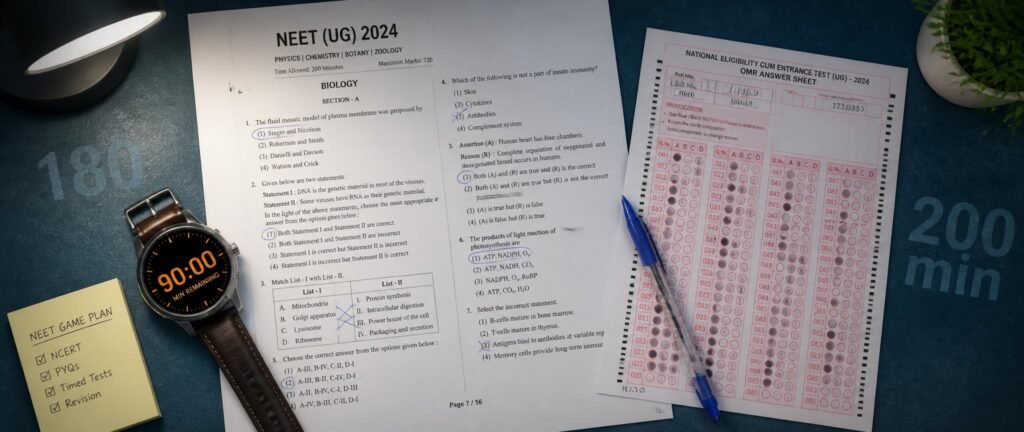
The Re-NEET 2026 time management strategy you walk into the exam hall with on June 21 will determine more about your score than anything you revise in the final 48 hours. Most students who underperform in NEET don’t run out of knowledge — they run out of time.
200 minutes. 180 questions. 66 seconds per question on average. But NEET is not an average game — it’s a strategy game. Here’s exactly how to play it.
Table of Contents
Know Your Time Budget First
| Section | Questions | Marks | Suggested Time |
|---|---|---|---|
| Biology (Botany + Zoology) | 90 | 360 | 55–60 minutes |
| Chemistry | 45 | 180 | 45–50 minutes |
| Physics | 45 | 180 | 55–60 minutes |
| Buffer / Review | — | — | 30–35 minutes |
Biology gives the most marks and requires no calculation — which is why every effective NEET 200 minutes 180 questions strategy starts there. Check your Re-NEET 2026 exam day checklist before entering the hall so logistics don’t eat into your 200 minutes.
The 3-Round System: Core of Your Re-NEET 2026 Time Management Strategy
Round 1 — Speed Pass (120 minutes)
Go through the entire paper once. Apply one simple rule:
- Know it instantly → Attempt and move on
- Vaguely familiar → Skip, put a circle next to it
- No idea → Skip, put a cross next to it
Do not spend more than 90 seconds on any question in Round 1. Target: 100–120 questions confirmed.
Round 2 — Revisit (50 minutes)
Return to every circled question. Fresh eyes and no time pressure resolve most of these. Target: 30–40 more questions.
Round 3 — Review (30 minutes)
Check OMR against your question paper marks. Resolve any uncertain answers. Attempt crossed questions where you can eliminate 2 options.
This is the NEET 200 minutes 180 questions strategy that separates students who finish with time to spare from students who are still rushing Biology when the bell rings.



Re-NEET 2026 Exam Attempt Order: Subject-by-Subject Rules
Biology First — Always
The Re-NEET 2026 exam attempt order must be Biology → Chemistry → Physics. Biology questions are direct NCERT recall — read, recognise, mark. No calculation, no formula, no wasted seconds.
Rules: Max 30 seconds per Biology question in Round 1. If you’re spending more than 45 seconds, skip — it belongs in Round 2. Target 75–80 Biology questions confirmed in the first pass.
Your Re-NEET 2026 Biology quick revision directly increases Round 1 Biology speed — the more lines you recognise instantly, the faster you move through all 90 questions.
Chemistry Second
Chemistry splits into recall questions (reactions, nomenclature, properties) and numericals (mole concept, equilibrium, electrochemistry). Do recall first within Chemistry, numericals second.
Rules: Max 60 seconds for recall questions, max 90 seconds for numericals. Never spend more than 2 minutes on a Chemistry numerical in Round 1 — skip it. Your Re-NEET 2026 Chemistry formula sheet makes recall questions instant answers.
Physics Last
Physics takes the most time per question. Numericals require reading, identifying variables, selecting a formula, and calculating.
Rules: Max 2 minutes per Physics numerical in Round 1. Conceptual Physics questions — max 60 seconds. If a numerical needs more than one formula substitution, skip immediately. The NEET time per question 2026 benchmark for Physics is strict — do not negotiate with it. Review the Re-NEET 2026 Physics formula sheet the night before so formulas are in instant-recall memory.
4 Habits That Kill Your Time on June 21
1. Strict sequential order — Never attempt Q.1 to Q.180 in order. Physics Q.1 might be a 4-minute calculation. Skip it. Do Biology Q.1 first.
2. Re-reading the same question three times — If you’ve read it twice and it hasn’t clicked, skip it. The third read almost never helps.
3. Recalculating the same numerical — If you got the same answer twice, trust it. Move on.
4. Checking your watch constantly — Check only three times: after Biology, after Chemistry, and at the halfway mark. Constant clock-watching creates anxiety that slows you down further.
The Negative Marking Filter
A complete Re-NEET 2026 paper attempt strategy must include a negative marking rule. Apply this test before every uncertain answer:
Attempt if: You can eliminate at least 2 of 4 options (50%+ chance of being right) Skip if: You have no basis to eliminate any option
Random guessing with no elimination is the fastest way to break your Re-NEET 2026 paper attempt strategy — it’s a mark-losing habit over 180 questions. The Re-NEET 2026 OMR sheet filling guide also covers this — since you cannot erase OMR bubbles, every mark is permanent.
If You Fall Behind: Triage Mode
If at the 150-minute mark you still have 40+ questions untouched:
- Scan all remaining questions — pick Biology first, regardless of order
- Skip all remaining Physics numericals that look calculation-heavy
- Answer every question where you can eliminate 2 options
The goal shifts to minimising blank answers in your strongest subject.
Practise This Before June 21
A Re-NEET 2026 time management strategy you’ve never rehearsed is a strategy that will fail. In every full mock test before June 21, apply the 3-round system exactly as described. Track how many questions you completed in each round. Identify which section ran over time.
Your Re-NEET 2026 last month strategy should have full mock tests in the final 10 days — use each one as a time management rehearsal, not just a score check. Do this at least twice before June 21 so the system feels automatic when it counts.
FAQ Section
Q: Should I attempt Biology, Chemistry, or Physics first in NEET? A: Always Biology first. It carries 360 marks, requires no calculation, and builds momentum for the rest of the paper. The Re-NEET 2026 exam attempt order is Biology → Chemistry → Physics without exception.
Q: How many questions should I target in the first pass? A: In a NEET 200 minutes 180 questions strategy, target 100–120 confirmed answers in your first 120-minute speed pass. This leaves 80 minutes for revisiting and reviewing.
Q: What are the NEET time per question 2026 benchmarks? A: Biology: 20–45 seconds. Chemistry recall: 45–60 seconds. Chemistry numericals: 60–90 seconds. Physics numericals: up to 2 minutes. Anything exceeding these NEET time per question 2026 limits gets skipped immediately.
Q: Should I guess on questions I’m unsure about? A: Only if you can eliminate at least 2 options — that gives you a 50%+ chance. Pure random guessing with no elimination is statistically likely to lose marks over many questions.
Q: What do I do if I’m running out of time? A: Switch to triage — scan remaining questions, grab all Biology questions first, skip heavy Physics numericals, answer everything where you can eliminate 2 options. Speed over thoroughness in the final 20 minutes.
Q: Should I review all my answers at the end? A: Only review answers you marked uncertain — not every answer. Changing confident answers based on second-guessing typically reduces scores. Use review time to verify OMR accuracy and resolve genuinely uncertain questions.