
Biology is 50% of your Re-NEET 2026 paper. 90 questions. 360 marks. No other subject comes close.
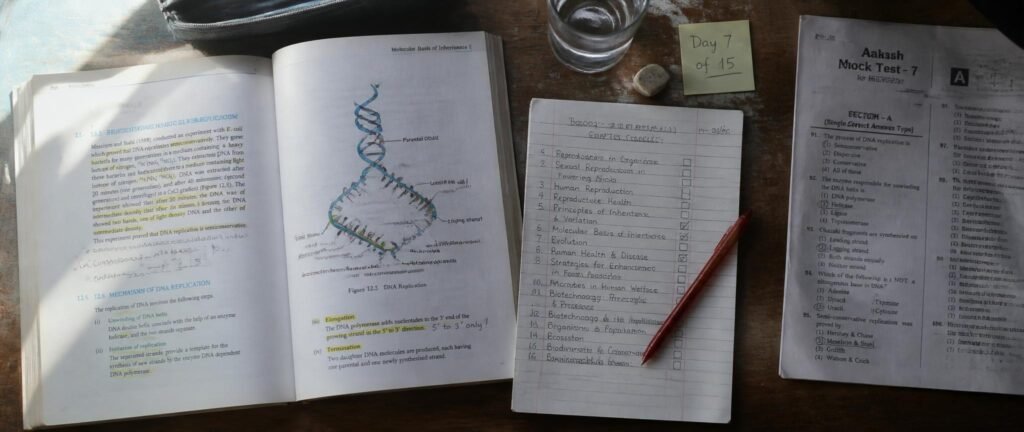
With 15 days left, you cannot revise everything — and you shouldn’t try. The Re-NEET 2026 Biology last 15 days revision strategy is about one thing: putting maximum marks on the board from the chapters that actually show up in the paper, year after year.
This article gives you the exact chapters to cover, in priority order, with a day-wise breakdown so you never waste a session wondering what to open next.
Table of Contents
Why Most Students Get Biology Wrong in the Final Stretch
They try to read NCERT cover to cover — again. They spend three days on a chapter that hasn’t appeared in NEET in five years. They confuse “finishing the syllabus” with “being prepared.”
The Re-NEET 2026 Biology last 15 days revision works differently. You identify the highest-yield chapters, go deep on those, practise PYQs chapter-wise, and leave the low-frequency topics for a quick skim at the end.
If you want the full subject-wise context of what Biology chapters carry the most marks, the Re-NEET 2026 Biology preparation guide breaks down the complete weightage picture. Use this article alongside that for the most efficient 15-day sprint.
High Yield Biology Topics for NEET 2026 — Priority Tier List
Here is how to categorise your Biology chapters before you begin:
Tier 1 — Revise Every Single Day (Highest Frequency)
These chapters appear in almost every NEET paper and carry disproportionate marks. They go first, deepest, and get the most PYQ drilling.
| Chapter | Why It’s Tier 1 |
|---|---|
| Genetics & Mendelian Inheritance | 5–8 questions every year, concept + application both tested |
| Molecular Basis of Inheritance | DNA replication, transcription, translation — NCERT lines directly quoted |
| Human Physiology (all systems) | Neural, endocrine, digestion, excretion — 10–14 questions combined |
| Cell Biology & Cell Division | Mitosis, meiosis, cell organelles — heavily tested in assertion-reason |
| Plant Physiology | Photosynthesis, respiration, transport — 4–6 questions consistent |
| Reproduction | Human reproduction + reproductive health — 5–7 questions, very NCERT-line specific |



Tier 2 — Revise Thoroughly (Medium-High Frequency)
| Chapter | Typical Questions |
|---|---|
| Ecology & Environment | Ecosystem, biodiversity, environmental issues — 4–6 Qs |
| Evolution | Origin of life, Darwin, Hardy-Weinberg — 2–4 Qs |
| Biotechnology | Principles + applications — 3–5 Qs, very definition-heavy |
| Biology in Human Welfare | Microbes, immunology — 3–4 Qs |
Tier 3 — Quick Skim Only (Low Frequency)
Biomolecules, Strategies for Enhancement in Food Production, Organisms and Populations. Spend 30–45 minutes maximum on each — just enough to recognise a question if it appears.
NEET Biology Final 15 Days Strategy — Day-by-Day Plan
Here is your complete Re-NEET 2026 Biology last 15 days revision schedule, built around Tier 1 first:
| Day | Morning Focus (3 hrs) | Afternoon Focus (2 hrs) | Evening (1.5 hrs) |
|---|---|---|---|
| Day 1 | Cell Biology — organelles, cell theory | Cell Division — mitosis vs meiosis diagrams | PYQs: Cell chapters (30 Qs) |
| Day 2 | Genetics — Mendel’s laws, monohybrid, dihybrid | Chromosomal disorders, sex determination | PYQs: Genetics (35 Qs) |
| Day 3 | Molecular Biology — DNA structure, replication | Transcription, translation, genetic code | PYQs: Molecular Biology (30 Qs) |
| Day 4 | Human Physiology — Digestion + Breathing | Excretion + Body Fluids + Circulation | PYQs: Physiology Part 1 (30 Qs) |
| Day 5 | Human Physiology — Neural + Chemical Coordination | Locomotion + Movement | PYQs: Physiology Part 2 (25 Qs) |
| Day 6 | Plant Physiology — Photosynthesis + Respiration | Transport in Plants + Mineral Nutrition | PYQs: Plant Physiology (25 Qs) |
| Day 7 | Reproduction in Organisms + Human Reproduction | Reproductive Health + Embryology | PYQs: Reproduction (30 Qs) |
| Day 8 | Ecology — Ecosystems, Nutrient Cycling | Biodiversity + Environmental Issues | PYQs: Ecology (25 Qs) |
| Day 9 | Evolution — Origin of Life, Natural Selection | Hardy-Weinberg, speciation | PYQs: Evolution (20 Qs) |
| Day 10 | Biotechnology — Principles (rDNA, vectors) | Biotechnology Applications (GM crops, insulin) | PYQs: Biotechnology (20 Qs) |
| Day 11 | Biology in Human Welfare — Microbes, immunity | Drugs, alcohol, cancer basics | PYQs: Human Welfare (15 Qs) |
| Day 12 | Tier 3 quick skim — Biomolecules, Food Production | Organisms and Populations | Short notes review — all chapters |
| Day 13 | Full Biology mock — 90 questions, timed 60 min | Error analysis — categorise mistakes by chapter | Revise top 3 weak chapters |
| Day 14 | Targeted revision of Day 13 weak chapters | NCERT diagrams + tables — Biology flashcard pass | PYQs from weak chapters only |
| Day 15 | Final short notes read-through — all Tier 1 | Diagram revision — reproductive system, cell, mitosis | Rest by 8 PM |
Most Important Biology Chapters Re-NEET Students Must Not Skip
If you are seriously short on time and need to make hard cuts, these are the absolute non-negotiables:
NCERT Biology Revision Re-NEET 2026 — Must-Cover Pages
Genetics & Molecular Biology
- NCERT Class 12, Chapter 5 — every diagram: DNA double helix, replication fork, lac operon
- NCERT Class 12, Chapter 6 — all bold terms, the genetic code table, tRNA structure
Human Physiology
- NCERT Class 11, Chapters 16–22 — highlighted sentences and all named diagrams
- Pay special attention to: nephron structure, neuron structure, sarcomere diagram, villus structure
Reproduction
- NCERT Class 12, Chapters 1–4 — every labelled diagram is a potential question
- Gametogenesis, placenta, embryo development stages — highly visual, highly tested
Plant Physiology
- NCERT Class 11, Chapters 11–15 — especially the Z-scheme diagram and Calvin cycle steps
One of the most common mistakes students make here is reading NCERT passively. Read the diagram captions. Read the bold sentences. Read the chapter-end summary boxes. These are where NEET question setters work. The NCERT enough for Re-NEET article explains exactly how deep your NCERT reading needs to go — worth 10 minutes of your time.
How to Actually Practise Biology PYQs in 15 Days
Reading chapters is only half the work. The other half is drilling previous year questions chapter-wise — not full mocks yet, but targeted chapter PYQs after every session.
Here is the method that works:
- Finish revising a chapter
- Immediately attempt 20–30 PYQs from that chapter only
- For every wrong answer — go back to the exact NCERT line it came from
- Add that line to your short notes if it’s not already there
This loop — revise, practise, trace back — is what converts passive reading into actual marks. Students who do this consistently across 15 days typically see a 40–60 mark jump in Biology alone.
For ready-to-use practice questions, the Re-NEET 2026 Biology MCQs article has 50 high-frequency questions across the most tested chapters — use it after Day 7 once your Tier 1 revision is done.
Fitting Biology Into Your Full 15-Day Schedule
If you are also revising Chemistry and Physics alongside this, Biology should take your morning sessions — your sharpest hours. Give it 3 hours every morning without exception.
The Re-NEET 2026 19 day plan maps out exactly how to structure your full day across all three subjects so Biology revision doesn’t eat into your Chemistry and Physics time.
And when you sit down for mock tests in Days 13–15, pay close attention to where you’re losing Biology marks — guessing on assertion-reason questions or misreading options costs more than a weak chapter. Study up on avoiding negative marking in NEET before your first full mock.
Final Word on Re-NEET 2026 Biology Last 15 Days Revision
Biology is the subject most students feel vaguely prepared in — and that vagueness is exactly what costs marks.
The Re-NEET 2026 Biology last 15 days revision plan above removes all vagueness. Every day has a chapter. Every chapter has PYQs. Every weak area gets a second pass. You walk into June 21 knowing exactly which Biology topics you’ve covered, how many questions you’ve practised, and where your strongest and weakest spots are.
That clarity is what separates a 280 Biology score from a 320.
Start Day 1 today.
Frequently Asked Questions
Q: Which Biology chapters are most important for Re-NEET 2026? A: Genetics, Molecular Biology, Human Physiology, Cell Biology, Plant Physiology, and Reproduction are the highest-frequency chapters. These 6 topic areas account for 60–70% of Biology questions in NEET papers historically.
Q: Is NCERT enough for Biology in Re-NEET 2026? A: Yes — for the vast majority of questions. Deep NCERT reading, including diagrams, captions, bold terms, and chapter-end summaries, is the most efficient Biology preparation strategy in the final 15 days.
Q: How many Biology PYQs should I solve per day? A: Aim for 20–35 chapter-wise PYQs per day after each revision session. In the final 2–3 days, shift to full 90-question Biology mocks under timed conditions.
Q: Should I start new Biology topics this close to Re-NEET 2026? A: No. Focus only on high-yield Tier 1 and Tier 2 chapters. Starting unfamiliar topics in the final 15 days creates confusion without adding meaningful marks.
Q: How much time should I give Biology every day in the final 15 days? A: A minimum of 5–6 hours daily — 3 hours of focused revision in the morning and 2–3 hours of PYQ practice across afternoon and evening sessions.