
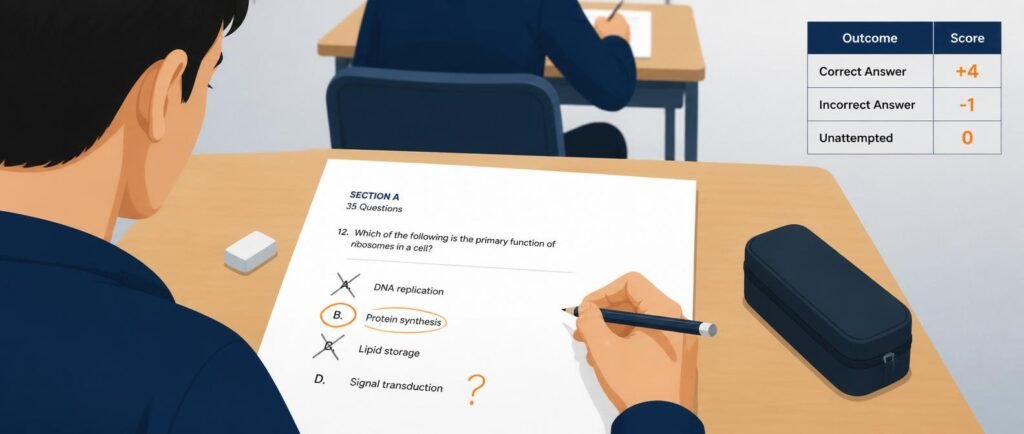
Every NEET aspirant knows the rule: right answer earns four marks, wrong answer loses one, unattempted earns nothing. Yet in the pressure of the exam hall, that simple rule gets broken again and again — a tentative guess here, a last-minute change there — and marks quietly drain away. Learning to avoid negative marking NEET 2027 demands isn’t about attempting fewer questions; it’s about attempting the right questions with the right intent. Done well, this skill alone can protect 20–30 marks and shift your rank by thousands. It requires practice, not luck — start building it now through a calibrated NEET 2027 mock test strategy, and set your prep timeline using this guide on when to start NEET 2027.
Table of Contents
Understand the Marking Scheme First
The numbers are simple:
| Answer | Marks |
|---|---|
| Correct | +4 |
| Wrong | −1 |
| Unattempted | 0 |
The implication is equally simple: an unattempted question costs you nothing. A wrong answer costs you a mark plus the four marks you could have scored — a net swing of five marks per question. One bad guess in a chapter you barely know is not “just minus one.” It’s potentially a five-mark swing. Use the NEET 2027 syllabus weightage to identify which chapters you’re genuinely strong in — those are your safe zones for attempts.
Five Rules to Avoid Negative Marking NEET 2027
Rule 1 — Attempt only from genuine strength. If you can answer a question without hesitation, mark it and move on. If you’re unsure and can’t reduce your options, skip it. The only time you should pause to attempt a doubtful question is if you can confidently eliminate at least one option. Strong, deep revision is the real protection here: the more thoroughly you’ve covered a topic through NCERT revision for NEET 2027, the fewer questions feel genuinely ambiguous.
Rule 2 — Know your subject zones. Every aspirant has chapters they know cold, chapters that are shaky, and chapters that are almost blank. Map them honestly. Attempt confidently from your strong zones; use the elimination method in moderately-known ones; skip your blank zones entirely. This zoning becomes clearer the more carefully you’ve worked through NCERT vs reference books to build solid conceptual foundations — surface-level reading produces exactly the “I half-know this” feeling that leads to bad guesses.
Rule 3 — Master the elimination method. Don’t guess; eliminate. When a question feels uncertain, work backwards. Cross out any option you’re confident is wrong. With four options, eliminating just one shifts your odds from 25% to 33% — and the maths of NEET makes this meaningful. Eliminating two options (50% chance) gives an expected value of +1.5 marks, a clear positive. If you can’t eliminate a single option, the question is a skip. Build the habit of active elimination inside your daily routine for NEET 2027 by practising it on every previous-year set you solve — not just under mock conditions.



Rule 4 — Use a skip-and-return system. Mark uncertain questions for review, move on, and return if time allows. This stops time pressure from forcing bad decisions. Students who feel rushed make impulsive, emotional choices — “I’ll just go with B” — that cost real marks. A calm two-pass strategy protects both accuracy and time. Repeaters in particular can boost their NEET 2027 score substantially by fixing impulsive marking habits from previous attempts.
Rule 5 — Control exam-day pressure. Most negative marks come from the last 30 minutes when time panic sets in and students start marking anything to fill the paper. Set a hard rule for yourself before exam day: no question marked in the final 10 minutes unless you already know the answer. A half-filled paper with high accuracy almost always outscores a fully-filled paper with panic-induced errors.
The Simple Maths of a Good Attempt
Theoretically, even a random guess at four options has a slightly positive expected value of +0.25 marks. So why is guessing still dangerous? Because NEET’s wrong options are engineered traps — they exploit common misconceptions, and students systematically pick them. In practice, a student who “guesses” in an unfamiliar chapter is choosing between options they can’t distinguish, and their effective accuracy often falls well below 25%.
The practical threshold: attempt when you’re at least 70–80% confident, or when you can eliminate at least two options. Below that, skip and protect the zero.
Common Negative Marking Traps
- Changing a correct answer due to last-minute doubt — first instinct is usually right
- Attempting assertion-reason questions with partial understanding
- Marking answers in unfamiliar chapters just to avoid a blank
- Losing track of question numbers and filling wrong rows (less relevant in CBT but a mindset issue)
- Rushing through the final stretch and abandoning the skip-and-return discipline
Final Thoughts
The ability to avoid negative marking NEET 2027 penalises is a trainable skill, not a personality trait. Know your strong zones, eliminate before you guess, skip what you truly don’t know, and never let time pressure override your strategy. Start practising these habits in every mock from today — by exam day, they should be automatic.
FAQ Section
Q: What is the negative marking rule in NEET 2027? A: Each correct answer gives +4 marks, each wrong answer deducts 1 mark, and unattempted questions score 0. The exam has 180 questions for a total of 720 marks.
Q: Should I attempt all questions in NEET 2027? A: No. Unattempted questions cost nothing, while wrong answers cost you 1 mark and the 4 you could have scored. Only attempt when you’re confident or can eliminate options.
Q: How do I know when to skip a question in NEET? A: Skip when the topic is unfamiliar, you can’t eliminate any option, and you have no confident basis for a choice. Mark it for review and return if time allows.
Q: Is guessing worth it in NEET 2027? A: Only if you can eliminate at least one or two options, which shifts the odds in your favour. Blind guessing is risky because NEET’s wrong options are designed to exploit common misconceptions.
Q: How does negative marking affect NEET rank? A: Significantly. Even 10–15 extra wrong answers can drop your rank by thousands. Accuracy and smart skipping often matter more than attempting the maximum number of questions.
Q: How can I practise avoiding negative marking? A: Track every wrong attempt in your mocks, identify which chapters and question types produce the most negative marks, and build a deliberate skip discipline from those patterns.