
Body Fluids and Circulation is one of the most scoring chapters in Human Physiology. The facts are clear, the numbers are fixed, and the question styles barely change. This body fluids circulation NEET PYQ analysis shows what NTA asks most and how to answer each type quickly.
For the full physiology plan, see our complete Human Physiology guide. This chapter is one of its most reliable scorers.
Want to test yourself first? Solve the Body Fluids and Circulation PYQs for free, then use this guide to fix the gaps.
Table of Contents
Why This Chapter Pays Off
NEET usually asks one to two questions from this chapter. They are mostly fact or number based: blood cell counts, ECG readings, heart sounds and blood groups.
Several of these facts also appear in statement-based questions. Our guide to assertion reason question tricks helps you handle that format with confidence.
Body Fluids Circulation NEET PYQ Analysis: What Gets Asked
When you sort a decade of NEET biology PYQs from this chapter, five question types cover almost everything.
| Question type | Frequency | What it tests |
|---|---|---|
| Heart cycle and sounds | Most frequent | Duration, stroke volume, cardiac output, lub-dub |
| ECG | Very frequent | Meaning of P, QRS and T |
| Blood components | Very frequent | RBC, WBC and platelet counts and roles |
| ABO and Rh groups | Regular | Donors, recipients, erythroblastosis foetalis |
| Conduction system and circulation | Regular | SAN, AVN, double circulation, heart chambers |
Heart sounds and ECG waves lead most years. Check the NEET 2027 chapter weightage to see how Human Physiology compares with the rest of Biology. For a quick warm-up before the full set, try these five quick physiology practice questions.
Blood Components: The Numbers to Know
- Plasma: about 55% of blood; formed elements make up about 45%
- RBCs: 5 to 5.5 million per mm³; lifespan about 120 days; destroyed in the spleen
- WBCs: 6000 to 8000 per mm³
- Platelets: 1.5 to 3.5 lakh per mm³; help in clotting
Among WBCs, neutrophils are the most abundant (60–65%) and basophils the least (0.5–1%). Eosinophils rise in allergic reactions. If numbers slow you down, practise these questions to solve PYQs under time pressure. Our list of the most repeated NEET topics shows how often these counts reappear.
Blood Groups
| Blood group | Can donate to | Can receive from |
|---|---|---|
| O | All groups (universal donor) | O only |
| AB | AB only | All groups (universal recipient) |
Rh incompatibility matters in pregnancy. If an Rh-negative mother carries an Rh-positive fetus, antibodies formed in a later pregnancy can destroy fetal RBCs. This condition is called erythroblastosis foetalis.
The Cardiac Cycle and Heart Sounds
- One heartbeat takes about 0.8 seconds at 72 beats per minute
- Stroke volume is about 70 mL
- Cardiac output = stroke volume × heart rate ≈ 5 litres per minute
- Lub (first sound): closure of the tricuspid and bicuspid valves
- Dub (second sound): closure of the semilunar valves
The SA node is the pacemaker and generates about 70–75 impulses per minute. The impulse then passes through the AV node, the bundle of His and the Purkinje fibres.
ECG Waves
| Wave | What it shows |
|---|---|
| P wave | Depolarisation of the atria |
| QRS complex | Depolarisation of the ventricles |
| T wave | Repolarisation of the ventricles |
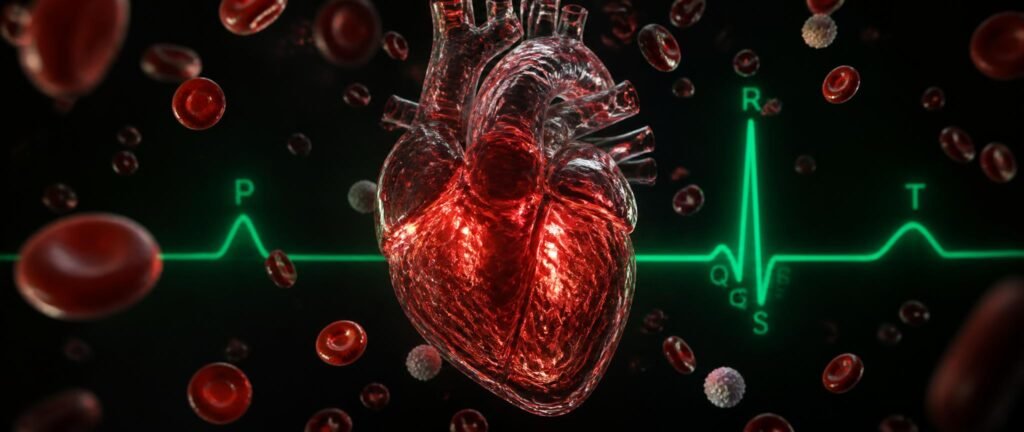
Counting QRS complexes in a given time gives the heart rate. NTA often asks what a wave represents, so learn this table by heart.
Worked PYQ-Pattern Questions
Q1. The QRS complex in an ECG represents: (a) Atrial depolarisation (b) Ventricular depolarisation (c) Ventricular repolarisation (d) Atrial repolarisation
Answer: (b) Ventricular depolarisation.
Q2. The most abundant type of WBC in human blood is:
Answer: Neutrophils, which make up about 60–65% of all WBCs.
Q3. If the stroke volume is 70 mL and the heart rate is 72 per minute, what is the cardiac output?
Answer: 5040 mL per minute, or about 5 litres. Cardiac output = 70 × 72.
Q4. The first heart sound “lub” is caused by:
Answer: Closure of the tricuspid and bicuspid valves at the start of ventricular systole.
Common Traps in This Chapter
- Linking the T wave to depolarisation instead of repolarisation
- Saying “dub” comes from the AV valves (it comes from the semilunar valves)
- Calling AB the universal donor instead of the universal recipient
- Confusing the most abundant WBC (neutrophils) with the least (basophils)
- Forgetting that the SA node, not the AV node, is the pacemaker
Practise Every Body Fluids and Circulation PYQ
This body fluids circulation NEET PYQ analysis gives you the full map. The next step is solving every past question until each type feels routine. All previous year questions from this chapter are available chapter-wise, free:
👉 Solve all Body Fluids and Circulation NEET PYQs
Keep a one-page sheet of every number in this chapter and revise it before each practice set.
Conclusion
This chapter rewards students who learn a small set of numbers and meanings. Use this body fluids circulation NEET PYQ analysis to master the heartbeat timeline, the ECG, blood counts and donor rules. Then practise until you can answer each question in seconds.
❓ FAQ
Q: How many questions come from Body Fluids and Circulation in NEET? A: Usually one to two questions, mostly on heart function, ECG and blood components.
Q: What does the T wave in an ECG represent? A: The T wave represents repolarisation of the ventricles, which means the ventricles are returning to their resting state.
Q: Which blood group is the universal donor? A: Blood group O is the universal donor, and AB is the universal recipient.
Q: What is the most important topic in this chapter for NEET? A: Heart function and ECG are the most tested. A body fluids circulation NEET PYQ analysis shows blood cell counts come next.
Q: Where can I practise Body Fluids and Circulation PYQs for free? A: You can solve every previous year question from this chapter chapter-wise for free using the practice link in this article.