Animal Kingdom looks like a memory-heavy chapter full of strange names. But when you study past papers, a clear pattern appears. This animal kingdom NEET PYQ analysis shows which phylum features and examples NTA returns to every year, so you can stop memorising everything and start memorising what scores.
If you are building your full Biology plan, start with our complete NEET Biology strategy and use this article for chapter-level detail.
Want to test yourself first? Solve the Animal Kingdom PYQs for free, then use this guide to fix the gaps.
Table of Contents
Why Animal Kingdom Is Worth the Effort
NEET usually asks two to three questions from this chapter, which makes it one of the highest-yield chapters in Class 11 Zoology. Most questions come straight from NCERT text and examples.
That means almost no calculation and almost no surprise. If you know the NCERT lines, you get the marks. Check the NEET 2027 chapter weightage to see how it compares with other Biology chapters.
Animal Kingdom NEET PYQ Analysis: The Four Question Types
When you sort a decade of NEET biology PYQs from this chapter, questions fall into four groups.
| Question type | Frequency | What it tests |
|---|---|---|
| Animal examples | Most frequent | Matching animals to phylum or class |
| Unique phylum traits | Very frequent | Unique features like flame cells, cnidoblasts, radula |
| Body plan and coelom | Regular | Basis of classification, germ layers |
| “Odd one out” questions | Regular | Common names that mislead, like jellyfish or silverfish |
NCERT examples dominate. Our Diversity of Living Organisms guide covers the classification logic that sits behind these questions. For a quick warm-up before the full set, try these five quick Animal Kingdom questions.
Basis of Classification: Coelom and Symmetry
This part is small but appears often. Learn it as a table, not as paragraphs. To remember these facts for months, use our method to retain NCERT facts longer.
| Feature | Groups |
|---|---|
| Diploblastic | Cnidaria, Ctenophora |
| Triploblastic | Platyhelminthes onwards |
| Acoelomate | Platyhelminthes |
| Pseudocoelomate | Aschelminthes |
| Coelomate | Annelida, Arthropoda, Mollusca, Echinodermata, Hemichordata, Chordata |
| Metameric segmentation | Annelida, Arthropoda, Chordata |
Echinoderm adults are radially symmetrical, but their larvae are bilaterally symmetrical. NTA likes this detail. Our list of the most repeated NEET topics shows how often classification facts like these come back in Biology papers.
Phylum Features You Must Know
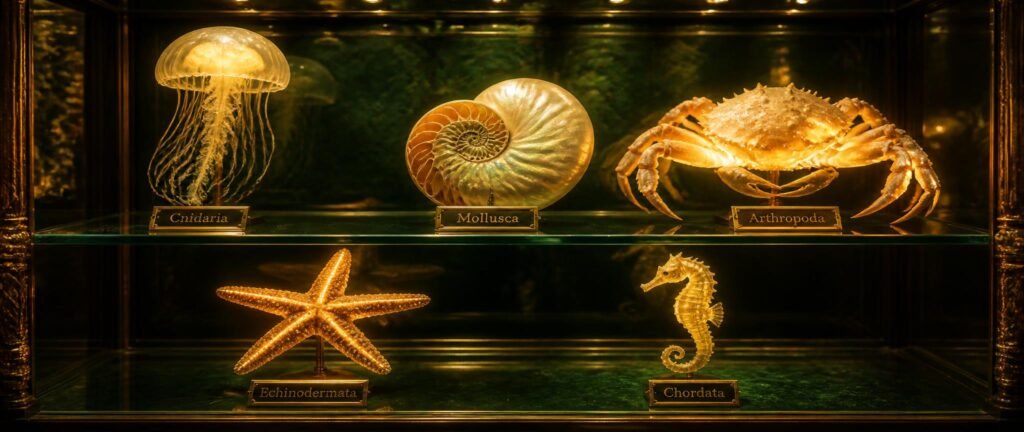
Each phylum has one or two features that make questions easy to answer:
- Porifera: canal system, choanocytes
- Cnidaria: cnidoblasts; metagenesis in Obelia
- Ctenophora: comb plates, bioluminescence
- Platyhelminthes: flame cells for excretion
- Annelida: nephridia; parapodia in Nereis
- Arthropoda: largest phylum; Malpighian tubules
- Mollusca: radula for feeding
- Echinodermata: water vascular system
These phylum features are exactly what “which statement is correct” questions test.
High-Yield NCERT Examples
These examples appear again and again:
- Living fossil: Limulus (king crab)
- Pearl oyster: Pinctada
- Sea hare: Aplysia; devil fish: Octopus
- Sea lily: Antedon; brittle star: Ophiura
- Sawfish: Pristis; electric ray: Torpedo
- Flying fish: Exocoetus; sea horse: Hippocampus
- Limbless amphibian: Ichthyophis
- Egg-laying mammal: Ornithorhynchus (platypus)
Common-name traps also matter. Jellyfish, silverfish, cuttlefish and starfish are not fish.
Worked PYQ-Pattern Questions
Q1. Which of the following is called a living fossil? (a) Pila (b) Limulus (c) Sepia (d) Apis
Answer: (b) Limulus. The king crab has changed very little over millions of years.
Q2. Metagenesis is seen in:
Answer: Obelia. It alternates between the polyp form (asexual) and the medusa form (sexual).
Q3. Flame cells help in excretion in:
Answer: Platyhelminthes, such as Planaria and Fasciola.
Q4. Which animal is pseudocoelomate? (a) Pheretima (b) Ascaris (c) Taenia (d) Hydra
Answer: (b) Ascaris. Aschelminthes have a pseudocoelom. Taenia is acoelomate and Hydra is diploblastic.
Common Traps in This Chapter
- Calling jellyfish, starfish or cuttlefish a true fish
- Saying Taenia has a coelom
- Forgetting that echinoderm larvae are bilateral
- Mixing up Pristis (sawfish) with Trygon (sting ray)
- Confusing cnidoblasts (Cnidaria) with comb plates (Ctenophora)
Practise Every Animal Kingdom PYQ
This animal kingdom NEET PYQ analysis gives you the full map. Practice turns it into speed. Every Animal Kingdom previous year question is available chapter-wise, free:
👉 Solve all Animal Kingdom NEET PYQs
After each set, write every example you missed into a single page of notes. Revise that page weekly.
Conclusion
Animal Kingdom is a direct NCERT chapter, and past papers show that. Use this animal kingdom NEET PYQ analysis to focus on unique phylum traits, body plan and the repeated examples. Then practise until each animal’s name instantly brings up its phylum.
❓ FAQ
Q: How many questions come from Animal Kingdom in NEET? A: Usually two to three questions. That makes it one of the highest-weightage chapters in Class 11 Zoology.
Q: What is the most important topic in Animal Kingdom for NEET? A: Examples from NCERT are the most tested, followed by the unique features of each phylum and the basis of classification.
Q: Is Animal Kingdom only memorisation? A: Mostly, yes, but the memorisation is predictable. An animal kingdom NEET PYQ analysis shows which examples repeat, so you can focus on them first.
Q: Which phylum is the largest in the animal kingdom? A: Arthropoda is the largest phylum. Mollusca is the second largest.
Q: Where can I practise Animal Kingdom NEET PYQs for free? A: You can solve every Animal Kingdom previous year question chapter-wise for free using the practice link in this article.