Human Reproduction is one of the highest-yield chapters in Class 12 Biology. It is detailed, but almost every question is a direct NCERT fact. This human reproduction NEET PYQ analysis shows which stages, hormones and numbers NTA repeats, so you can revise the chapter in the order that scores.
For concept building, pair this with our human reproduction strategy guide. This article focuses on what past papers actually ask.
Want to test yourself first? Solve the Human Reproduction PYQs for free, then use this guide to fix the gaps.
Table of Contents
Why This Chapter Is a Must-Do
NEET usually asks three to four questions from Human Reproduction, which puts it among the top chapters in the whole Biology paper. The questions test sequences, sites and hormones.
Diagrams are tested often: the sperm, the ovary section and the seminiferous tubule. Our guide to memorising NCERT Biology diagrams helps with those. See every Biology unit in our full Biology chapter list.
Human Reproduction NEET PYQ Analysis: The Repeated Question Types
When you sort a decade of NEET biology PYQs from this chapter, five question types cover almost everything.
| Question type | Frequency | What it tests |
|---|---|---|
| Gametogenesis | Most frequent | Stages, ploidy and timing of meiosis |
| Menstrual cycle and hormones | Very frequent | LH surge, ovulation, corpus luteum |
| Fertilisation to implantation | Very frequent | Site, cleavage, morula, blastocyst |
| Reproductive system structures | Regular | Cells and ducts and their functions |
| Pregnancy, placenta and parturition | Regular | Placental hormones, foetal development timeline |
For a quick warm-up before the full set, try these five quick reproduction practice questions.
Reproductive System: Cells and Their Roles
- Sertoli cells nourish developing sperm.
- Leydig (interstitial) cells secrete androgens, mainly testosterone.
- The testes lie in the scrotum, which keeps them 2–2.5°C below body temperature.
- Sperm path: seminiferous tubules → rete testis → vasa efferentia → epididymis → vas deferens.
- The uterus wall has three layers: perimetrium, myometrium and endometrium.
- The fallopian tube has three parts: infundibulum (with fimbriae), ampulla and isthmus.
Spermatogenesis and Oogenesis
| Feature | Spermatogenesis | Oogenesis |
|---|---|---|
| Begins | At puberty | During foetal life |
| Stem cell | Spermatogonium (2n) | Oogonium (2n) |
| After meiosis I | Two secondary spermatocytes (n) | One secondary oocyte (n) and a first polar body |
| Meiosis II completes | Soon after meiosis I | Only when a sperm enters |
| Final products | Four sperm | One ovum and polar bodies |
Key timing facts for oogenesis:
- Primary oocytes are arrested in prophase I before birth.
- The secondary oocyte is arrested in metaphase II and completes meiosis II only at sperm entry.
In males, spermatids change into sperm by spermiogenesis, and sperm are released from the tubule by spermiation. The meiosis stages behind all this are covered in our Cell Cycle PYQ patterns article.
The Menstrual Cycle
| Phase | Days (approx.) | Key events |
|---|---|---|
| Menstrual | 1–5 | Endometrium breaks down |
| Follicular | 6–13 | Follicles grow; oestrogen rises; endometrium regenerates |
| Ovulatory | 14 | LH surge causes ovulation |
| Luteal | 15–28 | Corpus luteum secretes progesterone |
The LH surge in the middle of the menstrual cycle triggers ovulation. If fertilisation does not occur, the corpus luteum degenerates and a new cycle begins. The hormones involved are covered in our Endocrine System PYQ patterns article.
Fertilisation and Implantation
- Fertilisation takes place in the ampulla of the fallopian tube.
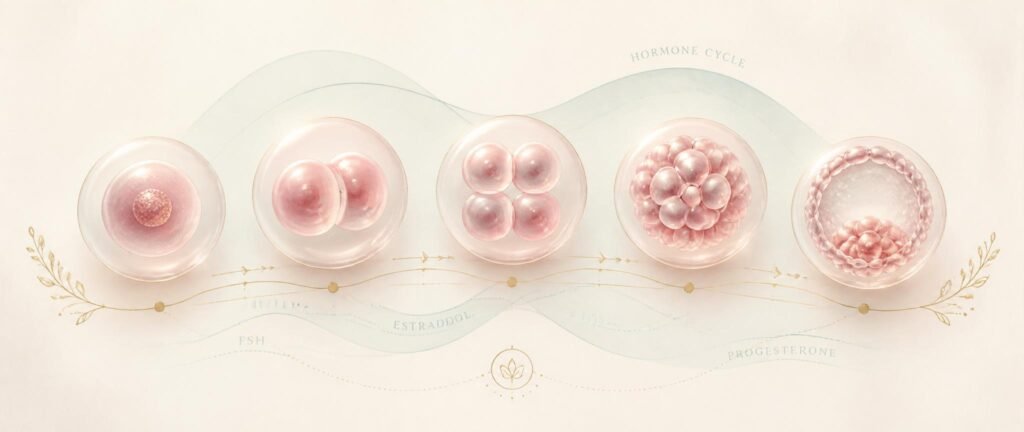
- The zygote divides by cleavage to form a morula of 8–16 blastomeres.
- The morula becomes a blastocyst, with an outer trophoblast and an inner cell mass.
- The blastocyst embeds in the endometrium. This is implantation.
- The inner cell mass forms the embryo.
Pregnancy and Parturition
- The placenta secretes hCG, hPL, oestrogens and progestogens.
- hCG, hPL and relaxin are produced only during pregnancy.
- Foetal milestones: the heart forms after one month; limbs and digits appear by the end of the second month; most major organ systems form by the end of the first trimester; first movements are felt in the fifth month.
- Parturition is triggered by the foetal ejection reflex, which causes oxytocin release.
- Colostrum, the first milk, is rich in antibodies, especially IgA.
Worked PYQ-Pattern Questions
Q1. Where does fertilisation take place in humans?
Answer: In the ampulla of the fallopian tube.
Q2. When does the secondary oocyte complete meiosis II?
Answer: At the time of sperm entry. Until then, it stays arrested in metaphase II.
Q3. Which cells secrete testosterone? (a) Sertoli cells (b) Leydig cells (c) Spermatogonia (d) Spermatids
Answer: (b) Leydig cells, which lie in the spaces between the seminiferous tubules.
Q4. What triggers ovulation?
Answer: The LH surge around the middle of the cycle.
Q5. Which hormone is produced only during pregnancy? (a) Oestrogen (b) Progesterone (c) hCG (d) LH
Answer: (c) hCG. hPL and relaxin are also produced only during pregnancy.
Common Traps in This Chapter
- Swapping Sertoli cells and Leydig cells
- Mixing up the two oocyte arrest stages (prophase I and metaphase II)
- Confusing spermiogenesis with spermiation
- Placing fertilisation in the uterus or the isthmus
- Saying the morula implants (it is the blastocyst)
Practise Every Human Reproduction PYQ
This human reproduction NEET PYQ analysis gives you the sequences and tables. Practice makes them automatic. Every previous year question from this chapter is available chapter-wise, free:
👉 Solve all Human Reproduction NEET PYQs
Write the sequence from spermatogonium to sperm, and from oogonium to ovum, once before each practice set. Sequence questions are the most common in this chapter.
Conclusion
This chapter is about order and timing. Use this human reproduction NEET PYQ analysis to master gametogenesis, the cycle phases, the journey from zygote to blastocyst and the placental hormones. Then practise until each stage brings its site and hormone to mind.
❓ FAQ
Q: How many questions come from Human Reproduction in NEET? A: Usually three to four questions, which makes it one of the highest-weightage chapters in Class 12 Biology.
Q: What is the most important topic in this chapter? A: Gametogenesis is the most tested, followed by the menstrual cycle with its hormones and the events from fertilisation to implantation.
Q: At which stage is the oocyte arrested? A: The primary oocyte is arrested in prophase I before birth. The secondary oocyte is arrested in metaphase II until a sperm enters.
Q: What is the difference between spermiogenesis and spermiation? A: Spermiogenesis is the change of spermatids into sperm. Spermiation is the release of sperm from the seminiferous tubules.
Q: How should I revise this chapter for NEET? A: Use a human reproduction NEET PYQ analysis to list the repeated sequences and facts, learn the NCERT diagrams, and solve past questions chapter-wise.
Q: Where can I practise Human Reproduction NEET PYQs for free? A: You can solve every previous year question from this chapter for free using the practice link in this article.