Cell Cycle and Cell Division is a short chapter, but it produces some of the most predictable questions in NEET Biology. This cell cycle NEET PYQ analysis shows which stages are asked most, how to handle chromosome and DNA counting questions, and where students lose easy marks.
For the full Biology plan, see our complete NEET Biology strategy. This chapter connects directly to cell structure and genetics.
Want to test yourself first? Solve the Cell Cycle and Cell Division PYQs for free, then use this guide to fix the gaps.
Table of Contents
Why This Chapter Is a Scoring Opportunity
NEET usually asks one to two questions from this chapter. The questions test a small set of ideas: stage names, events in each stage, and chromosome or DNA counts.
It also builds on concepts from our cell biology guide and leads into genetics for NEET, where meiosis explains how traits are inherited.
Cell Cycle NEET PYQ Analysis: The Repeated Question Types
When you sort a decade of NEET biology PYQs from this chapter, four question types cover nearly everything.
| Question type | Frequency | What it tests |
|---|---|---|
| Meiosis I prophase | Most frequent | Events in leptotene to diakinesis |
| Stages of mitosis | Very frequent | Events of prophase, metaphase, anaphase, telophase |
| Chromosome and DNA counts | Very frequent | Changes across G1, S, G2 and division |
| Interphase and G0 | Regular | Phases, duration, quiescent stage |
Meiosis prophase I leads every year. Our list of the most repeated NEET topics shows it is one of the most asked areas in Class 11 Biology. For a quick warm-up before the full set, try these five quick cell division questions.
Interphase: Where Most of the Cycle Happens
Interphase takes up more than 95% of the cell cycle. It has three phases:
- G1: cell grows, no DNA replication
- S: DNA replicates; DNA content doubles from 2C to 4C, but chromosome number stays the same
- G2: proteins are made for mitosis
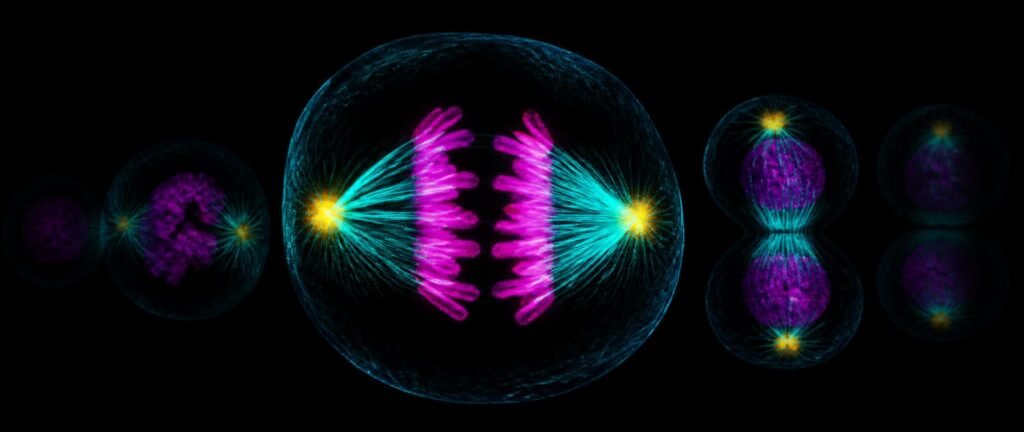
Cells that stop dividing enter G0, the quiescent stage. A typical human cell cycle takes about 24 hours, and the M phase takes only about an hour of that.
Mitosis Stages
| Stage | Key events |
|---|---|
| Prophase | Chromatin condenses; nucleolus, Golgi, ER and nuclear envelope disappear |
| Metaphase | Chromosomes line up at the metaphase plate; best stage to study chromosome shape |
| Anaphase | Centromeres split; sister chromatids move to opposite poles |
| Telophase | Nuclear envelope and nucleolus reappear |
In animal cells, cytokinesis happens by a furrow. In plant cells, a cell plate forms in the centre and grows outward. To get these stages right in diagram questions, use our guide to memorising NCERT Biology diagrams.
Meiosis Prophase I: The Five Sub-Stages
| Sub-stage | Key event |
|---|---|
| Leptotene | Chromosomes become visible |
| Zygotene | Synapsis; synaptonemal complex forms; bivalents appear |
| Pachytene | Exchange of segments between homologues; recombination nodules appear |
| Diplotene | Synaptonemal complex dissolves; chiasmata become visible |
| Diakinesis | Terminalisation of chiasmata; nuclear envelope breaks down |
Crossing over happens in pachytene and is catalysed by the enzyme recombinase. NCERT also notes that diplotene can last for months or years in the oocytes of some vertebrates.
In anaphase I, homologous chromosomes separate, but sister chromatids stay together. That is why meiosis I is called the reductional division.
Worked PYQ-Pattern Questions
Q1. Crossing over takes place during: (a) Leptotene (b) Zygotene (c) Pachytene (d) Diplotene
Answer: (c) Pachytene. Recombination nodules appear here.
Q2. The synaptonemal complex is formed during:
Answer: Zygotene, when homologous chromosomes pair up.
Q3. A cell has 16 chromosomes in G1. How many chromosomes does it have in G2?
Answer: 16. DNA content doubles in the S phase, but the chromosome number does not change.
Q4. The best stage to study the shape of chromosomes is:
Answer: Metaphase, when chromosomes are most condensed and lined up at the plate.
Common Traps in This Chapter
- Doubling the chromosome number after the S phase
- Placing recombination in zygotene instead of pachytene
- Saying sister chromatids separate in anaphase I
- Confusing chiasmata (diplotene) with the synaptonemal complex (zygotene)
- Forgetting that plant cells form a cell plate, not a furrow
Practise Every Cell Cycle PYQ
This cell cycle NEET PYQ analysis gives you the stage-by-stage map. Practice makes it quick. Every previous year question from this chapter is available chapter-wise, free:
👉 Solve all Cell Cycle and Cell Division NEET PYQs
Before each set, write the five prophase I sub-stages from memory. It takes 30 seconds and saves marks.
Conclusion
This chapter rewards students who know the stages cold. Use this cell cycle NEET PYQ analysis to master prophase I of meiosis, the stages of mitosis and chromosome counting. Then practise until every stage name instantly brings up its event.
❓ FAQ
Q: How many questions come from Cell Cycle and Cell Division in NEET? A: Usually one to two questions. They are mostly direct NCERT-based questions on stages and events.
Q: What is the most important topic in this chapter for NEET? A: The first prophase of meiosis is the most tested, especially the events of zygotene, pachytene and diplotene.
Q: Does the chromosome number double in the S phase? A: No. DNA content doubles in the S phase, but the chromosome number stays the same.
Q: In which stage does recombination between homologues occur? A: It occurs in the pachytene stage of prophase I. A cell cycle NEET PYQ analysis shows this is one of the most repeated facts.
Q: Where can I practise Cell Cycle NEET PYQs for free? A: You can solve every Cell Cycle and Cell Division previous year question chapter-wise for free using the practice link in this article.