If there’s one unit that can single-handedly lift your Biology score, it’s human physiology. Biology makes up half the NEET paper, and human physiology is among its highest-weightage units — meaning a strong grip here banks a large, reliable chunk of marks every single year. The challenge is that human physiology for NEET 2027 is detail-dense: pathways, hormones, diagrams, and mechanisms that blur together if you only mug them. The fix is a method built on understanding and visuals, not rote memory. Start by knowing your target through the NEET 2027 syllabus weightage, and if you’re still planning your prep, this guide on when to start NEET 2027 sets the timeline right.
Table of Contents
Why Human Physiology Matters So Much
Biology carries 90 questions and 360 marks in NEET — fully half of the total. Within it, the physiology chapters consistently contribute several questions, making this unit one of the best returns on your study time. Skip it and you’re conceding marks you could almost certainly have scored.
These chapters sit in the Class 11 syllabus, so a solid Class 11 foundation is non-negotiable. Students who treat Class 11 as “old material” and rush past physiology pay for it in the final score.
The Chapters You Must Master
Human physiology in NCERT covers a tight, predictable set of chapters:
- Digestion and Absorption
- Breathing and Exchange of Gases
- Body Fluids and Circulation
- Excretory Products and their Elimination
- Locomotion and Movement
- Neural Control and Coordination
- Chemical Coordination and Integration
Each is heavily NCERT-based, so resist the urge to over-complicate it. Understanding NCERT vs reference books keeps you anchored to the text that actually sets these questions, instead of getting lost in thick guides.
How to Study Human Physiology for NEET 2027 the Right Way
Physiology rewards understanding processes, not memorising isolated facts. Build your study around these habits:
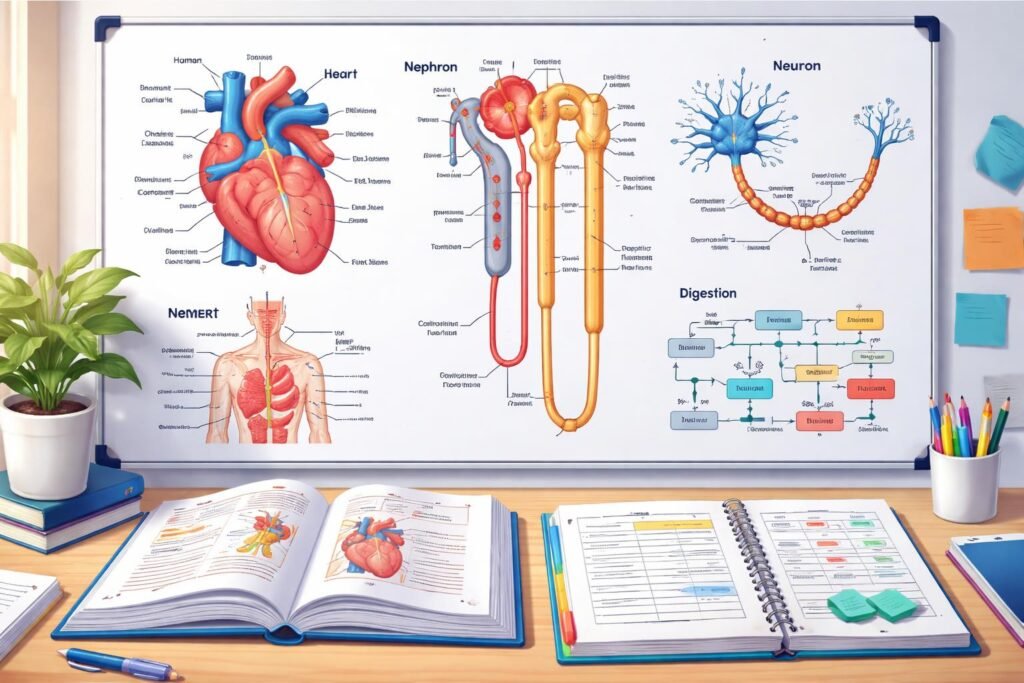
- Learn mechanisms as flowcharts. Map digestion, the cardiac cycle, the nephron’s filtration, and nerve impulse transmission as step-by-step flows — your brain remembers sequences better than paragraphs.
- Master every diagram. The heart, nephron, neuron, brain, and joints are recurring favourites. Practise drawing and labelling them from memory.
- Build hormone tables. For chemical coordination, a single table of gland, hormone, and function saves hours and prevents confusion.
- Compare systems side by side. Contrasts — like different types of joints or transport mechanisms — stick far better than separate lists.
Fold a fixed physiology slot into your daily routine for NEET 2027 so this large unit gets steady attention rather than a last-minute scramble.



Revise With Diagrams and Flowcharts
Physiology fades fast without review — there’s simply too much detail to hold passively. Revise using diagram-based recall: cover the labels and redraw them, rebuild flowcharts from a blank page, and quiz yourself on hormone functions. Tie this into disciplined NCERT revision for NEET 2027 on a spaced schedule, so each pass takes less time than the last and the details finally stick.
Practice and Test Relentlessly
Physiology is a previous-year goldmine — patterns repeat, and assertion-reason and diagram-based questions appear often. Solve plenty of PYQs, then move to full-length mocks. A consistent NEET 2027 mock test strategy exposes the small confusions — a misread pathway, a swapped hormone — that quietly cost marks, and lets you fix them well before exam day.
Common Mistakes to Avoid
- Memorising processes without understanding the underlying mechanism
- Skipping diagrams or never practising them from memory
- Ignoring small NCERT lines that turn into direct questions
- Leaving hormones and pathways unrevised until the end
- Studying the theory but neglecting previous-year questions
Final Thoughts
Mastering human physiology for NEET 2027 is one of the highest-leverage moves in your entire Biology preparation. Lean on NCERT, convert mechanisms into flowcharts and diagrams, build hormone tables, and revise visually on a spaced schedule. Do that consistently, and this dense, intimidating unit becomes one of your most dependable sources of marks. Start mapping those pathways today — your future score will thank you.
FAQ Section
Q: Is human physiology important for NEET 2027? A: Very. It’s one of the highest-weightage units in Biology, and Biology makes up half the NEET paper, so strong physiology preparation banks a large chunk of marks.
Q: Which chapters come under human physiology in NEET? A: Digestion and Absorption, Breathing and Exchange of Gases, Body Fluids and Circulation, Excretory Products, Locomotion and Movement, Neural Control and Coordination, and Chemical Coordination — all from Class 11.
Q: Is NCERT enough for human physiology in NEET? A: Largely yes. Most physiology questions are based on NCERT lines and diagrams. Read it thoroughly and supplement with previous-year questions rather than many reference books.
Q: How do I memorise physiology for NEET 2027? A: Understand the mechanisms, convert pathways into flowcharts, master diagrams from memory, build hormone tables, and revise on a spaced schedule.
Q: How much weightage does physiology carry in NEET? A: It’s among the highest in Biology, with several questions typically drawn from these chapters each year, making it a high-return unit.
Q: How can I revise human physiology quickly? A: Use diagram-based recall, redraw flowcharts of key pathways from memory, and quiz yourself on hormone functions using a single summary table.
[…] the full physiology plan, see our complete Human Physiology guide. This chapter is one of its most reliable […]
[…] the full physiology plan, see our complete Human Physiology guide. This article gives you the chapter-level […]
[…] the full physiology plan, see our complete Human Physiology guide. This article gives you the chapter-level […]