
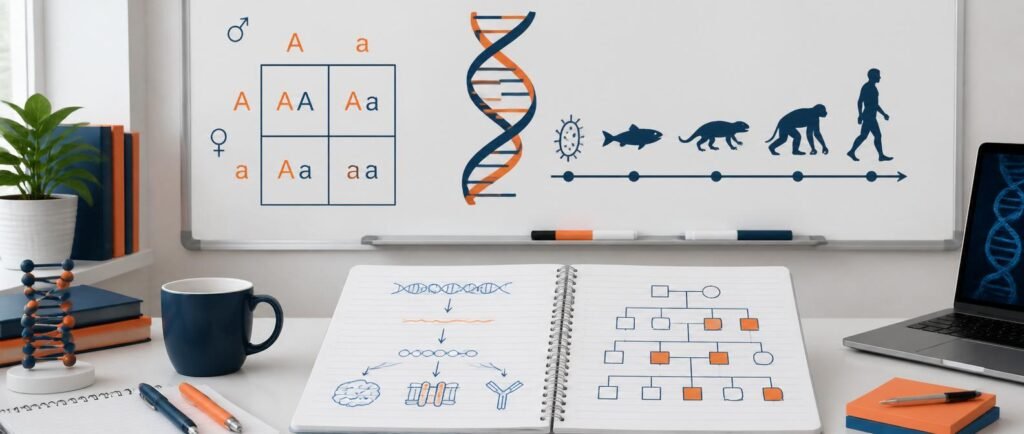
Genetics and Evolution is one of the most rewarding units in NEET Biology — and one of the most feared. The inheritance problems feel like maths, the molecular biology looks like a chemistry lab, and evolution seems like a history chapter with no structure. But here’s the reality: genetics for NEET 2027 is predictable. The same concepts appear year after year in different clothes, and students who understand the logic rather than cramming the outcomes score consistently well. This guide breaks the unit into three manageable sections and gives each a specific strategy. Start by anchoring your effort to the NEET 2027 syllabus weightage, then decide your prep timeline through this guide on when to start NEET 2027.
Table of Contents
Why Genetics Matters So Much for NEET 2027
Biology is 360 of the 720 marks on NEET, and Genetics & Evolution is among its highest-scoring Class 12 units. Several questions appear from this unit every single year — from straightforward Punnett squares to assertion-reason on DNA replication and theory-based evolution questions. Treat this as one of your non-negotiable strong points.
NCERT is the authority here. Most questions trace directly to its lines, diagrams, and tables, so resist piling on reference books you’ll never finish. Understanding what NCERT vs reference books actually gives you keeps this large unit from becoming unmanageable.
The Chapters You Need to Cover
Three chapters form the complete unit:
- Principles of Inheritance and Variation — Mendel’s laws, dominance, codominance, incomplete dominance, multiple alleles, chromosomal theory, sex determination, linkage, mutation, and pedigree analysis
- Molecular Basis of Inheritance — DNA structure, replication, transcription, translation, gene regulation (lac operon), Human Genome Project, and DNA fingerprinting
- Evolution — Origin of life, Darwinism, Neo-Darwinism, Hardy-Weinberg principle, adaptive radiation, speciation
Cover them in this order. Genetics builds a logic you need before molecular biology makes full sense, and evolution is best tackled once the molecular chapter is solid. Slot regular genetics study into your daily routine for NEET 2027 so the detail accumulates steadily instead of being crammed.
Mendelian Genetics for NEET 2027: Crosses Made Simple
Inheritance problems scare students who treat them as calculations. They aren’t — they’re logic puzzles with a small set of rules. Master the rules, and any cross becomes solvable.
Build your foundation in this order: understand the Law of Segregation, then Independent Assortment, then work through all cross types — monohybrid, dihybrid, test cross, back cross. For each, solve using a Punnett square until the ratios are automatic. Then layer on sex-linked inheritance, codominance, and incomplete dominance.
Pedigree analysis is predictable: practice reading autosomal dominant, autosomal recessive, and X-linked patterns until you can identify them in seconds. This is an area where previous-year questions are almost a complete syllabus in themselves, making it one of the best places for repeaters to boost their NEET 2027 score without learning new material.



Cracking the Molecular Basis of Inheritance
This chapter intimidates students who try to memorise processes out of sequence. The trick is to map each process as a step-by-step flow before anything else.
Build three clean process maps: DNA replication (enzymes, direction, leading vs lagging strand), transcription (template strand, RNA polymerase, mRNA), and translation (ribosomes, codons, tRNA, polypeptide chain). Understand each step before adding detail. The lac operon appears often in assertion-reason format — understand induction and repression as a concept, not as a set of statements to mug.
DNA fingerprinting, the Human Genome Project, and key experiments (Griffith, Hershey-Chase, Meselson-Stahl) are NCERT-direct and factual. Revise these as a tight list. Pair all of this with regular NCERT revision for NEET 2027 — the molecular chapter rewards frequent short passes far more than one long reread.
Evolution: Lean, Targeted, and Still Scoring
Evolution has fewer questions than the other two chapters, but they’re largely free marks if you prepare the right things. Focus here:
- The sequence of origin of life theories (chemical evolution, Oparin-Haldane, Miller-Urey experiment)
- Darwin’s theory and natural selection; Lamarckism vs Darwinism
- Hardy-Weinberg principle — understand when equilibrium holds, the five disturbing factors, and how allele frequencies shift; numerical questions appear here
- Adaptive radiation and speciation: the classic examples (Darwin’s finches, marsupials) and the difference between allopatric and sympatric speciation
Keep a single NCERT-based summary page for evolution. Test yourself on these with PYQs and under timed conditions using a disciplined NEET 2027 mock test strategy to ensure theory you know on the page translates into marks you score in the exam.
Common Mistakes to Avoid
- Skipping cross practice because the theory “makes sense” — it must feel automatic under pressure
- Treating molecular biology as a reading chapter without process maps or diagrams
- Leaving Hardy-Weinberg calculations unpractised
- Memorising pedigree outcomes instead of reading the logic of each pattern
- Not covering key experiments, which appear as direct or assertion-reason questions
Final Thoughts
Genetics for NEET 2027 rewards students who invest in understanding over those who rush to memorise. Build your Mendelian logic, map your molecular processes, and target the predictable corners of evolution. Each pass you make — crosses, diagrams, PYQs — converts confusion into confidence. This unit has given consistent marks to well-prepared students for years. Make sure you’re one of them.
FAQ Section
Q: Is genetics important for NEET 2027? A: Very. Genetics and Evolution is consistently one of the highest-scoring Class 12 Biology units, with questions appearing every year from all three chapters.
Q: Which chapters are covered in genetics for NEET? A: Principles of Inheritance and Variation, Molecular Basis of Inheritance, and Evolution — all from Class 12 NCERT Biology.
Q: How do I solve genetics crosses for NEET? A: Understand Mendel’s Laws first, then practise all cross types using Punnett squares until the ratios are automatic. Pedigree analysis follows the same logical framework.
Q: Is evolution important for NEET 2027? A: Yes. Hardy-Weinberg, Darwin’s theory, adaptive radiation, and speciation questions appear regularly and are largely free marks with targeted preparation.
Q: Is NCERT enough for genetics in NEET? A: Yes. Stick closely to NCERT — most questions trace directly to its lines, diagrams, and key experiments. Supplement with previous-year questions rather than extra books.
Q: How should I study the Molecular Basis of Inheritance? A: Map replication, transcription, and translation as step-by-step process flows with diagrams. Understand the lac operon as a concept, and cover key experiments as a factual list.
[…] human physiology chapters goes chapter by chapter. For the genetics block, this breakdown of inheritance and molecular genetics covers the concepts that keep […]
[…] also builds on concepts from our cell biology guide and leads into genetics for NEET, where meiosis explains how traits are […]
[…] concept building, pair this with our genetics preparation strategy guide, and see where the chapter fits in the plan to score 360 in Biology. This article focuses on what […]