
Most NEET aspirants make the same mistake: they treat every chapter equally and try to cover everything at the same pace. That is a losing strategy for a 720-mark exam with about 80 chapters across three subjects.
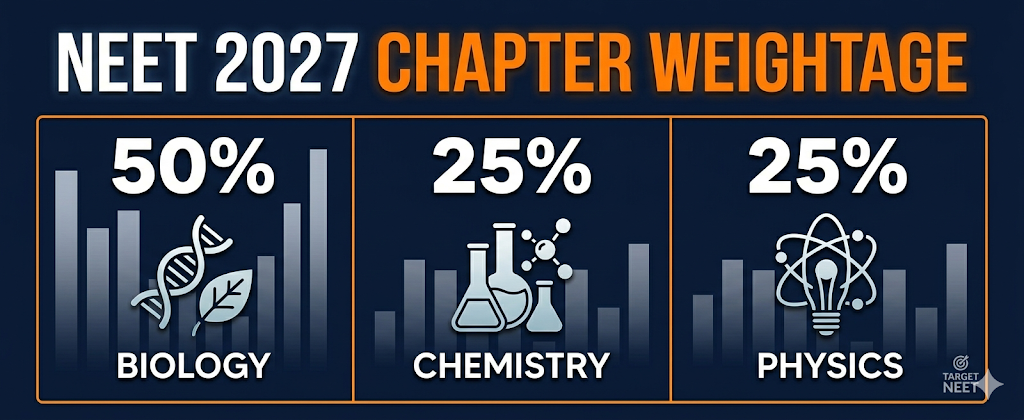
Understanding the NEET 2027 syllabus chapter weightage is the most useful thing you can do before building your study plan. When you know which chapters give the most questions year after year, you stop spending time on low-yield topics and put it where the marks are.
This NEET 2027 syllabus chapter weightage guide gives the full chapter list for Physics, Chemistry and Biology as per the current NMC syllabus, the average number of questions each chapter has produced in recent papers, a priority tag, and a free PYQ practice link for every chapter.
In short:
- Syllabus status: the official NEET 2027 syllabus has not been released yet. Prepare from the current NMC syllabus, which was left unchanged for NEET 2026.
- Pattern: 180 questions, 720 marks. Biology is 360 marks; Physics and Chemistry are 180 each.
- Highest-weightage chapters: Molecular Basis of Inheritance, Principles of Inheritance, Sexual Reproduction in Flowering Plants, Current Electricity and Equilibrium.
- Rule of thumb: about 30 chapters produce close to 60% of the paper.
Want to see the weightage for yourself? Solve chapter-wise NEET previous year questions from the heaviest chapter first, free, and notice how often the same ideas return.
Table of Contents
NEET 2027 Syllabus: What Is Official Right Now
The NEET syllabus is set by the National Medical Commission (NMC), and NTA conducts the exam on that basis. The NMC syllabus for NEET 2026 was released in December 2025 with no changes from the previous year.
No separate notification for 2027 has been issued so far. Until one is, the current NMC syllabus is the only reliable reference, and every table below follows it. We track the possibilities in our note on NEET 2027 syllabus changes, and you can check the list of deleted topics so you do not study what has been removed.
If you want the syllabus topic by topic, without weightage, use our chapter-wise syllabus breakdown.
NEET 2027 Exam Pattern: Marks Distribution
| Subject | Questions | Maximum marks | Share of paper |
|---|---|---|---|
| Physics | 45 | 180 | 25% |
| Chemistry | 45 | 180 | 25% |
| Biology (Botany + Zoology) | 90 | 360 | 50% |
| Total | 180 | 720 | 100% |
Each correct answer carries 4 marks, and each wrong answer costs 1 mark. All 180 questions are compulsory, and the duration is 3 hours.


How to Read the Chapter Wise Weightage Tables
- Average questions is the typical number asked from that chapter in recent NEET papers. It is a trend from PYQ analysis, not an official figure, and it shifts by a question or so each year.
- Priority combines the question count with how predictable the chapter is.
- Every chapter name is a link to its previous year questions, so you can check the trend yourself and practise in the same sitting.
For subject-level planning, see our guides to the important NEET Biology chapters, the important NEET Chemistry topics and the important NEET Physics chapters.
NEET 2027 Biology Chapter Weightage
Biology is the most scoring and most predictable subject. Questions are overwhelmingly NCERT-based, so the textbook is non-negotiable; our comparison of NCERT and reference books explains how to use it. The NMC syllabus has 10 Biology units, which map to 32 NCERT chapters.
Class 11 Biology
| Chapter (click to practise PYQs) | Average questions | Priority |
|---|---|---|
| The Living World | 1 | 🟡 Medium |
| Biological Classification | 2–3 | 🟠 High |
| Plant Kingdom | 2–3 | 🟠 High |
| Animal Kingdom | 3–4 | 🔴 Very High |
| Morphology of Flowering Plants | 2–3 | 🟠 High |
| Anatomy of Flowering Plants | 2 | 🟠 High |
| Structural Organisation in Animals | 1–2 | 🟡 Medium |
| Cell: The Unit of Life | 3 | 🔴 Very High |
| Biomolecules | 3–4 | 🔴 Very High |
| Cell Cycle and Cell Division | 2–3 | 🟠 High |
| Photosynthesis in Higher Plants | 2–3 | 🟠 High |
| Respiration in Plants | 2 | 🟠 High |
| Plant Growth and Development | 2 | 🟠 High |
| Breathing and Exchange of Gases | 2 | 🟠 High |
| Body Fluids and Circulation | 2–3 | 🟠 High |
| Excretory Products and their Elimination | 2 | 🟠 High |
| Locomotion and Movement | 2 | 🟠 High |
| Neural Control and Coordination | 2 | 🟠 High |
| Chemical Coordination and Integration | 3 | 🔴 Very High |
Class 12 Biology
| Chapter (click to practise PYQs) | Average questions | Priority |
|---|---|---|
| Sexual Reproduction in Flowering Plants | 4 | 🔴 Very High |
| Human Reproduction | 3–4 | 🔴 Very High |
| Reproductive Health | 2–3 | 🟠 High |
| Principles of Inheritance and Variation | 4–5 | 🔴 Very High |
| Molecular Basis of Inheritance | 5–7 | 🔴 Very High |
| Evolution | 2–3 | 🟠 High |
| Human Health and Disease | 3 | 🔴 Very High |
| Microbes in Human Welfare | 2 | 🟠 High |
| Biotechnology: Principles and Processes | 3 | 🔴 Very High |
| Biotechnology and its Applications | 2–3 | 🟠 High |
| Organisms and Populations | 3 | 🔴 Very High |
| Ecosystem | 2 | 🟠 High |
| Biodiversity and Conservation | 2–3 | 🟠 High |
Biology Weightage by Unit
| Unit | Approximate questions | Share of Biology |
|---|---|---|
| Genetics and Evolution | 12–15 | About 15% |
| Human Physiology | 13–15 | About 15% |
| Reproduction | 9–11 | About 11% |
| Cell Structure and Function | 8–10 | About 10% |
| Diversity in Living World | 8–10 | About 10% |
| Ecology | 7–8 | About 8% |
| Plant Physiology | 6–7 | About 7% |
| Biotechnology | 5–6 | About 6% |
| Structural Organisation | 5–7 | About 7% |
| Biology and Human Welfare | 5 | About 6% |
Biology in one line: Genetics, Human Physiology and Reproduction together give close to 40 of the 90 questions. Finish these three units first.
NEET 2027 Chemistry Chapter Weightage
The chapter wise weightage in Chemistry is flatter than in Biology. There are 45 questions, spread fairly evenly across Physical, Inorganic and Organic Chemistry. The current syllabus has 20 units. One of them, Principles Related to Practical Chemistry, has no separate NCERT chapter and usually gives 1–2 questions.
Physical Chemistry
| Chapter (click to practise PYQs) | Average questions | Priority |
|---|---|---|
| Some Basic Concepts of Chemistry | 1–2 | 🟠 High |
| Structure of Atom | 1–2 | 🟠 High |
| Thermodynamics | 2 | 🔴 Very High |
| Equilibrium | 2–3 | 🔴 Very High |
| Redox Reactions | 1 | 🟡 Medium |
| Solutions | 2 | 🔴 Very High |
| Electrochemistry | 2 | 🔴 Very High |
| Chemical Kinetics | 2 | 🟠 High |
Inorganic Chemistry
| Chapter (click to practise PYQs) | Average questions | Priority |
|---|---|---|
| Classification of Elements and Periodicity | 1–2 | 🟠 High |
| Chemical Bonding and Molecular Structure | 2–3 | 🔴 Very High |
| The p-Block Elements | 2–3 | 🔴 Very High |
| The d- and f-Block Elements | 2–3 | 🔴 Very High |
| Coordination Compounds | 2–3 | 🔴 Very High |
Organic Chemistry
| Chapter (click to practise PYQs) | Average questions | Priority |
|---|---|---|
| Organic Chemistry: Basic Principles and Techniques (GOC) | 2–3 | 🔴 Very High |
| Hydrocarbons | 2–3 | 🔴 Very High |
| Haloalkanes and Haloarenes | 1–2 | 🟠 High |
| Alcohols, Phenols and Ethers | 2 | 🟠 High |
| Aldehydes, Ketones and Carboxylic Acids | 2–3 | 🔴 Very High |
| Amines | 1–2 | 🟠 High |
| Biomolecules | 1–2 | 🟠 High |
Chemistry in one line: Physical Chemistry needs calculation practice, Organic needs mechanism-based reasoning, and Inorganic is NCERT line by line. Treat each branch differently.
NEET 2027 Physics Chapter Weightage
Physics decides rank more than any other subject, because scores vary the most here. Its chapter wise weightage leans slightly towards Class 12. The current syllabus has 20 units. One of them, Experimental Skills, usually gives 1–2 questions.
Class 11 Physics
| Chapter (click to practise PYQs) | Average questions | Priority |
|---|---|---|
| Units and Measurements | 1 | 🟡 Medium |
| Motion in a Straight Line | 1 | 🟡 Medium |
| Motion in a Plane | 1–2 | 🟠 High |
| Laws of Motion | 2 | 🔴 Very High |
| Work, Energy and Power | 1–2 | 🟠 High |
| System of Particles and Rotational Motion | 2–3 | 🔴 Very High |
| Gravitation | 1–2 | 🟠 High |
| Mechanical Properties of Solids | 1 | 🟡 Medium |
| Mechanical Properties of Fluids | 1–2 | 🟠 High |
| Thermal Properties of Matter | 1 | 🟡 Medium |
| Thermodynamics | 2 | 🔴 Very High |
| Kinetic Theory | 1 | 🟡 Medium |
| Oscillations | 1–2 | 🟠 High |
| Waves | 1 | 🟡 Medium |
Class 12 Physics
| Chapter (click to practise PYQs) | Average questions | Priority |
|---|---|---|
| Electric Charges and Fields | 1–2 | 🟠 High |
| Electrostatic Potential and Capacitance | 2 | 🔴 Very High |
| Current Electricity | 3–4 | 🔴 Very High |
| Moving Charges and Magnetism | 2–3 | 🔴 Very High |
| Magnetism and Matter | 1 | 🟡 Medium |
| Electromagnetic Induction | 1–2 | 🟠 High |
| Alternating Current | 1–2 | 🟠 High |
| Electromagnetic Waves | 1 | 🟡 Medium |
| Ray Optics and Optical Instruments | 2–3 | 🔴 Very High |
| Wave Optics | 1–2 | 🟠 High |
| Dual Nature of Radiation and Matter | 1–2 | 🟠 High |
| Atoms | 1 | 🟡 Medium |
| Nuclei | 1–2 | 🟠 High |
| Semiconductor Electronics | 2–3 | 🔴 Very High |
Physics in one line: Class 12 gives slightly more than half the paper. Current Electricity, Ray Optics, Semiconductors and Moving Charges alone can account for 9–12 questions.
Top 15 High-Weightage Chapters for NEET 2027
If you want a single list of the NEET 2027 important chapters, this is it. Together these 15 give roughly 45–55 questions.
| Rank | Chapter | Subject | Average questions |
|---|---|---|---|
| 1 | Molecular Basis of Inheritance | Biology | 5–7 |
| 2 | Principles of Inheritance and Variation | Biology | 4–5 |
| 3 | Sexual Reproduction in Flowering Plants | Biology | 4 |
| 4 | Human Reproduction | Biology | 3–4 |
| 5 | Animal Kingdom | Biology | 3–4 |
| 6 | Biomolecules | Biology | 3–4 |
| 7 | Current Electricity | Physics | 3–4 |
| 8 | Cell: The Unit of Life | Biology | 3 |
| 9 | Human Health and Disease | Biology | 3 |
| 10 | Biotechnology: Principles and Processes | Biology | 3 |
| 11 | Organisms and Populations | Biology | 3 |
| 12 | Equilibrium | Chemistry | 2–3 |
| 13 | Coordination Compounds | Chemistry | 2–3 |
| 14 | Ray Optics and Optical Instruments | Physics | 2–3 |
| 15 | System of Particles and Rotational Motion | Physics | 2–3 |
Class 11 vs Class 12 Weightage
| Subject | Class 11 share | Class 12 share |
|---|---|---|
| Physics | About 45% | About 55% |
| Chemistry | About 45% | About 55% |
| Biology | About 50% | About 50% |
The split is close to even, so neither year can be skipped. Droppers often over-revise Class 12 and lose easy Class 11 marks in Biology.
Chapters Not in the Current Syllabus
Do not spend time on these unless a new notification brings them back:
- Biology: Transport in Plants, Mineral Nutrition, Digestion and Absorption, Reproduction in Organisms, Strategies for Enhancement in Food Production, Environmental Issues
- Chemistry: States of Matter, Hydrogen, s-Block Elements, Environmental Chemistry, Solid State, Surface Chemistry, Metallurgy, Polymers, Chemistry in Everyday Life
- Physics: no full chapters removed, but topics such as heat engines, the Carnot cycle and Earth’s magnetism are out
How to Use the NEET 2027 Syllabus Chapter Weightage
Knowing the weightage is step one. Using it well is what separates planned preparation from random preparation.
Step 1: Sort Your Chapters Into Three Buckets
- Must-master (🔴 Very High): cover these first, revise them most often, and never leave them incomplete.
- Should-cover (🟠 High): cover after the must-masters and revise at least twice.
- Cover once (🟡 Medium): study once and revise briefly. They are still in the exam, so do not skip them.
Step 2: Give High-Weightage Chapters 60–70% of Your Time
This is not about ignoring small chapters. It is about not giving equal time to a chapter worth one question and a chapter worth six.
Step 3: Use PYQs as Your Weightage Compass
Previous year questions are the most accurate guide to the high-weightage chapters. Solving them chapter-wise shows you what is asked and how it is asked. All chapters are sorted by subject here:
👉 Practise NEET PYQs chapter-wise
Step 4: Revise by Weightage
A chapter such as Molecular Basis of Inheritance or Current Electricity needs three to four revision rounds. A chapter such as Kinetic Theory can be reviewed once closer to the exam.
Quick Summary Table
| Subject | Marks | Top 3 chapters by weightage |
|---|---|---|
| Biology | 360 | Molecular Basis of Inheritance, Principles of Inheritance, Sexual Reproduction in Flowering Plants |
| Chemistry | 180 | Equilibrium, Coordination Compounds, Chemical Bonding |
| Physics | 180 | Current Electricity, Ray Optics, Rotational Motion |
The Bottom Line
The NEET 2027 syllabus chapter weightage data is clear: a small set of chapters carries a large share of the paper. Students who identify the NEET 2027 important chapters early, and build their plan around them, have a structural advantage over those who study everything equally.
Use the tables to decide the order, the PYQ links to test each chapter, and the official NMC syllabus as the final word once the 2027 notification is out.
FAQ
Q: What is the chapter wise weightage for Biology in NEET 2027?
A: Biology has 90 questions worth 360 marks. Molecular Basis of Inheritance (5–7 questions), Principles of Inheritance (4–5), Sexual Reproduction in Flowering Plants (4) and Human Reproduction (3–4) are the heaviest chapters.
Q: Which Physics chapters have the highest weightage in NEET 2027?
A: Based on PYQ trends, Current Electricity, Ray Optics, Semiconductor Electronics, Moving Charges and Magnetism, Rotational Motion and Laws of Motion give the most questions.
Q: Which Chemistry chapters are most important for NEET 2027?
A: Equilibrium, Chemical Bonding, Coordination Compounds, p-Block, d- and f-Block, GOC, Hydrocarbons and Aldehydes, Ketones and Carboxylic Acids are the most frequently tested.
Q: Has the NEET 2027 syllabus been released?
A: Not yet. Until an official notification is published, prepare from the current NMC syllabus, which was unchanged for NEET 2026.
Q: Is the NEET 2027 syllabus chapter weightage final?
A: No. The NEET 2027 syllabus chapter weightage shown here is a trend from past papers, not an official figure. It varies by a question or so per chapter each year, but the list of heavy chapters stays largely the same. Use weightage to set priorities, not to skip chapters.
Q: How many chapters are there in the NEET 2027 syllabus?
A: Going by the current syllabus, there are about 80 NCERT chapters: 28 in Physics, 20 in Chemistry and 32 in Biology, plus one practical-skills unit each in Physics and Chemistry.
Motivation
[…] what PYQs show you with the chapter-wise weightage for NEET 2027, and you’ll know exactly where your hours should […]
[…] focused sessions, and the questions rarely have tricks you cannot predict. Compare that with the NEET 2027 chapter weightage of heavier units, and the return on time is hard to […]
[…] repeated NEET topics, especially questions on the variation of g and satellite motion. Check the NEET 2027 chapter weightage to see how it compares with other Class 11 […]
[…] you want the full chapter weightage first, see our NEET 2027 chapter weightage guide. This article focuses only on what may or may not change. To keep practising while you wait, […]
[…] NEET usually asks two to three questions from Morphology of Flowering Plants. Most are “match the term with the example” questions taken straight from NCERT. To see how Botany chapters compare, check the NEET 2027 chapter weightage. […]
[…] a weak base here quietly costs marks across Physical Chemistry. See where the chapter sits in the NEET 2027 chapter weightage, and find every Chemistry unit in our full Chemistry chapter […]
[…] where the unit sits in the NEET 2027 chapter weightage, and see every Physics unit with its PYQs in our full Physics chapter […]
[…] Thermodynamics also appears in Chemistry, and our thermodynamics overlap explained guide shows how to prepare both at once. See where these chapters sit in the NEET 2027 chapter weightage. […]
[…] and Electrochemistry”. See every unit in our full Chemistry chapter list, and check the NEET 2027 chapter weightage for its share of the […]
[…] these two chapters together. That makes the unit one of the heaviest in Class 12 Physics, as the NEET 2027 chapter weightage breakdown […]
[…] syllabus is set by the NMC and is expected to follow the current one. Our breakdown of NEET 2027 syllabus weightage shows which chapters give the most […]
[…] way to bring Class 11 back: they show you what NTA asks, so you revise only what matters. Use our NEET 2027 chapter weightage breakdown to see the full picture. If you are in Class 12, our guide on how to balance board exams […]
[…] stay based on the NCERT Class 11–12 curriculum, with the familiar +4/−1 marking scheme. The NEET 2027 syllabus chapter weightage breakdown shows which chapters carry the most marks. Among all the NEET 2027 Latest Updates so far, […]
[…] is simpler: the best books for NEET 2027 are the ones that match your current level, cover the NEET 2027 syllabus weightage completely, and that you will actually finish, cover to cover, with […]
[…] can answer most questions in under 30 seconds. To see where it sits among other chapters, check the NEET 2027 chapter weightage, and for chapter notes, use our Biological Classification class 11 […]
[…] For chapter notes, use our Periodic Table class 11 notes. To see where it sits among other chapters, check the NEET 2027 chapter weightage. […]
[…] the whole problem, and the whole solution. Start with NCERT versus reference books and check subject-wise chapter weightage to see how far your board’s coverage actually […]
[…] and a link to practise previous year questions for each chapter. For marks per chapter, see the NEET 2027 chapter weightage […]