Most NEET aspirants make the same mistake — they treat all chapters equally and try to cover everything at the same pace. That’s a losing strategy for a 720-mark exam with 97 chapters across three subjects.
Understanding NEET 2027 syllabus chapter weightage is the single most important thing you can do before building your study plan. When you know which chapters consistently deliver the most questions, you stop wasting time on low-yield topics and start investing it where it actually counts.
This guide breaks down the NEET 2027 subject-wise chapter weightage for Biology, Chemistry, and Physics — based on PYQ analysis across multiple years — so you can prioritise like a topper from Day 1. And if you want expert guidance on executing this prioritisation inside a structured program, joining an outcome-focused NEET coaching batch ensures you never miss a high-weightage chapter.
NEET 2027 Exam Pattern: Marks Distribution at a Glance
Before diving into chapters, here’s how NEET 2027 marks are distributed:
| Subject | Questions | Maximum Marks |
|---|---|---|
| Physics | 45 | 180 |
| Chemistry | 45 | 180 |
| Biology (Botany + Zoology) | 90 | 360 |
| Total | 180 | 720 |
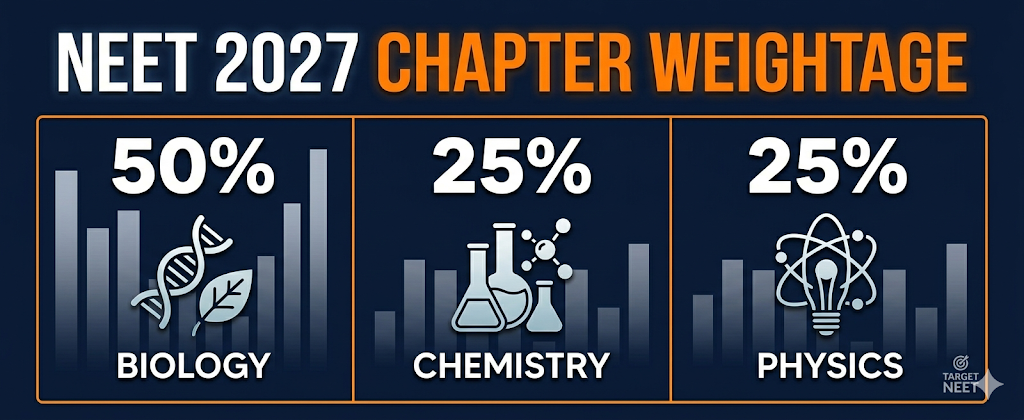
Biology alone accounts for 50% of the total marks. Physics and Chemistry are 25% each. This immediately tells you where to invest the most time.
NEET 2027 Biology Chapter Weightage
Biology is the most scoring and most predictable subject in NEET. Questions are overwhelmingly NCERT-based — which means mastering your textbook is non-negotiable. For a detailed breakdown of how to use NCERT effectively, read this guide on NCERT vs reference books NEET.
Biology is split equally: 45 questions from Botany, 45 from Zoology.
High-Weightage Biology Chapters (Class 11)
| Chapter | Average Questions | Priority |
|---|---|---|
| Human Physiology | 8–10 | 🔴 Very High |
| Cell Structure and Function | 4–5 | 🔴 Very High |
| Plant Physiology | 4–5 | 🔴 Very High |
| Diversity in Living World | 3–4 | 🟠 High |
| Structural Organisation (Animals & Plants) | 3–4 | 🟠 High |
| Biomolecules | 2–3 | 🟡 Medium |
High-Weightage Biology Chapters (Class 12)
| Chapter | Average Questions | Priority |
|---|---|---|
| Reproduction (Flowering Plants + Human) | 8–10 | 🔴 Very High |
| Genetics and Evolution | 8–10 | 🔴 Very High |
| Ecology and Environment | 5–6 | 🔴 Very High |
| Biology in Human Welfare | 3–4 | 🟠 High |
| Biotechnology | 3–4 | 🟠 High |
| Molecular Basis of Inheritance | 3–4 | 🟠 High |
Biology strategy in one line: If you ace Human Physiology, Reproduction, Genetics, and Ecology — you’ve secured roughly 30–35 marks from Biology alone.



NEET 2027 Chemistry Chapter Weightage
Chemistry in NEET is split across three branches — Physical, Organic, and Inorganic — with roughly equal representation. The Chemistry section in NEET consists of 45 questions, and the paper is usually balanced across Physical Chemistry, Organic Chemistry, and Inorganic Chemistry.
High-Weightage Physical Chemistry Chapters
| Chapter | Average Questions | Priority |
|---|---|---|
| Equilibrium | 3–4 | 🔴 Very High |
| Thermodynamics | 2–3 | 🔴 Very High |
| Solutions | 2–3 | 🔴 Very High |
| Electrochemistry | 2–3 | 🟠 High |
| Mole Concept (Some Basic Concepts) | 1–2 | 🟠 High |
| Chemical Kinetics | 1–2 | 🟡 Medium |
High-Weightage Organic Chemistry Chapters
| Chapter | Average Questions | Priority |
|---|---|---|
| Organic Compounds with Nitrogen | 2–3 | 🔴 Very High |
| Biomolecules | 2–3 | 🔴 Very High |
| Haloalkanes and Haloarenes | 2–3 | 🟠 High |
| Alcohols, Phenols and Ethers | 2–3 | 🟠 High |
| Aldehydes, Ketones and Carboxylic Acids | 2–3 | 🟠 High |
| Hydrocarbons | 1–2 | 🟡 Medium |
High-Weightage Inorganic Chemistry Chapters
| Chapter | Average Questions | Priority |
|---|---|---|
| Coordination Compounds | 2–3 | 🔴 Very High |
| p-Block Elements | 2–3 | 🔴 Very High |
| d and f Block Elements | 2–3 | 🟠 High |
| Chemical Bonding | 2–3 | 🟠 High |
| s-Block Elements | 1–2 | 🟡 Medium |
Chemistry strategy in one line: Physical Chemistry demands calculation practice; Organic Chemistry is NCERT-heavy; Inorganic Chemistry is pure memorisation — treat each branch differently.
NEET 2027 Physics Chapter Weightage
Physics is the most challenging section for most students — not because the questions are impossible, but because students underinvest in concept clarity early on. Based on previous NEET exam trends, certain chapters such as Laws of Motion, Thermodynamics, Current Electricity, Magnetic Effects of Current and Magnetism, and System of Particles and Rigid Body are considered high-weightage chapters.
High-Weightage Physics Chapters (Class 11)
| Chapter | Average Questions | Priority |
|---|---|---|
| Laws of Motion | 2–3 | 🔴 Very High |
| Thermodynamics | 2–3 | 🔴 Very High |
| System of Particles & Rigid Body | 2–3 | 🔴 Very High |
| Work, Energy and Power | 2–3 | 🟠 High |
| Gravitation | 1–2 | 🟠 High |
| Oscillations and Waves | 2–3 | 🟠 High |
| Kinetic Theory of Gases | 1–2 | 🟡 Medium |
High-Weightage Physics Chapters (Class 12)
| Chapter | Average Questions | Priority |
|---|---|---|
| Current Electricity | 3–4 | 🔴 Very High |
| Magnetic Effects of Current & Magnetism | 2–3 | 🔴 Very High |
| Electrostatics | 2–3 | 🔴 Very High |
| Optics (Ray + Wave) | 3–4 | 🔴 Very High |
| Atoms and Nuclei | 2–3 | 🟠 High |
| Semiconductor Electronics | 1–2 | 🟠 High |
| Electromagnetic Induction | 1–2 | 🟡 Medium |
Physics strategy in one line: Focus on Class 12 Physics for high-frequency questions — Current Electricity, Optics, and Electrostatics alone can fetch you 8–10 marks consistently.
How to Use This NEET 2027 Chapter Weightage Data
Knowing the weightage is step one. Using it correctly is what separates smart preparation from random preparation.
Step 1: Categorise Your Chapters
Divide all chapters into three buckets based on priority:
- Must-Master (🔴 Very High): Cover these first, revise most frequently, and never leave them incomplete
- Should-Cover (🟠 High): Cover after must-masters; revise at least twice before the exam
- Can-Skim (🟡 Medium): Cover once, revise briefly — don’t spend disproportionate time here
Step 2: Build Your Study Plan Around Weightage
Your NEET 2027 high-weightage topics should occupy at least 60–70% of your total preparation time. This isn’t about ignoring low-weightage chapters — it’s about not giving equal time to a chapter worth 1 question and a chapter worth 8.
For a complete month-by-month framework, read this NEET 2027 preparation timeline guide that helps you map weightage to your study calendar.
Step 3: Use PYQs as Your Weightage Compass
Previous year questions are the most accurate predictor of NEET 2027 important chapters. Solving PYQs chapter-wise tells you not just what gets asked — but how it gets asked. That’s a different kind of preparation than just reading the chapter.
Step 4: Revise High-Weightage Chapters More Often
A chapter like Human Physiology or Current Electricity needs at least 3–4 revision rounds before the exam. A chapter like Kinetic Theory can be reviewed once closer to the exam. Build your revision schedule around this principle.
NEET 2027 Syllabus: Are There Any Changes?
As of now, the official NEET 2027 syllabus PDF has not been released by NTA. Until NTA publishes a separate notification for NEET 2027, aspirants should use the latest official NEET UG syllabus as the most reliable reference.
There is no confirmed syllabus reduction or addition for NEET 2027 yet. Prepare based on the current NTA-notified syllabus and stay updated for any official changes. For students currently deciding whether to prepare for Re-NEET 2026 or focus entirely on NEET 2027, this breakdown of the drop year decision after NEET can help you choose the right path.
NEET 2027 Chapter Weightage: Quick Summary Table
| Subject | Total Marks | Top 3 Highest Weightage Chapters |
|---|---|---|
| Biology | 360 | Human Physiology, Genetics & Evolution, Reproduction |
| Chemistry | 180 | Equilibrium, Coordination Compounds, Organic Nitrogen Compounds |
| Physics | 180 | Current Electricity, Optics, Laws of Motion |
The Bottom Line
The NEET 2027 syllabus chapter weightage data is clear: a handful of chapters carry a disproportionately large share of the exam. Students who identify these NEET 2027 important chapters early and build their preparation around them have a structural advantage over those who study everything equally.
Don’t just study hard. Study smart — with weightage as your guide.
Whether you’re in Class 11 just starting out or a dropper gearing up for another attempt, understanding how to prepare for NEET 2027 from Class 11 will help you apply this weightage data to your actual study plan.
FAQ Section
Q: What is the chapter weightage for Biology in NEET 2027? A: Biology carries 360 marks (90 questions) in NEET 2027. The highest-weightage chapters are Human Physiology, Genetics and Evolution, Reproduction, and Ecology. These chapters alone can fetch 30–40 marks if prepared thoroughly from NCERT.
Q: Which Physics chapters have the highest weightage in NEET 2027? A: Based on PYQ trends, Current Electricity, Optics, Electrostatics, Laws of Motion, and Magnetic Effects of Current & Magnetism are the highest-weightage Physics chapters in NEET. Focus on Class 12 Physics for maximum returns.
Q: Which Chemistry chapters are most important for NEET 2027? A: Equilibrium, Coordination Compounds, Organic Nitrogen Compounds, Solutions, and p-Block Elements are among the most frequently tested Chemistry chapters in NEET. All three branches — Physical, Organic, and Inorganic — are equally represented.
Q: Has the NEET 2027 syllabus been released by NTA? A: No, the official NEET 2027 syllabus PDF has not yet been released by NTA. Aspirants should prepare based on the current official NTA NEET UG syllabus until a separate notification is published.
Q: How should I use chapter weightage to plan my NEET 2027 preparation? A: Categorise chapters as Very High, High, and Medium priority based on weightage. Spend 60–70% of your prep time on Very High priority chapters, cover High priority chapters thoroughly, and skim Medium priority chapters. Revise high-weightage chapters at least 3–4 times before the exam.