
Thermodynamics and the Kinetic Theory of Gases (KTG) are two short chapters that together give NEET two to three questions almost every year. This thermodynamics and KTG NEET PYQ analysis shows which processes, formulas and ratios NTA keeps testing, and how to answer each type in under a minute.
For the full subject plan, see our complete NEET Physics strategy. This article gives you the chapter-level detail.
Want to test yourself first? Solve the free Thermodynamics PYQs and Kinetic Theory PYQs, then use this guide to fix the gaps.
Table of Contents
Why These Two Chapters Go Together
Both chapters describe the same gas from two sides. Thermodynamics looks at heat, work and internal energy. KTG explains those quantities using moving molecules. Many questions mix the two, so it pays to study them as one block.
Thermodynamics also appears in Chemistry, and our thermodynamics overlap explained guide shows how to prepare both at once. See where these chapters sit in the NEET 2027 chapter weightage.
Thermodynamics and KTG NEET PYQ Analysis: The Repeated Question Types
When you sort a decade of NEET physics PYQs from these chapters, six question types cover almost everything.
| Question type | Chapter | Frequency |
|---|---|---|
| Thermodynamic processes and P–V graphs | Thermodynamics | Most frequent |
| First law calculations | Thermodynamics | Very frequent |
| Molecular speeds | KTG | Very frequent |
| Specific heats and γ | KTG | Very frequent |
| Kinetic energy and temperature | KTG | Regular |
| Mean free path | KTG | Occasional |
For a quick warm-up, try these five quick thermodynamics practice questions and these five quick kinetic theory questions.
The First Law of Thermodynamics and the Four Processes
ΔQ = ΔU + ΔW, where heat supplied equals the rise in internal energy plus the work done by the gas.
| Process | Condition | Key result |
|---|---|---|
| Isothermal | Temperature constant | ΔU = 0, so Q = W = nRT ln(V₂/V₁) |
| Adiabatic | No heat exchange | Q = 0, so W = −ΔU; PV^γ = constant |
| Isochoric | Volume constant | W = 0, so Q = ΔU |
| Isobaric | Pressure constant | W = PΔV |
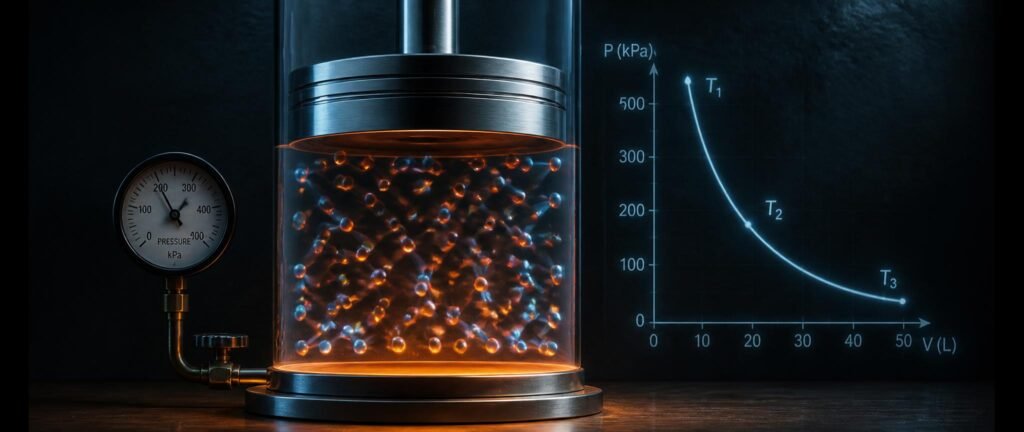
Two graph rules solve most P–V questions:
- Work done equals the area under the P–V curve.
- In a cyclic process, ΔU = 0 and the work done equals the area enclosed by the loop.
An adiabatic curve is steeper than an isothermal curve through the same point. If numericals slow you down, our tips on building physics problem intuition will help. Heat engines and refrigerators are not part of the current syllabus, as our full Physics chapter list explains.
Kinetic Theory: Molecular Speeds
| Speed | Formula |
|---|---|
| Root mean square (rms) | √(3RT/M) |
| Average speed | √(8RT/πM) |
| Most probable speed | √(2RT/M) |
The order is always: rms > average > most probable. All three are proportional to √T and to 1/√M. Always convert the temperature to kelvin first.
The average kinetic energy of one molecule is (3/2)kT. It depends only on temperature, not on the type of gas.
Degrees of Freedom and Specific Heats
| Gas | f | Cv | Cp | γ = Cp/Cv |
|---|---|---|---|---|
| Monoatomic | 3 | (3/2)R | (5/2)R | 5/3 |
| Diatomic | 5 | (5/2)R | (7/2)R | 7/5 |
| Polyatomic (non-linear) | 6 | 3R | 4R | 4/3 |
Use these relations: internal energy U = (f/2)nRT, Cp − Cv = R, and γ = 1 + 2/f.
Worked PYQ-Pattern Questions
Q1. An ideal gas expands isothermally. What is the change in its internal energy?
Answer: Zero. Internal energy of an ideal gas depends only on temperature, so all the heat absorbed becomes work.
Q2. The rms speed of a gas at 27°C is v. What is it at 927°C?
Answer: 2v. The temperature rises from 300 K to 1200 K, which is four times, and the speed ∝ √T.
Q3. What is the value of γ for a diatomic gas?
Answer: 7/5, or 1.4. A diatomic gas has f = 5, so γ = 1 + 2/5.
Q4. A gas does 100 J of work in an adiabatic expansion. What is the change in its internal energy?
Answer: −100 J. With Q = 0, ΔU = −W, so the gas cools.
Q5. What is the ratio of the rms speeds of hydrogen and oxygen at the same temperature?
Answer: 4 : 1. Speed ∝ 1/√M, and √(32/2) = 4.
Common Traps in These Chapters
- Using Celsius instead of kelvin in speed formulas
- Getting the sign of work wrong (work done by the gas is positive)
- Assuming ΔU = 0 in an adiabatic process (that is true for isothermal)
- Mixing up the order of the three molecular speeds
- Using f = 3 for a diatomic gas
Practise Every Thermodynamics and KTG PYQ
This thermodynamics and KTG NEET PYQ analysis gives you the tables and patterns. Practice makes them automatic. Every previous year question from both chapters is available chapter-wise, free:
👉 Solve all Thermodynamics NEET PYQs
👉 Solve all Kinetic Theory NEET PYQs
For every process question, write the condition first (ΔT = 0, Q = 0, ΔV = 0 or ΔP = 0). The answer usually follows in one line.
Conclusion
These two chapters reward students who learn two tables well: the four processes and the specific heats. Use this thermodynamics and KTG NEET PYQ analysis to master the first law, P–V graphs, molecular speeds and specific heats. Then practise until each question type feels routine.
❓ FAQ
Q: How many questions come from Thermodynamics and KTG in NEET? A: Usually two to three questions across the two chapters, mostly on thermodynamic processes, molecular speeds and specific heats.
Q: Is the Carnot engine in the NEET syllabus? A: No. Heat engines and refrigerators were removed from the Thermodynamics unit in the 2024 revision, and the syllabus has not changed since.
Q: What is the order of molecular speeds? A: The rms value is the highest, followed by average speed, and then most probable speed.
Q: What is the change in internal energy in an isothermal process? A: Zero for an ideal gas, because internal energy depends only on temperature, and the temperature stays constant.
Q: How should I revise these chapters before NEET? A: Use a thermodynamics and KTG NEET PYQ analysis to list the repeated question types, memorise the process and degrees-of-freedom tables, and solve past questions chapter-wise.
Q: Where can I practise these PYQs for free? A: You can solve every Thermodynamics and Kinetic Theory previous year question for free using the practice links in this article.