
Quick answer: A wave optics NEET PYQ analysis shows that NTA asks about two questions a year from this chapter, with 40 past questions in total. Almost all of them come from two areas: Young’s double slit experiment (fringe width, intensity, coherent sources) and polarisation (Malus’s law and Brewster’s law). Single-slit diffraction and Huygens’ principle fill most of the rest. The 2024 papers alone asked five questions from YDSE and polarisation.
This guide breaks down what NTA repeats, the formulas you must know and solved PYQ-pattern numericals. Before you start, get the bigger picture from our complete NEET Physics strategy, and follow official exam news on our NEET 2027 latest updates page.
Want to test yourself first? Solve the Wave Optics PYQs for free, then use this guide to fix the gaps.
Why Wave Optics Is Worth Mastering
Wave optics questions use only a few formulas: β = λD/d, I = I₀cos²θ and tan iB = n. Learn them well and the chapter becomes two reliable marks. For chapter notes, use our Wave Optics class 12 notes, and for a concept-first explanation, read our Wave Optics guide.
The ray picture of light is in our Ray Optics PYQ analysis, and our five quick optics questions are a good warm-up. Planning your year? Our guide to the NEET 2027 registration date shows when the form is expected.
Wave Optics NEET PYQ Analysis: What NTA Repeats
When you sort the past NEET physics PYQs from this chapter, four question types cover nearly everything.
| Question type | Frequency | What it tests |
|---|---|---|
| Young’s double slit experiment | Most frequent | Fringe width, effect of changing λ, D, d or medium, intensity at a point |
| Polarisation | Very frequent | Malus’s law, Brewster’s angle, polaroids |
| Interference and coherence | Regular | Coherence, maximum and minimum intensity, energy conservation |
| Diffraction and Huygens’ principle | Regular | Single-slit minima, width of the central maximum, wavefronts |
Huygens’ Principle
- Every point on a wavefront acts as a source of secondary wavelets; the new wavefront is the forward envelope of these wavelets.
- It explains reflection and refraction. When light enters a denser medium, its speed and wavelength decrease, but its frequency stays the same.
Interference and Coherence
- Coherent sources have a constant phase difference. Two independent bulbs are not coherent, so they do not give a steady interference pattern.
- Resultant intensity: I = I₁ + I₂ + 2√(I₁I₂) cos φ. For two equal sources of intensity I₀: I = 4I₀ cos²(φ/2).
- Constructive interference: path difference = nλ. Destructive: path difference = (n + ½)λ.
- Imax/Imin = [(√I₁ + √I₂)/(√I₁ − √I₂)]²
- Interference only redistributes energy; the total energy is conserved. This was asked in 2026.
Young’s Double Slit Experiment
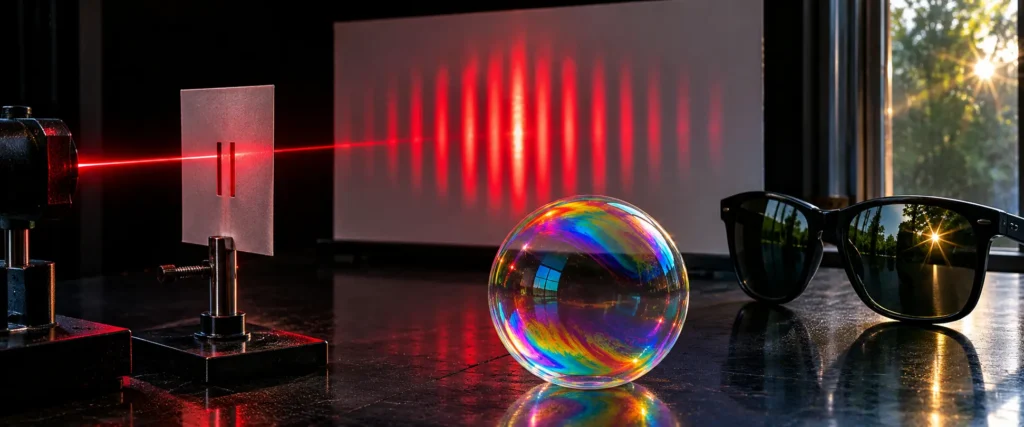
Young’s double slit experiment has been asked almost every year, including 2022, 2023, 2024 (twice) and 2026.
| Quantity | Formula |
|---|---|
| Fringe width | β = λD/d |
| Angular fringe width | θ = λ/d |
| Position of nth bright fringe | y = nλD/d |
| Fringe width in a medium of refractive index n | β’ = β/n |
- Fringe width increases with λ and D and decreases as the slit separation d increases.
- With white light, the central fringe is white and the other fringes are coloured.
Single-Slit Diffraction
- Minima occur at a sin θ = nλ (n = 1, 2, 3…), where a is the slit width.
- The central maximum has angular width 2λ/a and linear width 2λD/a. It is twice as wide as the other maxima.
- Diffraction becomes noticeable when the slit width is comparable to the wavelength.
Polarisation
Polarisation shows that light is a transverse wave.
| Law | Formula and meaning |
|---|---|
| Unpolarised light through one polaroid | Intensity becomes I₀/2 |
| Malus’s law | I = I₀ cos²θ, where θ is the angle between the polariser and analyser axes |
| Brewster’s law | tan iB = n; at this angle, the reflected light is completely polarised, and the reflected and refracted rays are perpendicular (iB + r = 90°) |
For glass with n = 1.5, Brewster’s angle is about 56°. Malus’s law was asked in 2022, 2024 and 2025, and Brewster’s law in 2024 and 2025.
Worked PYQ-Pattern Questions
Q1. In YDSE, λ = 600 nm, D = 1 m and d = 1 mm. Find the fringe width.
β = λD/d = (600 × 10⁻⁹ × 1)/(1 × 10⁻³).
Answer: 6 × 10⁻⁴ m, or 0.6 mm.
Q2. The YDSE apparatus is immersed in water (n = 4/3). The fringe width: (a) Increases to 4/3 times (b) Becomes 3/4 times (c) Stays the same (d) Doubles
Answer: (b) Becomes 3/4 times, because the wavelength in water is λ/n.
Q3. Two coherent sources have intensities in the ratio 9 : 1. Find Imax : Imin.
Imax/Imin = [(3 + 1)/(3 − 1)]² = (4/2)².
Answer: 4 : 1.
Q4. Unpolarised light of intensity I₀ passes through two polaroids whose axes are at 60°. Find the final intensity.
After the first: I₀/2. After the second: (I₀/2) × cos²60° = (I₀/2) × ¼.
Answer: I₀/8.
Q5. Find Brewster’s angle for a medium of refractive index √3.
tan iB = √3.
Answer: 60°.
Q6. What is the angular width of the central maximum in single-slit diffraction?
Answer: 2λ/a, where a is the slit width.
Common Traps in This Chapter
- Saying fringe width increases when the slit separation d increases (it decreases)
- Forgetting to halve the intensity of unpolarised light at the first polaroid
- Saying frequency changes when light enters a denser medium (wavelength and speed change)
- Writing λ/a for the full angular width of the central maximum (it is 2λ/a)
- Saying interference destroys energy at dark fringes (energy is only redistributed)
- Using sin iB = n instead of tan iB = n for Brewster’s law
Practise Every Wave Optics PYQ
This wave optics NEET PYQ analysis shows you where the marks are. Solving real past questions makes the formulas automatic. Every Wave Optics previous year question is available chapter-wise, free:
👉 Solve all Wave Optics NEET PYQs
Keep the YDSE and polarisation tables beside you for the first round, then solve the second round without them.
Conclusion
Wave Optics comes down to YDSE and polarisation, with a little diffraction. Use this wave optics NEET PYQ analysis to master fringe width, intensity, coherent sources, Malus’s law, Brewster’s law and single-slit diffraction. Then solve the past numericals until each one takes under a minute.
❓ FAQ
Q: How many questions come from Wave Optics in NEET? A: Usually about two questions a year, mostly on YDSE and polarisation.
Q: What is the most important topic in Wave Optics for NEET? A: Young’s double slit experiment, especially fringe width, followed by Malus’s law and Brewster’s law.
Q: What is the formula for fringe width in YDSE? A: β = λD/d, where λ is the wavelength, D the distance to the screen and d the slit separation.
Q: What is Malus’s law? A: The intensity of light through an analyser is I = I₀ cos²θ, where θ is the angle between the polariser and analyser axes.
Q: What happens at Brewster’s angle? A: The reflected light is completely polarised, and the reflected and refracted rays are at 90° to each other; tan iB = n.
Q: Where can I practise Wave Optics NEET PYQs for free? A: You can solve every Wave Optics previous year question chapter-wise for free using the practice links in this article.
Related posts:
 Wave Optics for NEET 2027: Interference, Diffraction and the Concepts You Skip
 Alternating Current NEET PYQ Analysis: LCR Circuits, Resonance and Transformers
 Ray Optics NEET PYQ Analysis: Lenses, Prism, TIR and Optical Instruments
 Electromagnetic Induction NEET PYQ Analysis: Faraday’s Law, Motional EMF and Inductance