
Quick answer: An electromagnetic induction NEET PYQ analysis shows that NTA asks one to two questions a year from this chapter, with 40 past questions in total. They come from four areas: Faraday’s law and magnetic flux, motional emf (a moving rod and a rotating rod or coil), self-inductance (solenoids, energy stored, inductors in series and parallel), and Lenz’s law. The 2026 papers asked four questions, three of them in the Re-NEET.
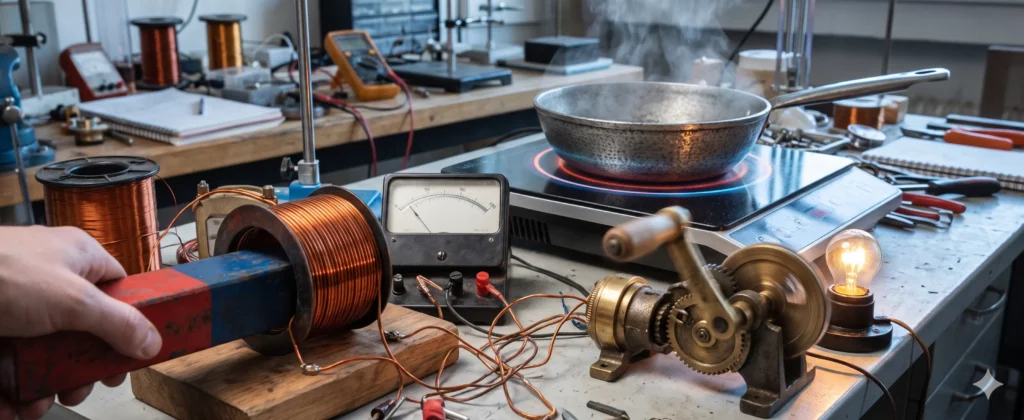
This guide breaks down what NTA repeats, the formulas you must know and solved PYQ-pattern numericals. Before you start, get the bigger picture from our complete NEET Physics strategy, and follow official exam news on our NEET 2027 latest updates page.
Want to test yourself first? Solve the Electromagnetic Induction PYQs for free, then use this guide to fix the gaps.
Why EMI Is Worth Mastering
Electromagnetic induction has a small formula set, and most of its questions are one-line numericals. For chapter notes, use our EMI class 12 notes, and for a concept-first view of EMI with AC, read our EMI and AC guide.
The magnetic field side comes from our Magnetism PYQ analysis, and induction leads into our Alternating Current PYQ analysis. Planning your year? Our guide to the NEET 2027 registration date shows when the form is expected.
Electromagnetic Induction NEET PYQ Analysis: What NTA Repeats
When you sort the past NEET physics PYQs from this chapter, four question types cover nearly everything.
| Question type | Frequency | What it tests |
|---|---|---|
| Faraday’s law and flux | Most frequent | Induced emf from a changing flux, induced charge, flux through a coil |
| Motional emf | Very frequent | Rod moving in a field, rod rotating about one end, rotating coil |
| Self-inductance | Very frequent | Inductance of a solenoid, energy stored, inductors in series and parallel |
| Lenz’s law and eddy currents | Regular | Direction of induced current, energy conservation, uses of eddy currents |
Magnetic Flux and Faraday’s Law
- Magnetic flux: Φ = BA cos θ, measured in weber (Wb).
- Faraday’s law: the induced emf equals the rate of change of flux: ε = −dΦ/dt, or ε = −N dΦ/dt for N turns.
- Induced charge: q = NΔΦ/R. It depends only on the change in flux and the resistance, not on how fast the flux changes.
Faraday’s law questions were asked in 2022 and in the 2026 Re-NEET.
Lenz’s Law
The induced current flows in a direction that opposes the change in flux that produced it. Lenz’s law follows from the conservation of energy: if the induced current helped the change, energy would be created from nothing.
Motional EMF
| Situation | Induced emf |
|---|---|
| Rod of length l moving with speed v perpendicular to B | ε = Blv |
| Rod of length l rotating with angular speed ω about one end | ε = ½Bωl² |
| Coil of N turns and area A rotating with angular speed ω | ε = NBAω sin ωt, maximum NBAω |
The rotating coil is the principle of the AC generator. Motional emf was asked in 2022 (a rotating coil) and 2026.
Eddy Currents
Eddy currents are loops of current induced in a bulk conductor by a changing flux. They waste energy as heat, so transformer and motor cores are laminated to reduce them. They are put to use in:
- Magnetic braking in trains
- Electromagnetic damping in galvanometers
- Induction furnaces and induction cooktops
- Electric power meters
Self and Mutual Inductance
| Relation | Meaning |
|---|---|
| Φ = LI | Flux linked with a coil is proportional to its current |
| ε = −L dI/dt | Emf induced by a changing current in the same coil |
| L = μ₀N²A/l = μ₀n²Al | Self-inductance of a long solenoid (n = N/l) |
| U = ½LI² | Energy stored in an inductor |
| M = μ₀n₁n₂Al | Mutual inductance of two coaxial solenoids |
| Series (no coupling) | L = L₁ + L₂ |
| Parallel (no coupling) | 1/L = 1/L₁ + 1/L₂ |
- Since L ∝ N², doubling the number of turns (same length and area) makes the inductance four times.
- In a DC circuit in steady state, an ideal inductor behaves like a plain wire with zero resistance. This was asked in 2025.
Self-inductance questions appeared in 2024 and twice in the 2026 Re-NEET.
Worked PYQ-Pattern Questions
Q1. A rod 1 m long moves at 5 m/s perpendicular to a magnetic field of 0.2 T. Find the induced emf.
ε = Blv = 0.2 × 1 × 5.
Answer: 1 V.
Q2. A rod 1 m long rotates at 20 rad/s about one end in a field of 0.5 T perpendicular to its plane of rotation. Find the emf between its ends.
ε = ½Bωl² = ½ × 0.5 × 20 × 1².
Answer: 5 V.
Q3. The flux through each turn of a 100-turn coil changes by 0.02 Wb in 0.1 s. Find the average induced emf.
ε = NΔΦ/Δt = 100 × 0.02/0.1.
Answer: 20 V.
Q4. Find the energy stored in a 2 H inductor carrying a current of 3 A.
U = ½LI² = ½ × 2 × 9.
Answer: 9 J.
Q5. Lenz’s law is a consequence of the conservation of: (a) Charge (b) Momentum (c) Energy (d) Mass
Answer: (c) Energy.
Q6. The number of turns of a solenoid is doubled, keeping its length and area the same. Its self-inductance becomes:
Answer: Four times, because L ∝ N².
Common Traps in This Chapter
- Saying induced charge depends on how fast the flux changes (it depends only on ΔΦ and R)
- Writing Bωl² instead of ½Bωl² for a rotating rod
- Saying self-inductance doubles when the turns double (it becomes four times)
- Linking Lenz’s law with conservation of charge instead of energy
- Saying eddy currents are reduced by using a solid iron core (a laminated core reduces them)
- Treating an inductor as an open circuit in DC steady state
Practise Every Electromagnetic Induction PYQ
This electromagnetic induction NEET PYQ analysis shows you where the marks are. Solving real past questions makes the formulas automatic. Every Electromagnetic Induction previous year question is available chapter-wise, free:
👉 Solve all Electromagnetic Induction NEET PYQs
Keep the motional emf and inductance tables beside you for the first round, then solve the second round without them.
Conclusion
Electromagnetic Induction is a short, formula-driven chapter. Use this electromagnetic induction NEET PYQ analysis to master Faraday’s law and flux, motional emf, Lenz’s law, eddy currents and self-inductance. Then solve the past numericals until each one takes under a minute.
❓ FAQ
Q: How many questions come from Electromagnetic Induction in NEET? A: Usually one to two questions a year, with more in some years, such as 2026.
Q: What is the most important topic in EMI for NEET? A: Faraday’s law and motional emf, followed by self-inductance and energy stored in an inductor.
Q: What is the emf across a rod rotating about one end? A: ε = ½Bωl², where l is the rod’s length and ω its angular speed.
Q: How much energy is stored in an inductor? A: U = ½LI², where L is the inductance and I the current.
Q: Why are transformer cores laminated? A: To reduce eddy currents, which waste energy as heat.
Q: Where can I practise Electromagnetic Induction NEET PYQs for free? A: You can solve every Electromagnetic Induction previous year question chapter-wise for free using the practice links in this article.
Related posts:
 Alternating Current NEET PYQ Analysis: LCR Circuits, Resonance and Transformers
 Electromagnetic Waves NEET PYQ Analysis: Spectrum, Displacement Current and Wave Properties
 Current Electricity NEET PYQ Analysis: Wheatstone Bridge, Cells and Resistance
 Ray Optics NEET PYQ Analysis: Lenses, Prism, TIR and Optical Instruments