Ask ten NEET toppers what books they used, and nine of them will say the same thing: NCERT first, always.
But here is what most students misunderstand — toppers do not use only NCERT. They use NCERT as the foundation and layer reference books strategically on top. The NCERT vs reference books NEET 2027 debate is not an either-or question. It is a sequencing question.
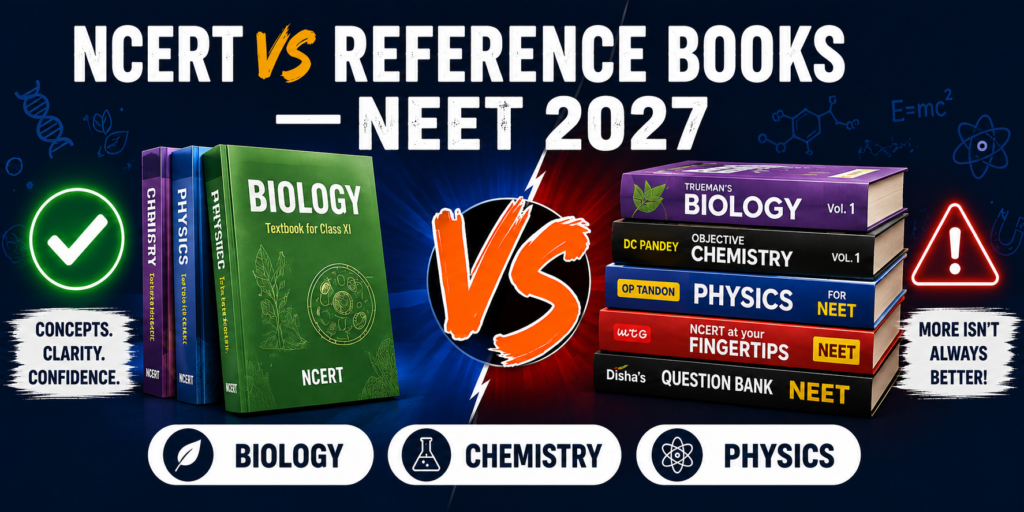
This guide breaks it down subject by subject, score range by score range, so you know exactly which books to use, when to use them, and when to put them down.
NCERT vs Reference Books NEET 2027: Understanding What the Exam Actually Tests
Before picking any book, understand what NEET 2027 actually rewards.
Around 65–70% of NEET questions are directly NCERT-based — either verbatim from the text, from diagrams, from tables, or from bold-highlighted terms. This is especially true for Biology, where NCERT is practically the question paper itself.
The remaining 30–35% requires application, numerical ability, and concept depth that goes slightly beyond NCERT — particularly in Physics and Physical Chemistry.
This split tells you everything about how to approach your NEET 2027 book selection:
- If you are not NCERT-perfect, no reference book will save you
- If you are NCERT-perfect, the right reference books push you from 550 to 650+
With that framing in place, let’s go subject by subject.
Biology: NCERT Is Non-Negotiable
The Honest Answer for Biology
For Biology, NCERT is not just important — it is the exam. Every diagram, every bold term, every table, and every exception mentioned in NCERT Class 11 and 12 has appeared as a NEET question at some point.
Students who score 340–360 in Biology almost always say the same thing: they read NCERT Biology at least 5–6 times across their preparation. Students who score 280–300 usually read it twice and spent the rest of the time in reference books that added confusion without adding marks.
When to Use a Biology Reference Book
A Biology reference book is only useful for one purpose: MCQ practice. Not for learning concepts, not for reading theory — only for practising question formats after your NCERT is solid.
Recommended Biology MCQ books:
- MTG Fingertips Biology — the most widely used, covers NCERT-based MCQs comprehensively
- MTG Objective NCERT at Your Fingertips — chapter-wise MCQ practice with NCERT mapping
What to avoid: Any Biology reference book that tries to teach you “beyond NCERT” for NEET. If it is not in NCERT, it is almost certainly not in NEET.
Biology NCERT Strategy
- Read NCERT Class 11 and 12 Biology cover to cover — at least 4 times across the year
- On every read, highlight something new — your second read reveals things you missed in the first
- Draw and redraw diagrams from memory — mitosis, meiosis, nephron, heart, photosynthesis diagrams appear directly
- Make a separate list of all exceptions, special cases, and organism-specific details — these are favourite question sources
For chapter-wise Biology priorities, the Re-NEET 2026 Biology high-weightage chapters are directly relevant for NEET 2027 — the same chapters dominate the paper every year.
Chemistry: Three Sections, Three Different Approaches
Chemistry is where the NCERT vs reference books question gets genuinely complicated — because Chemistry has three distinct sections that require completely different study approaches.
Physical Chemistry: Reference Books Add Real Value
Physical Chemistry is the one section where NCERT alone is not enough for a high score. The reason is numerical depth. NCERT Physical Chemistry explains concepts well but does not provide enough numerical practice for the variety of questions NEET asks.
Recommended Physical Chemistry books:
- N Avasthi (Narendra Awasthi) — the gold standard for Physical Chemistry numericals; use selectively, not cover to cover
- VK Jaiswal — also strong for Physical Chemistry practice
How to use them: Read NCERT for the concept first. Then solve numericals from these books chapter by chapter. Do not jump to reference books before NCERT — you will waste time solving problems whose underlying concept you have not understood.
Chapters where reference books matter most: Thermodynamics, Chemical Equilibrium, Electrochemistry, Chemical Kinetics, Mole Concept.
Organic Chemistry: NCERT + One Good Practice Book
Organic Chemistry sits in the middle. NCERT covers the reactions and mechanisms you need, but additional MCQ practice is genuinely useful here.
Recommended Organic Chemistry practice book:
- MS Chauhan — widely used, covers reaction MCQs well
What to focus on from NCERT: Named reactions, reaction mechanisms (SN1, SN2, elimination), and the chapters on Biomolecules and Polymers — these are almost entirely NCERT-based. Refer to most important Organic Chemistry chapters for NEET for a full priority breakdown.
Inorganic Chemistry: NCERT Only, No Exceptions
This is the most misunderstood section. Students buy thick Inorganic Chemistry reference books hoping to score more. Almost always, it backfires.
NCERT Inorganic Chemistry is the answer paper. P-Block, D-Block, Coordination Compounds, Metallurgy — every question comes from NCERT. Word for word, table for table.
Strategy: Read NCERT Inorganic 3–4 times. Write out properties, reactions, and exceptions by hand. Do not open any reference book for Inorganic unless you are using it purely as an MCQ drill after finishing NCERT.
Physics: Concepts From NCERT, Numericals From Reference Books
Why NCERT Alone Falls Short for Physics
NCERT Physics is well-written and concept-rich — but it does not provide enough numerical practice for NEET’s application-heavy questions. This is where Physics differs most sharply from Biology.
If you only study NCERT Physics, you will understand concepts but struggle with unfamiliar numerical formats in the exam. The best books for NEET Physics add the numerical depth NCERT lacks.
Recommended Physics Reference Books
HC Verma (Concepts of Physics) — the most trusted Physics book for NEET and JEE both. Strong on conceptual clarity and has excellent exercise problems. Use Volume 1 and 2 selectively — focus on chapters with high NEET weightage.
DC Pandey — better for NEET-specific numerical practice. More targeted than HC Verma for the types of questions NEET actually asks.
Which one to choose? If you are strong in Physics conceptually, DC Pandey is more efficient for NEET. If you have concept gaps, start with HC Verma to build understanding before moving to numericals.
How to Use Physics Reference Books Without Wasting Time
The biggest mistake: opening DC Pandey or HC Verma before finishing the NCERT chapter. Always follow this sequence:
- Read NCERT chapter
- Understand all derivations once
- Note all formulas with their conditions
- Solve NCERT examples and exercises
- Then move to reference book numericals for that chapter
High-priority Physics chapters for reference book practice: Mechanics (Rotational Motion, Work-Energy), Electrostatics, Current Electricity, Optics, Modern Physics. Full chapter-wise guidance is in Re-NEET 2026 Physics important topics — these priorities are identical for NEET 2027.
Score-Based Book Strategy: What You Actually Need
Your current score determines how many reference books you actually need.
Targeting 600–720
At this level, NCERT must be completely locked — every diagram, every table, every exception. Reference books are used for numerical mastery (Physics, Physical Chemistry) and MCQ variety (Organic Chemistry).
Book list:
- Biology: NCERT only + MTG Fingertips for MCQ practice
- Physical Chemistry: NCERT + selective N Avasthi chapters
- Organic Chemistry: NCERT + MS Chauhan
- Inorganic Chemistry: NCERT only
- Physics: NCERT + DC Pandey (selective chapters)
Targeting 450–599
Focus 70% on NCERT mastery and 30% on reference book numericals. Do not buy more than one reference book per subject — it creates confusion and splits your focus.
Book list:
- Biology: NCERT only (read it more times, not a new book)
- Chemistry: NCERT + N Avasthi for Physical Chemistry only
- Physics: NCERT + DC Pandey (high-weightage chapters only)
Targeting Below 450
If you are below 450, the answer is almost never “buy more books.” The answer is NCERT revision and mock test analysis. Adding reference books at this level delays the NCERT mastery that is the actual problem. Refer to the NEET 2027 dropper study plan for a full phase-wise approach.
The “Too Many Books” Trap
This deserves its own section because it is one of the most common preparation mistakes — especially among droppers.
Buying 5 books per subject feels productive. It is not.
Every new book you add is a new syllabus to cover, a new style to adapt to, and more time away from revision and mock tests. The students who crack NEET 2027 with 650+ are not the ones with the biggest book collection. They are the ones who read 2–3 books so many times that they know them cold.
The rule: One primary reference book per subject, maximum. Master it before considering anything else. For most students, the complete NEET 2027 preparation books list is:
- NCERT Class 11 and 12 (Biology, Chemistry, Physics) — non-negotiable
- MTG Fingertips Biology — MCQ practice
- N Avasthi — Physical Chemistry numericals
- MS Chauhan — Organic Chemistry practice
- DC Pandey or HC Verma — Physics numericals
That is it. Five books outside NCERT. Any more is counterproductive.
When to Stop Reading and Start Solving
One final point that most book-selection guides miss: at some point, books stop being the bottleneck.
From Month 7–8 of your NEET 2027 preparation onwards, the limiting factor is not which books you have read — it is how many mock tests you have taken and how rigorously you have analysed them. The NEET 2027 dropper study plan covers this transition in detail — when to shift from coverage to revision to mock-test intensity.
No book replaces a well-analysed full-length mock test in the final 3 months.
Final Word
The NCERT vs reference books debate for NEET 2027 has a clear answer: NCERT first, always — and reference books only where NCERT genuinely falls short.
For Biology: NCERT only. For Inorganic Chemistry: NCERT only. For Physical Chemistry and Physics: NCERT first, then one targeted reference book for numerical depth.
Pick your books now, stick with them, and do not switch mid-year. The students who waste the most time in a drop year are the ones chasing the “perfect book list” instead of mastering the books they already have.
FAQ Section:
Q: Is NCERT enough for NEET 2027? A: NCERT is enough for Biology and Inorganic Chemistry — both are almost entirely NCERT-based. For Physical Chemistry and Physics, NCERT covers the concepts but you need one reference book each for numerical practice. For Organic Chemistry, NCERT plus one MCQ practice book is the ideal combination.
Q: Which reference book is best for NEET 2027 Physics? A: DC Pandey is the most efficient choice for NEET-specific Physics numerical practice. If you have concept gaps, start with HC Verma for conceptual clarity before switching to DC Pandey for MCQ practice. Always finish the NCERT chapter before opening any reference book.
Q: How many times should I read NCERT for NEET 2027? A: For Biology, aim to read NCERT at least 5–6 times across your preparation year. For Chemistry and Physics, 3–4 reads of relevant NCERT chapters is standard. Each read reveals details you missed before — especially diagrams, tables, and exceptions that directly appear in NEET questions.
Q: Should I use MTG or Fingertips for NEET Biology 2027? A: MTG Fingertips Biology is the most widely recommended MCQ practice book for NEET Biology. Use it after completing NCERT — it is for practice only, not for learning new concepts. Do not replace NCERT Biology reading time with Fingertips reading time.
Q: Is N Avasthi good for NEET 2027 Chemistry? A: N Avasthi (Narendra Awasthi) is excellent for Physical Chemistry numericals and is widely used by NEET toppers. Use it selectively — focus on high-weightage chapters like Thermodynamics, Equilibrium, and Electrochemistry rather than attempting the entire book.
Q: How many reference books should a NEET 2027 dropper use? A: One reference book per subject is the maximum. Most droppers make the mistake of buying too many books and failing to master any of them. Complete NCERT mastery with one targeted reference book per subject will outperform a scattered approach across five books per subject every time.