
Every year, lakhs of families face the same question the moment their child decides to prepare for NEET: Do we invest in coaching, or does self-study work?
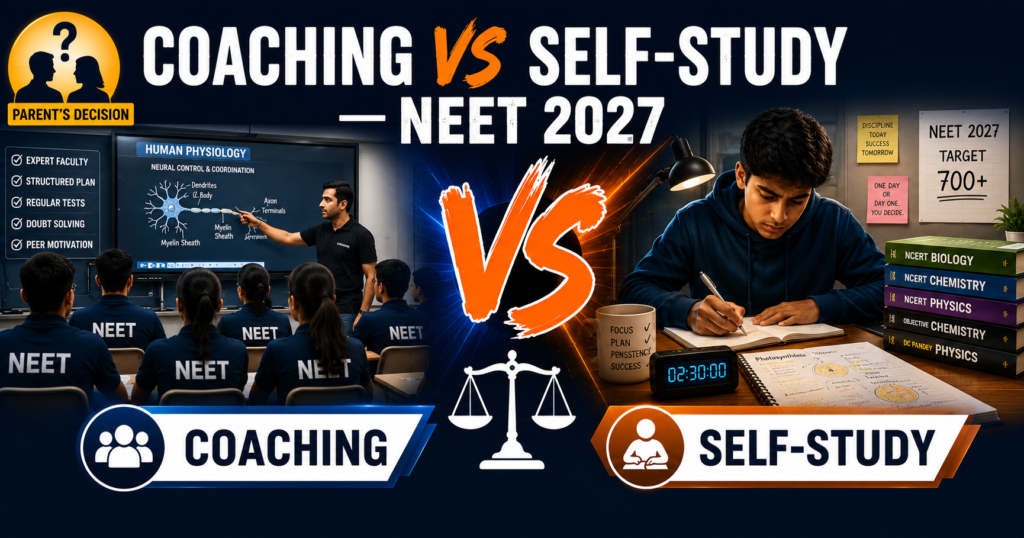
The answer nobody gives you is that it depends — and not on what you can afford, but on who your child actually is. The NEET 2027 coaching or self study decision is one of the most consequential choices a family makes in this journey. Get it right and your child has the best possible setup for success. Get it wrong and you either waste money on coaching your child doesn’t use, or you leave a self-study student without the structure they desperately needed.
This guide is written for parents. Not to sell you on either option, but to give you the honest framework to make the right call for your child — based on their learning style, their academic baseline, and the reality of what NEET 2027 demands.
NEET 2027 Coaching or Self Study: What the Exam Actually Demands
Before comparing options, understand what NEET 2027 will test.
NEET is a 720-mark, 200-question paper covering Physics, Chemistry, and Biology from Class 11 and 12 NCERT. It is competitive in a very specific way — not because the questions are impossibly hard, but because:
- 65–70% of questions are directly NCERT-based, requiring complete textbook mastery
- 30–35% require application and numerical ability that goes beyond passive reading
- Time management is critical — 180 questions in 200 minutes means roughly 66 seconds per question
- Consistency over 12–14 months matters more than any single burst of hard work
Both coaching and self-study can produce these outcomes. The question is which path is more likely to produce them for your specific child.
The Case for NEET 2027 Coaching
Structure That Most Students Cannot Create Alone
The single biggest advantage of coaching is structure. A timetable, daily classes, weekly tests, and a teacher to answer doubts — these force a consistency that most 17-year-olds struggle to create for themselves over 12 months.
For students who are easily distracted, prone to skipping topics they dislike, or who have never studied independently for long stretches, coaching provides the scaffolding that makes preparation possible.
Concept Clarity for Weak Subjects
Physics is the most common weak subject among NEET aspirants. For a student who genuinely does not understand Mechanics or Electrostatics from NCERT alone, a good Physics teacher can explain in 30 minutes what the student has been struggling with for weeks.
The same applies to Physical Chemistry — a subject that requires numerical intuition that many students find hard to build without guided practice and feedback.
Peer Competition and Motivation
Being in a classroom with other serious NEET aspirants creates a competitive environment that is genuinely motivating for many students. Weekly rankings, common test schedules, and the social energy of shared preparation keep students engaged through the difficult middle months of the year — typically Months 4–6, when motivation dips sharply.
Test Series and Performance Tracking
Most coaching institutes run structured test series that simulate NEET conditions closely. Regular mock tests with comparative rankings give students and parents a realistic picture of where the child stands — something self-study students have to arrange independently.
Refer to the NEET 2027 dropper study plan to understand how mock test frequency fits into a full-year preparation strategy.
When Coaching Is the Right Choice
Coaching is likely the better option if your child:
- Has concept gaps in Physics or Physical Chemistry that self-study hasn’t fixed
- Struggles with self-discipline and needs external accountability
- Performs better with a fixed schedule imposed from outside
- Is appearing for NEET for the first time without a strong Class 11–12 foundation
- Has access to a genuinely good coaching institute — not just a neighbourhood tuition centre
The Case for NEET 2027 Self-Study
NCERT Mastery Is a Solo Activity
Here is something most coaching parents don’t realise: the 65–70% of NEET that is NCERT-based cannot be cracked in a classroom. It requires sitting alone with a Biology or Chemistry textbook, reading it slowly, highlighting, re-reading, and memorising — repeatedly.
No coaching class teaches you to read NCERT. That work always happens outside the classroom. A self-study student who masters NCERT completely can score 400–450 from Biology and Inorganic Chemistry alone — without a single coaching class.
For the complete picture on which books matter most, refer to NCERT vs reference books for NEET 2027.
Self-Paced Learning Suits Certain Students
Some students learn faster than the coaching batch moves. Sitting through a chapter explanation they already understand wastes 2 hours a day — hours that compound into weeks of lost self-study time across a year.
For a student with a strong Class 11–12 foundation, self-study allows them to move quickly through chapters they know, spend extra time on weak areas, and study at peak hours rather than a fixed coaching schedule.
Lower Financial Pressure
Quality NEET coaching in India ranges from ₹80,000 to ₹2,00,000 or more per year for classroom programmes. For families where this is a significant financial burden, the added pressure on the student — “I have to succeed because of how much we spent” — can hurt performance rather than help it.
A well-equipped self-study student with good reference books, a quality test series, and online resources can prepare for a fraction of that cost. The NEET 2027 preparation cost for families is worth thinking through honestly before committing to coaching fees.
Online Resources Have Changed the Equation
Ten years ago, self-study for NEET was genuinely harder without coaching. Today, high-quality video lectures, NCERT-based MCQ platforms, and affordable online test series have levelled the playing field significantly.
A motivated self-study student in 2027 has access to resources that were simply not available before — meaning the gap between coaching and self-study outcomes has narrowed considerably for disciplined students.
When Self-Study Is the Right Choice
Self-study is likely the better option if your child:
- Is highly self-disciplined and can stick to a schedule without external pressure
- Has a strong Class 11–12 foundation in all three subjects
- Learns better at their own pace than in a classroom setting
- Is a dropper whose main issue was strategy and revision — not conceptual gaps
- Has access to good online resources and a structured test series
The Honest Comparison: Coaching vs Self-Study for NEET 2027
| Factor | Coaching | Self-Study |
|---|---|---|
| Structure and discipline | ✅ Built-in | ❌ Student must create |
| Concept clarity (Physics, Chemistry) | ✅ Teacher available | ⚠️ Depends on resources |
| NCERT mastery | ❌ Must happen outside class | ✅ Full time available |
| Mock tests and tracking | ✅ Structured series | ⚠️ Must arrange separately |
| Flexibility and pace | ❌ Fixed batch schedule | ✅ Full control |
| Cost | ❌ ₹80K–₹2L+ per year | ✅ Significantly lower |
| Peer motivation | ✅ Built-in | ❌ Must find independently |
| Time efficiency | ⚠️ Travel + batch time | ✅ No commute overhead |
The Hybrid Model: What Most Toppers Actually Do
Here is what parents rarely hear: most NEET toppers do not rely exclusively on coaching or exclusively on self-study. They use a hybrid model — and it is worth considering seriously for NEET 2027.
The hybrid approach:
- Attend coaching for Physics and Physical Chemistry — the two subjects where teacher guidance adds the most value
- Self-study for Biology and Inorganic Chemistry — the two subjects where NCERT mastery alone drives marks
- Use coaching’s test series for mock tests and performance tracking
- Study independently outside coaching hours for revision, NCERT reading, and weak area work
This model gives your child the concept support where it matters most without sacrificing the self-study hours that NCERT mastery requires.
Questions Parents Should Ask Before Deciding
Before committing to either path, have an honest conversation with your child — and yourself — about these questions:
About your child:
- Has your child studied seriously without being told to, in the past?
- Which subjects are genuinely weak — not just disliked, but conceptually unclear?
- Does your child work better with a fixed external schedule or flexible self-managed time?
- How did they perform in Class 11–12 in Physics, Chemistry, Biology specifically?
About the coaching institute:
- Is it a reputed institute with a track record of NEET results — or just a local tuition centre?
- What is the batch size? Large batches (60+ students) rarely give individual attention
- Does the institute provide a serious mock test series with analysis?
- What is the actual teaching quality — not the marketing, but the actual faculty?
About finances:
- Is the fee comfortable, or will it create household pressure that affects your child?
- Are you buying coaching because you believe it will help, or because “everyone else is doing it”?
The NEET 2027 dropper strategy covers the self-discipline question in detail — it is worth reading alongside this guide to assess your child’s readiness for independent preparation.
A Note for Parents of Droppers
If your child is repeating NEET for NEET 2027 after a previous attempt, the coaching vs self-study calculation shifts.
A dropper already knows the exam format, has studied the syllabus at least once, and typically has a clearer picture of their specific weak areas. For many droppers, targeted coaching for weak subjects — rather than full-year classroom coaching — is the most efficient use of time and money.
Blind repetition of the same full coaching programme that did not produce the desired result the first time rarely produces a different outcome the second time. The variable that needs to change is usually strategy and revision intensity — not the number of coaching hours. Refer to Re-NEET 2026 mindset and preparation reset for how to approach a preparation reset effectively.
Final Word
The NEET 2027 coaching or self study question does not have one right answer. It has one right answer for your child — and that answer comes from honest assessment, not from what a coaching institute’s marketing tells you or from what your neighbour’s child is doing.
A disciplined, self-aware student with strong NCERT fundamentals can crack NEET 2027 without coaching. A student with concept gaps and poor self-discipline will struggle even with the best coaching in the country.
Know your child. Make the decision accordingly.
If you want an honest assessment of whether your child is ready for self-study or needs structured coaching support, KSquare’s counselors are available for a free guidance session — no sales pitch, just an honest conversation.
FAQ Section
Q: Is coaching necessary for NEET 2027? A: Coaching is not strictly necessary for NEET 2027, but it helps students who have concept gaps in Physics or Chemistry, struggle with self-discipline, or need structured mock test series. Students with a strong Class 11–12 foundation and high self-discipline can crack NEET 2027 through self-study, especially with quality online resources and a good test series.
Q: Can a student crack NEET 2027 without coaching? A: Yes. Many NEET toppers have cracked the exam through self-study, particularly those with strong NCERT mastery and consistent mock test practice. The key requirements are discipline, a structured study plan, and honest analysis of mock test performance — all of which can be achieved without classroom coaching.
Q: How much does NEET coaching cost in 2027? A: Quality NEET classroom coaching in India typically ranges from ₹80,000 to ₹2,00,000 or more per year depending on the institute and city. Online coaching programmes are significantly more affordable, ranging from ₹15,000 to ₹50,000 for a full-year programme. Self-study with books and a test series can be done for ₹10,000–₹20,000 total.
Q: What subjects need coaching most for NEET 2027? A: Physics and Physical Chemistry are the subjects where coaching adds the most value — both require concept clarity and numerical practice that is harder to build independently. Biology and Inorganic Chemistry are largely NCERT-based and do not require coaching as strongly. A hybrid approach — coaching for Physics and Chemistry, self-study for Biology — is often the most efficient model.
Q: Is online coaching as good as offline coaching for NEET 2027? A: For self-disciplined students, online coaching can be equally effective and offers the added advantages of flexibility, lower cost, and access to high-quality faculty regardless of location. However, students who need external accountability and peer competition to stay motivated tend to benefit more from offline classroom coaching.
Q: What should parents look for in a NEET coaching institute? A: Key factors are faculty quality and track record, batch size (smaller is better for individual attention), quality of the mock test series, and whether the institute has a realistic and structured study plan rather than just classroom hours. Avoid institutes where marketing is stronger than their actual NEET results.