
Physics is where NEET ranks are made or broken. Not because it carries more marks than Biology — it does not. But because it is the subject most students fear, underprepare, and lose the most avoidable marks in.
Here is the reality of Re-NEET 2026 physics preparation strategy: Physics has 45 questions worth 180 marks — exactly 25% of your total score. A student who scores 100 in Physics while their competitor scores 140 has already lost significant ground, regardless of how well they did in Biology. In a re-examination where every student has had extra preparation time, Physics is where the real rank separation will happen.
This guide gives you the complete chapter-wise breakdown, the right approach for each unit, and the specific preparation tips that will help you target 130+ in Physics for Re-NEET 2026.
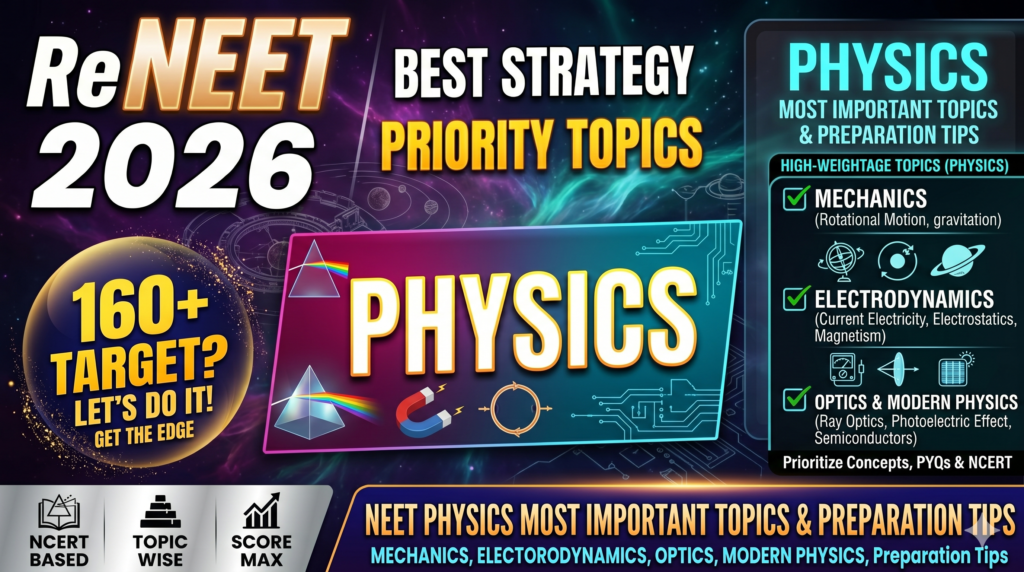
Physics in NEET 2026 — Structure and Weightage Overview
The Physics section follows Class 11 and Class 12 NCERT content, with Class 12 carrying slightly higher weightage — approximately 54% — compared to Class 11 at 46%. The paper from May 3rd, 2026 confirmed what past years have consistently shown: questions are concept-driven, application-oriented, and require clear understanding rather than formula memorization.
Here is the broad unit-wise breakdown based on previous NEET trends:
| Unit | Approximate Weightage |
|---|---|
| Mechanics (Class 11) | 20–22% (~9–10 questions) |
| Electrodynamics (Class 12) | 20–22% (~9–10 questions) |
| Modern Physics (Class 12) | 14–16% (~6–7 questions) |
| Optics (Class 12) | 10–12% (~5 questions) |
| Thermodynamics (Class 11) | 8–10% (~4 questions) |
| Magnetism (Class 12) | 8–10% (~4 questions) |
| Waves and Oscillations (Class 11) | 6–8% (~3 questions) |
| Semiconductors (Class 12) | 5–6% (~2–3 questions) |
Now let us go through each unit with exactly what to study and how.
You may also like:
- Re-NEET 2026 Complete Study Plan: 40-Day Best Strategy to Score 650+
- Re-NEET 2026 Biology High-Weightage Chapters You Can’t Skip
- Re-NEET 2026 Chemistry Most Important Topics & Preparation Tips
- NEET 2026 Re-Exam Date Announcement: Expected Schedule, New Rules & What Every Student Must Know
UNIT 1: Mechanics — The Largest and Most Foundational Unit
Mechanics is the backbone of Physics. It covers the bulk of Class 11 Physics and contributes the highest number of questions in the paper. More importantly, a weak Mechanics foundation makes Class 12 topics like Electrodynamics and Modern Physics harder — the problem-solving approach carries over.
Laws of Motion (Class 11) ⭐⭐⭐
What to focus on:
- Newton’s three laws — conceptual clarity, not just statements
- Free Body Diagrams (FBD) — draw them for every problem, no exceptions
- Friction — static, kinetic, limiting friction; angle of friction
- Circular motion — centripetal force, banking of roads
- Pulley and Atwood machine problems
Preparation tip: Every Mechanics problem becomes easier when you draw an FBD first. Train yourself to do this automatically — it eliminates 80% of sign convention and direction errors.
Work, Energy, and Power (Class 11) ⭐⭐⭐
What to focus on:
- Work-energy theorem — application to variable forces
- Conservation of mechanical energy
- Elastic and inelastic collisions — coefficient of restitution
- Power — instantaneous and average
- Potential energy curves — identifying stable and unstable equilibrium
Rotational Motion (Class 11) ⭐⭐⭐
One of the most numerically intensive chapters in NEET Physics. Questions here require combining multiple concepts in one problem.
What to focus on:
- Moment of inertia — formulas for standard bodies (ring, disc, sphere, rod)
- Parallel and perpendicular axes theorems
- Torque and angular momentum
- Conservation of angular momentum — applications
- Rolling motion — rolling without slipping condition
Kinematics (Class 11) ⭐⭐
What to focus on:
- Equations of motion — application to projectile problems
- Relative velocity — 1D and 2D
- Graphs — displacement-time, velocity-time, acceleration-time interpretation
Gravitation (Class 11) ⭐⭐
What to focus on:
- Universal law of gravitation — variation of g with height, depth, latitude
- Orbital velocity and escape velocity — derivations and applications
- Kepler’s laws — especially the third law numerical
- Geostationary satellites — conditions
Properties of Matter — Fluids (Class 11) ⭐
What to focus on:
- Bernoulli’s theorem — application problems
- Viscosity — Stokes’ law, terminal velocity
- Surface tension — excess pressure in bubble vs drop vs cavity
UNIT 2: Electrodynamics — The Highest-Scoring Class 12 Unit
Electrodynamics is the most important Class 12 unit for Re-NEET 2026 physics preparation strategy. It spans four interconnected chapters and contributes nearly 9–10 questions consistently. Students who master this unit gain a massive advantage.
Electrostatics (Class 12) ⭐⭐⭐
What to focus on:
- Coulomb’s law — force between multiple charges
- Electric field and potential — point charge, dipole, uniformly charged sphere
- Gauss’s law — applications to find field for symmetric charge distributions
- Capacitance — parallel plate, combinations of capacitors, energy stored
- Effect of dielectric on capacitors
Current Electricity (Class 12) ⭐⭐⭐
This is consistently one of the top two or three highest-scoring chapters in the entire Physics section. Expect 3–4 questions directly from here in every NEET paper.
What to focus on:
- Ohm’s law and its limitations
- Resistivity and conductivity — temperature dependence
- Series and parallel combinations — complex circuit problems
- Kirchhoff’s laws — mesh and node analysis
- Wheatstone bridge — balanced condition and application
- Potentiometer — comparison of EMFs, internal resistance measurement
- Metre bridge — practical setup
Preparation tip: Practice circuit problems every single day. Speed and accuracy in Current Electricity questions directly translates to marks. Time spent here is among the highest ROI in Physics.
Electromagnetic Induction and Alternating Currents (Class 12) ⭐⭐⭐
What to focus on:
- Faraday’s laws — induced EMF calculations
- Lenz’s law — direction of induced current
- Motional EMF — rod moving in magnetic field
- Self and mutual inductance
- LC oscillations — energy interchange
- AC circuits — impedance, phase difference, resonance condition
- Transformer — turns ratio, efficiency, power loss
Electromagnetic Waves (Class 12) ⭐
Short chapter but 1–2 predictable questions every year.
What to focus on:
- Properties of EM waves
- EM spectrum — wavelength ranges and applications of each type
- Displacement current — concept
UNIT 3: Magnetism — The Bridge Between Units
Moving Charges and Magnetism (Class 12) ⭐⭐
What to focus on:
- Biot-Savart law and Ampere’s circuital law — applications
- Force on a moving charge — magnetic field direction (use Fleming’s rule)
- Cyclotron — principle and limitations
- Force on a current-carrying conductor in a magnetic field
- Torque on a current loop — galvanometer principle
Magnetism and Matter (Class 12) ⭐
What to focus on:
- Dia, para, and ferromagnetic materials — properties and examples
- Hysteresis curve — area significance, retentivity, coercivity
- Earth’s magnetism — declination, dip, horizontal component
UNIT 4: Optics — Reliable Marks Every Year
Optics is one of the most predictable sections in NEET Physics. The same types of questions reappear year after year, which means strong Optics preparation is almost guaranteed marks.
Ray Optics (Class 12) ⭐⭐⭐
What to focus on:
- Laws of reflection and refraction — numerical applications
- Total internal reflection — critical angle, optical fibre
- Refraction at spherical surfaces — lens maker’s equation
- Mirror and lens formulas — sign convention is critical
- Power of a lens — combination of lenses
- Human eye — defects and corrections with lens power
- Optical instruments — microscope and telescope — magnification formulas
Wave Optics (Class 12) ⭐⭐
What to focus on:
- Huygens’ principle — wave propagation
- Young’s double slit experiment — fringe width, condition for bright and dark fringes
- Diffraction — single slit, central maximum width
- Polarization — Brewster’s law, Malus’s law
UNIT 5: Modern Physics — The Most Scoring Class 12 Unit
Modern Physics is where many students pick up easy marks because the question types are highly predictable and the concepts are well-defined. This is a unit you absolutely cannot afford to underperform in.
Dual Nature of Matter and Radiation (Class 12) ⭐⭐⭐
What to focus on:
- Photoelectric effect — threshold frequency, work function, stopping potential
- Einstein’s photoelectric equation — numerical problems
- de Broglie wavelength — applications
- Davisson-Germer experiment — confirmation of wave nature
Atoms and Nuclei (Class 12) ⭐⭐⭐
What to focus on:
- Bohr’s model of hydrogen atom — energy levels, radius, velocity
- Spectral series — Lyman, Balmer, Paschen — wavelength formula
- Nuclear binding energy — mass defect calculations
- Radioactivity — alpha, beta, gamma decay — laws
- Half-life and mean life — numerical problems
- Nuclear fission and fusion — Q-value concept
Semiconductor Electronics (Class 12) ⭐⭐
This chapter is frequently underestimated. Questions are direct, conceptual, and entirely NCERT-based — making it one of the easiest scoring chapters in Physics.
What to focus on:
- Energy band theory — conductor, semiconductor, insulator
- p-type and n-type semiconductors — majority and minority carriers
- p-n junction diode — forward and reverse bias, I-V characteristics
- Rectifiers — half wave and full wave
- Zener diode — voltage regulation
- Logic gates — AND, OR, NOT, NAND, NOR — truth tables and Boolean expressions
- Transistors — CB, CE, CC configurations; CE amplifier basics
UNIT 6: Thermodynamics and Oscillations
Thermodynamics (Class 11) ⭐⭐
What to focus on:
- Zeroth, first, second, third laws — statements and applications
- Thermodynamic processes — isothermal, adiabatic, isochoric, isobaric
- Work done in each process — PV diagrams
- Carnot engine — efficiency formula
- Refrigerator — coefficient of performance
Oscillations and Waves (Class 11) ⭐⭐
What to focus on:
- SHM — equations of displacement, velocity, acceleration
- Simple pendulum and spring-mass system — time period formulas
- Resonance — condition and examples
- Speed of sound — Newton’s formula and Laplace correction
- Doppler effect — all cases with formula
5 Preparation Tips That Actually Work for Physics
Tip 1 — Build a dedicated formula notebook. Physics has hundreds of formulas across chapters. Maintain a single notebook organized by chapter — formula, unit, condition of applicability. Review it every morning for 10 minutes. This alone can recover 15–20 marks lost to formula confusion.
Tip 2 — Solve 10 numericals per chapter before moving on. Do not revise a chapter by reading theory alone. After every chapter, solve at least 10 PYQ numericals specifically from that chapter. This bridges the gap between knowing a concept and applying it under exam pressure.
Tip 3 — Never skip Semiconductors. Students consistently underestimate this chapter. It is short, NCERT-based, and the questions are almost always direct. Three guaranteed questions for two to three days of focused study is exceptional return on investment.
Tip 4 — Use the three-round method in the exam. In the actual exam, attempt Physics in three passes — first, solve all direct and conceptual questions you are confident about. Second, attempt numerical problems you can set up. Third, return to the remaining questions with leftover time. This protects your score from time mismanagement.
Tip 5 — Treat NCERT examples as exam questions. NEET Physics questions are frequently modeled on NCERT solved examples with changed numbers. Work through every NCERT example and in-text question as if it were a real exam problem.
Re-NEET 2026 Physics Preparation — 20-Day Revision Schedule
| Days | Focus Area |
|---|---|
| Day 1–3 | Mechanics — Laws of Motion, Work-Energy, Rotational Motion |
| Day 4–5 | Kinematics, Gravitation, Fluids |
| Day 6–8 | Electrostatics + Current Electricity |
| Day 9–10 | EMI + AC Circuits + EM Waves |
| Day 11–12 | Magnetism (both chapters) |
| Day 13–14 | Ray Optics + Wave Optics |
| Day 15–16 | Modern Physics — Dual Nature + Atoms + Nuclei |
| Day 17 | Semiconductors (full chapter in one day) |
| Day 18 | Thermodynamics + Oscillations + Waves |
| Day 19–20 | Full-length mock test + complete error analysis |
Final Word
Physics does not have to be your weakest subject in Re-NEET 2026. Every single chapter in NEET Physics is learnable, and the question patterns repeat enough across years that a well-prepared student can predict where marks will come from. The Re-NEET 2026 physics preparation strategy in this guide is not about studying harder — it is about knowing exactly where to focus, how to practice, and how to approach the paper on exam day.
Combine this with the Re-NEET 2026 Complete Study Plan and the subject-wise guides for Biology and Chemistry to build a complete preparation system.
Check the official NTA website regularly for Re-NEET 2026 exam dates and admit card updates.
Frequently Asked Questions (FAQ)
Q1. Which is the most important chapter in Physics for Re-NEET 2026? Current Electricity and Modern Physics are consistently the two highest-scoring chapters. Current Electricity requires strong numerical practice, while Modern Physics is more conceptual with predictable question patterns. Together they can contribute 6–8 questions, making them the highest priority in your Re-NEET 2026 physics preparation strategy.
Q2. How can I improve my Physics score quickly for Re-NEET 2026? The fastest improvement comes from three areas: Semiconductors (direct NCERT questions, easy to master in 2 days), Modern Physics (predictable patterns, concept-based), and Ray Optics (formula-based, consistent questions). Focus on these three first for quick score gains before tackling the heavier Mechanics and Electrodynamics chapters.
Q3. Is NCERT enough for Physics in Re-NEET 2026? NCERT is the foundation and must be thoroughly read — most questions are based on NCERT concepts, examples, and diagrams. However, Physics also requires numerical practice beyond NCERT. Use previous year NEET papers and the NTA Abhyas App for additional problem-solving practice, especially for Mechanics and Electrodynamics.
Q4. How much time should I give Physics daily for Re-NEET 2026? A minimum of 2.5 to 3 hours daily is recommended. Split it as: 1 hour for concept revision or new chapter, 1 hour for numericals and PYQs, and 30–45 minutes for formula revision and weak chapter targeting. Consistency matters far more than occasional long study sessions.
Q5. What is the biggest mistake students make in Physics preparation for NEET? The most common mistake is spending too much time on difficult Mechanics derivations while neglecting high-scoring, easy chapters like Semiconductors, EM Waves, and Modern Physics. Smart Re-NEET 2026 physics preparation strategy means picking up guaranteed marks from predictable chapters before fighting for marks in tougher ones.
Q6. How should I handle Physics negative marking in Re-NEET 2026? Avoid attempting questions where you genuinely have no conceptual anchor. However, if you can eliminate two wrong options confidently, the probability favors attempting. In Physics especially, units and dimensional analysis can often help you eliminate options even when the concept is unclear — making an informed guess better than a complete skip.
Q7. Can I realistically improve my Physics score by 20–30 marks for Re-NEET 2026? Yes, absolutely. A 20–30 mark improvement is very achievable in 30–40 days if you focus on: consolidating Semiconductors and Modern Physics (high yield, low effort), strengthening Current Electricity numericals, and eliminating silly mistakes through regular mock test analysis. These three changes alone can add 20+ marks.