Chemistry is the great equalizer in NEET. Biology decides your ceiling, Physics tests your patience — but Chemistry is where smart students quietly build a lead. With 45 questions and 180 marks, a well-prepared Chemistry section can be the difference between a rank of 5,000 and a rank of 500.
For Re-NEET 2026, the stakes are even higher. With the exam cancelled and rescheduled for approximately late June to early July 2026, you have a genuine second shot. The Re-NEET 2026 chemistry best strategy is not about studying more — it is about knowing exactly which chapters deserve your time and which approach works for each of the three sections.
This guide breaks it all down, section by section.
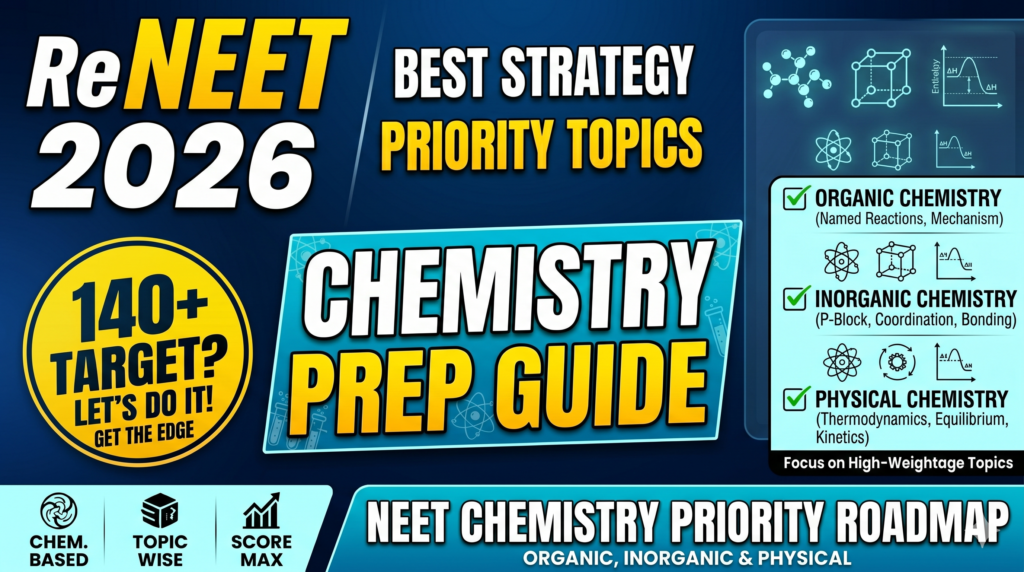
Chemistry in NEET 2026 — The Structure
The Chemistry section has 45 questions worth 180 marks, divided across three sections:
| Section | Expected Questions | Expected Marks |
|---|---|---|
| Physical Chemistry | 15–18 questions | 60–72 marks |
| Organic Chemistry | 14–17 questions | 56–68 marks |
| Inorganic Chemistry | 10–13 questions | 40–52 marks |
All three sections carry roughly equal importance, which means you cannot afford to neglect any one of them. However, within each section, certain chapters consistently dominate the paper year after year. That is where your Re-NEET 2026 chemistry best strategy begins.
The target for this guide: score 140+ in Chemistry.
You may also like:
- Re-NEET 2026 Complete Study Plan: 40-Day Best Strategy to Score 650+
- Re-NEET 2026 Biology High-Weightage Chapters You Can’t Skip
- Re-NEET 2026 Physics Most Important Topics & Preparation Tips
PART 1: Physical Chemistry — Concept First, Numbers Second
Physical Chemistry is the most formula-heavy section of NEET Chemistry. Students who approach it by memorizing formulas without understanding concepts struggle when questions are framed in unfamiliar ways. The Re-NEET 2026 chemistry best strategy for Physical Chemistry is to understand the concept behind every formula first, then practice numericals until the application becomes instinctive.
1. Mole Concept and Stoichiometry (Class 11) ⭐⭐⭐
This is the foundation of Physical Chemistry. If your mole concept is shaky, everything built on top of it — solutions, electrochemistry, gaseous state — will feel harder than it needs to be.
What to focus on:
- Mole-mass-number relationships
- Empirical and molecular formula calculations
- Limiting reagent problems
- Percentage composition and yield
- Concentration expressions — molarity, molality, mole fraction, normality
Practice tip: Solve at least 40 PYQ numericals from this chapter before moving on. The question types repeat — only the numbers change.
2. Chemical Equilibrium and Ionic Equilibrium (Class 11) ⭐⭐⭐
This is consistently one of the highest-scoring Physical Chemistry chapters in NEET, with both conceptual and numerical questions appearing regularly.
What to focus on:
- Kc and Kp — relationship and calculations
- Le Chatelier’s principle — effect of temperature, pressure, concentration
- Degree of dissociation
- pH calculations — strong acid, weak acid, buffer solutions
- Solubility product (Ksp) and common ion effect
- Henderson-Hasselbalch equation
3. Chemical Kinetics (Class 12) ⭐⭐⭐
One of the most consistent chapters across all recent NEET papers. Expect 2–3 questions directly from here.
What to focus on:
- Rate of reaction — average and instantaneous
- Order vs molecularity — the difference is frequently tested
- First-order reactions — half-life formula and calculations
- Arrhenius equation — activation energy problems
- Effect of temperature on rate constant
4. Electrochemistry (Class 12) ⭐⭐⭐
Electrochemistry is a high-yield chapter that rewards students who understand the logic rather than just formulas.
What to focus on:
- Galvanic vs electrolytic cells — differences
- Standard electrode potential — cell EMF calculations
- Nernst equation — numerical problems
- Faraday’s laws of electrolysis — both laws, calculations
- Conductance — specific, molar, equivalent
- Kohlrausch’s law
5. Thermodynamics (Class 11) ⭐⭐
What to focus on:
- First, second, and third laws — statements and implications
- Enthalpy, entropy, Gibbs free energy
- Hess’s law calculations
- Spontaneity — relationship between ΔG, ΔH, ΔS
6. Solutions (Class 12) ⭐⭐
What to focus on:
- Raoult’s law — ideal and non-ideal solutions
- Colligative properties — elevation of boiling point, depression of freezing point, osmotic pressure
- van’t Hoff factor — for electrolytes and non-electrolytes
- Abnormal molecular mass
Other Physical Chemistry Chapters to Cover
Solid State, Surface Chemistry, and Atomic Structure carry moderate weightage and should be revised from NCERT — 1–2 questions appear from these chapters regularly. Do not skip them; they offer predictable, straightforward questions.
PART 2: Organic Chemistry — Understand the Mechanism, Don’t Memorize It
Organic Chemistry is where most students either score very well or lose marks unnecessarily. The difference is almost always approach. Students who memorize reactions fail when questions are framed from a mechanism angle. Students who understand why reactions happen can answer questions they have never seen before.
For Re-NEET 2026 chemistry best strategy, Organic Chemistry should be your highest-confidence section.
1. General Organic Chemistry — GOC (Class 11) ⭐⭐⭐
GOC is the single most important chapter in Organic Chemistry. Every other Organic chapter builds on it. If your GOC is strong, the rest of Organic becomes significantly easier.
What to focus on:
- Hybridization — sp3, sp2, sp — bond angles, geometry
- Inductive effect — +I and -I groups, stability implications
- Resonance — rules, stability of resonance structures
- Hyperconjugation — stability of carbocations and alkenes
- Electrophiles and nucleophiles — definitions and examples
- Types of reactions — substitution, addition, elimination
- Reaction intermediates — carbocation, carbanion, free radical stability
NCERT tip: NCERT covers GOC in excellent depth. Read it three times, not once.
2. Aldehydes, Ketones, and Carboxylic Acids (Class 12) ⭐⭐⭐
This is consistently the highest-weightage Organic Chemistry chapter in NEET, with 3–4 questions appearing in most years.
What to focus on:
- Nucleophilic addition reactions — mechanism and products
- Aldol condensation — condition and product
- Cannizzaro reaction — when it occurs and why
- Hell-Volhard-Zelinsky reaction
- Carboxylic acid derivatives — acyl chloride, ester, amide
- Comparative reactivity of aldehydes vs ketones
3. Amines (Class 12) ⭐⭐⭐
What to focus on:
- Classification — primary, secondary, tertiary, quaternary
- Basicity order — aliphatic vs aromatic amines, reasons
- Reactions — acylation, Hinsberg test, carbylamine test
- Diazonium salts — preparation and reactions (Sandmeyer, Balz-Schiemann)
4. Haloalkanes and Haloarenes (Class 12) ⭐⭐
What to focus on:
- SN1 vs SN2 — conditions, stereochemistry
- E1 vs E2 elimination
- Reactions of haloarenes — nucleophilic aromatic substitution
- Named reactions — Wurtz, Finkelstein, Swarts
5. Alcohols, Phenols, and Ethers (Class 12) ⭐⭐
What to focus on:
- Acidity of phenols vs alcohols — reasons
- Lucas test — identifying alcohol types
- Reactions of phenols — Kolbe’s, Reimer-Tiemann, Fries rearrangement
- Williamson synthesis for ethers
6. Hydrocarbons (Class 11) ⭐⭐
What to focus on:
- Alkane — free radical halogenation mechanism
- Alkene — electrophilic addition, Markovnikov’s rule, anti-Markovnikov
- Alkyne — acidic character, reactions
- Benzene — aromaticity (Hückel’s rule), EAS mechanism
7. Biomolecules and Polymers (Class 12) ⭐
Short chapters but reliable for 1–2 easy questions each. Cover them from NCERT only — the questions are almost always direct facts.
Biomolecules: Carbohydrates (reducing vs non-reducing sugars), amino acid structure, enzyme properties, nucleic acids — DNA vs RNA differences.
Polymers: Addition vs condensation polymers, natural vs synthetic, examples of each type. Teflon, Nylon-6,6, Bakelite, Buna-S, Buna-N — know each one.
PART 3: Inorganic Chemistry — NCERT Is Your Only Book
Let this be said clearly: for Inorganic Chemistry, NCERT is the only resource you need. Almost every Inorganic question in NEET is a direct fact from the NCERT textbook — a property, a trend, a reaction, or an application. Students who read NCERT Inorganic thoroughly score full marks here. Students who rely on notes and summaries leave marks on the table.
1. Coordination Compounds (Class 12) ⭐⭐⭐
One of the highest-weightage Inorganic chapters — expect 3–4 questions consistently.
What to focus on:
- IUPAC nomenclature of coordination compounds — rules and practice
- Werner’s theory
- Crystal Field Theory — splitting, high spin vs low spin
- Isomerism — structural (ionization, linkage, solvate) and stereoisomerism (geometric, optical)
- Stability constants
- Colour, magnetism, and geometry relationships
- Organometallic compounds — examples
2. p-Block Elements (Class 11 and 12) ⭐⭐⭐
p-Block is the largest Inorganic unit and carries high weightage across both Class 11 (Groups 13 and 14) and Class 12 (Groups 15, 16, 17, 18).
What to focus on:
- Group 15 — allotropes of phosphorus, oxoacids of phosphorus and nitrogen
- Group 16 — allotropes of sulphur, oxoacids of sulphur, H2SO4 preparation
- Group 17 (Halogens) — interhalogen compounds, oxoacids of chlorine, trends
- Group 18 (Noble gases) — properties, xenon compounds
- Anomalous behaviour of first element in each group
3. Chemical Bonding and Molecular Structure (Class 11) ⭐⭐⭐
This chapter bridges Physical and Inorganic Chemistry and carries consistent weightage.
What to focus on:
- VSEPR theory — geometries and bond angles
- Hybridization — with and without lone pairs
- MO theory — bond order, magnetic character of O2, N2, F2
- Dipole moment — polarity, predicting geometry from dipole moment
- Hydrogen bonding — inter vs intramolecular, effect on properties
4. d and f Block Elements (Class 12) ⭐⭐
What to focus on:
- General properties — variable oxidation states, catalytic activity, coloured compounds
- Important compounds — KMnO4 (preparation and reactions), K2Cr2O7 (preparation and reactions)
- Lanthanoids and actinoids — key differences, lanthanoid contraction
5. General Principles and Processes of Isolation of Elements (Class 12) ⭐
What to focus on:
- Concentration methods — froth flotation, leaching, magnetic separation
- Reduction methods — thermite, carbon reduction, electrolytic
- Refining — vapour phase, zone refining, electrolytic refining
- Ellingham diagram — concept and use
The Chemistry Approach That Actually Works
Here is the Re-NEET 2026 chemistry best strategy in three clear rules:
Rule 1 — NCERT first, always. For Inorganic and Organic both, NCERT is the primary source. Reference books supplement; they do not replace.
Rule 2 — Solve PYQs chapter-wise. After finishing each chapter, solve all previous year questions from that chapter specifically. This reveals the exact type of question NTA asks and builds pattern recognition faster than any other method.
Rule 3 — Never skip Inorganic. Many students deprioritize Inorganic because it feels like rote learning. That is a costly mistake. Inorganic questions are among the easiest in the paper — they are direct, factual, and completely predictable if you have read NCERT. Ten minutes of Inorganic revision daily can protect 40–52 marks.
Final Word
Chemistry in Re-NEET 2026 is winnable for every student who approaches it with a clear plan. Physical Chemistry rewards consistent practice, Organic Chemistry rewards conceptual understanding, and Inorganic Chemistry rewards regular NCERT revision. Master all three with this Re-NEET 2026 chemistry best strategy and 140+ is an entirely realistic target.
Stay updated on Re-NEET 2026 exam dates and admit card releases at the official NTA website.
Frequently Asked Questions (FAQ)
Q1. Which section of Chemistry is easiest to score in for Re-NEET 2026? Inorganic Chemistry is the most straightforward section for scoring if you read NCERT thoroughly. Questions are almost entirely fact-based and directly lifted from NCERT text. Students who revise Inorganic regularly can score full marks in this section with minimal effort compared to Physical or Organic Chemistry.
Q2. How many questions come from Organic Chemistry in NEET? Based on previous year trends, Organic Chemistry contributes approximately 14–17 questions out of 45 in the Chemistry section. This makes it the second-highest contributor after Physical Chemistry and a critical area for Re-NEET 2026 chemistry best strategy.
Q3. Is NCERT enough for Physical Chemistry in Re-NEET 2026? NCERT covers Physical Chemistry concepts adequately, but you will need additional practice through PYQs and mock tests for numerical problems. Conceptual theory from NCERT plus consistent numerical practice is the ideal combination.
Q4. What is the most important chapter in Organic Chemistry for Re-NEET 2026? General Organic Chemistry (GOC) is the most foundational chapter. Without a strong GOC base, understanding reaction mechanisms in Aldehydes, Amines, and Haloalkanes becomes significantly harder. Invest time here — it pays dividends across every other Organic chapter.
Q5. How should I revise Inorganic Chemistry in the final 10 days? In the final 10 days, avoid re-reading Inorganic chapters from scratch. Instead, maintain a concise revision sheet with reactions, trends, exceptions, and named compounds. Review it every morning for 15 minutes. This spaced repetition locks in factual data far more effectively than repeated full reads.
Q6. How much time should I allocate to Chemistry daily in my Re-NEET 2026 preparation? A daily allocation of 2.5 to 3 hours for Chemistry is sufficient if used well. Divide it roughly as: 1 hour Physical Chemistry (concept + numericals), 1 hour Organic (mechanisms + reactions), 30–45 minutes Inorganic (NCERT facts + revision). Adjust based on your weak areas.