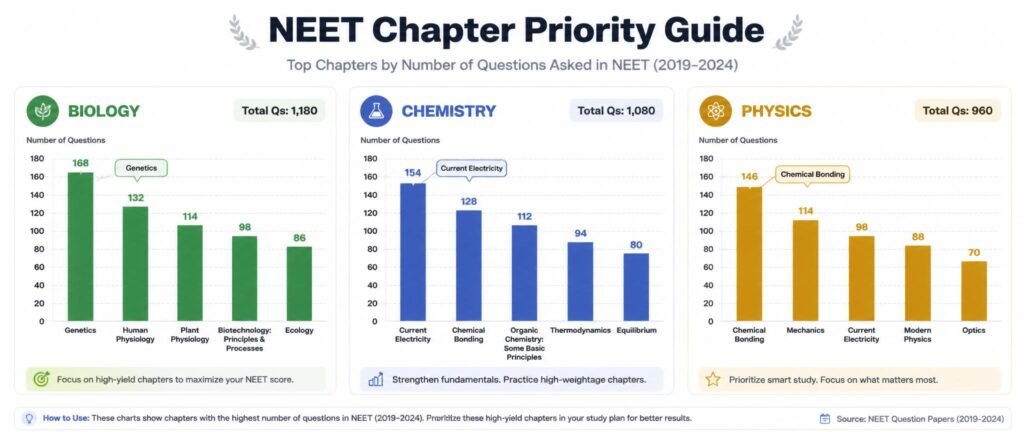
With 12 days left before June 21, the single most valuable question you can answer is: which chapters give the most marks per hour of revision? This is exactly what the Re-NEET 2026 chapter wise weightage analysis answers.
This is the complete Re-NEET 2026 chapter wise weightage guide — built from 5-year NEET data — built from 5-year NEET chapter wise marks distribution 2026 data (2020–2025), subject-wise breakdowns, and a marks-per-hour efficiency column that tells you exactly where to spend your final revision hours.
Table of Contents
How to Read This Re-NEET 2026 Chapter Wise Weightage Guide
Each table has three columns beyond the basic chapter data:
- Avg Questions: average questions from this chapter across NEET 2020–2025
- Marks: avg questions × 4
- Priority: based on marks + ease of revision in final 12 days
Priority tiers:
- 🔴 Must revise — high marks, high consistency, most are NCERT direct
- 🟡 Should revise — medium marks, important for score range 580–640
- 🟢 If time permits — lower frequency or formula-heavy
Re-NEET 2026 Biology Chemistry Physics Weightage: Biology — 90 Questions, 360 Marks
Biology is where NEET marks are won fastest — and where the Re-NEET 2026 chapter wise weightage analysis shows the biggest gap between effort and reward. Use the Biology last 15 days plan guide for chapter-specific revision. Most questions are direct NCERT recall — no calculation, no derivation.
| Chapter | Class | Avg Questions | Marks | Priority |
|---|---|---|---|---|
| Genetics & Evolution | 12 | 12–14 | 48–56 | 🔴 Must revise |
| Human Physiology | 11 | 10–12 | 40–48 | 🔴 Must revise |
| Sexual Reproduction in Plants | 12 | 8–10 | 32–40 | 🔴 Must revise |
| Human Reproduction | 12 | 6–8 | 24–32 | 🔴 Must revise |
| Plant Kingdom | 11 | 5–6 | 20–24 | 🔴 Must revise |
| Cell Structure & Function | 11 | 5–6 | 20–24 | 🔴 Must revise |
| Ecology & Environment | 12 | 5–6 | 20–24 | 🔴 Must revise |
| Biological Classification | 11 | 4–5 | 16–20 | 🟡 Should revise |
| Morphology of Flowering Plants | 11 | 3–4 | 12–16 | 🟡 Should revise |
| Biotechnology | 12 | 3–4 | 12–16 | 🟡 Should revise |
| Animal Kingdom | 11 | 3–4 | 12–16 | 🟡 Should revise |
| Reproductive Health | 12 | 2–3 | 8–12 | 🟡 Should revise |
| Biomolecules | 11 | 2–3 | 8–12 | 🟡 Should revise |
| Microbes in Human Welfare | 12 | 2–3 | 8–12 | 🟡 Should revise |
| Body Fluids & Circulation | 11 | 2–3 | 8–12 | 🟢 If time permits |
| All remaining chapters | 11/12 | 1–2 each | 4–8 | 🟢 If time permits |
Biology insight: The Re-NEET 2026 high weightage chapters in Biology are clear — Genetics alone gives 48–56 marks. Combined with Human Physiology and the two Reproduction chapters, these four chapters cover approximately 140–170 marks — nearly 40% of your total Biology allocation. If you have 3 days left, revise only these four.
Your Re-NEET 2026 Biology quick revision list has the exact NCERT lines for these chapters.
Chemistry — 45 Questions, 180 Marks
Chemistry splits into Physical (calculation-heavy), Organic (reaction-based), and Inorganic (fact-based). For the final 12 days, Inorganic gives the best return per revision hour.
| Chapter | Class | Avg Questions | Marks | Priority |
|---|---|---|---|---|
| Chemical Bonding & Molecular Structure | 11 | 3–4 | 12–16 | 🔴 Must revise |
| Coordination Compounds | 12 | 3–4 | 12–16 | 🔴 Must revise |
| p-Block Elements (Class 12) | 12 | 3–4 | 12–16 | 🔴 Must revise |
| Aldehydes, Ketones & Carboxylic Acids | 12 | 3–4 | 12–16 | 🔴 Must revise |
| Electrochemistry | 12 | 2–3 | 8–12 | 🔴 Must revise |
| Chemical Kinetics | 12 | 2–3 | 8–12 | 🔴 Must revise |
| Solutions | 12 | 2–3 | 8–12 | 🟡 Should revise |
| Organic Chemistry — Basic Principles | 11 | 2–3 | 8–12 | 🟡 Should revise |
| Equilibrium | 11 | 2–3 | 8–12 | 🟡 Should revise |
| Thermodynamics | 11 | 2–3 | 8–12 | 🟡 Should revise |
| d and f-Block Elements | 12 | 2–3 | 8–12 | 🟡 Should revise |
| Haloalkanes & Haloarenes | 12 | 2–3 | 8–12 | 🟡 Should revise |
| Some Basic Concepts (Mole Concept) | 11 | 2–3 | 8–12 | 🟡 Should revise |
| p-Block Elements (Class 11) | 11 | 2–3 | 8–12 | 🟢 If time permits |
| Alcohols, Phenols & Ethers | 12 | 1–2 | 4–8 | 🟢 If time permits |
| Amines | 12 | 1–2 | 4–8 | 🟢 If time permits |
| Remaining chapters | 11/12 | 1 each | 4 | 🟢 If time permits |
Chemistry insight on NEET 2026 most important chapters: The top 6 chapters (Chemical Bonding, Coordination Compounds, p-Block Class 12, Aldehydes/Ketones, Electrochemistry, Chemical Kinetics) together give approximately 60–80 marks. This is where your Re-NEET 2026 Chemistry quick revision list pays off directly.
Physics — 45 Questions, 180 Marks
Physics has the most numerical questions in NEET. Chapter-wise, the four Class 12 chapters below dominate.
| Chapter | Class | Avg Questions | Marks | Priority |
|---|---|---|---|---|
| Electrostatics | 12 | 3–4 | 12–16 | 🔴 Must revise |
| Current Electricity | 12 | 3–4 | 12–16 | 🔴 Must revise |
| Ray Optics | 12 | 3–4 | 12–16 | 🔴 Must revise |
| Modern Physics | 12 | 3–4 | 12–16 | 🔴 Must revise |
| Laws of Motion | 11 | 2–3 | 8–12 | 🔴 Must revise |
| Magnetism & Moving Charges | 12 | 2–3 | 8–12 | 🟡 Should revise |
| Work, Energy & Power | 11 | 2–3 | 8–12 | 🟡 Should revise |
| Electromagnetic Induction | 12 | 2–3 | 8–12 | 🟡 Should revise |
| Kinematics | 11 | 2–3 | 8–12 | 🟡 Should revise |
| Rotational Motion | 11 | 2–3 | 8–12 | 🟡 Should revise |
| Semiconductors | 12 | 2–3 | 8–12 | 🟡 Should revise |
| Alternating Current | 12 | 1–2 | 4–8 | 🟡 Should revise |
| Wave Optics | 12 | 1–2 | 4–8 | 🟡 Should revise |
| Gravitation | 11 | 1–2 | 4–8 | 🟢 If time permits |
| Thermodynamics (Physics) | 11 | 1–2 | 4–8 | 🟢 If time permits |
| Remaining chapters | 11/12 | 1 each | 4 | 🟢 If time permits |
Physics insight: The Re-NEET 2026 high weightage chapters in Physics are all Class 12 — (Electrostatics, Current Electricity, Ray Optics, Modern Physics) together give approximately 48–64 marks. If you have limited time, these four chapters plus Laws of Motion cover the bulk of Physics marks. Your Re-NEET 2026 Physics quick revision covers all the conceptual lines for these chapters.
The Re-NEET 2026 Chapter Wise Weightage Efficiency Table: Marks Per Hour
This is the most useful part of the Re-NEET 2026 chapter wise weightage analysis — not just marks, but marks per hour of revision for the final 12 days.
| Chapter | Marks Available | Avg Revision Hours Needed | Marks Per Hour |
|---|---|---|---|
| Genetics & Evolution | 48–56 | 4–5 hours | ~11 |
| Human Physiology | 40–48 | 4–5 hours | ~10 |
| Inorganic Chemistry (p-Block + d-Block) | 24–32 | 2–3 hours | ~10 |
| Modern Physics | 12–16 | 1–2 hours | ~9 |
| Coordination Compounds | 12–16 | 1–2 hours | ~9 |
| Sexual Reproduction in Plants | 32–40 | 4 hours | ~9 |
| Ray Optics | 12–16 | 1.5–2 hours | ~8 |
| Current Electricity | 12–16 | 2 hours | ~7 |
| Ecology & Environment | 20–24 | 3 hours | ~7 |
| Chemical Bonding | 12–16 | 2 hours | ~7 |
| Electrostatics | 12–16 | 2 hours | ~7 |
| Rotational Motion | 8–12 | 3 hours | ~4 |
| Thermodynamics (Chemistry) | 8–12 | 3 hours | ~4 |
Key finding from the NEET chapter wise marks distribution 2026 data: Inorganic Chemistry (p-Block + d-Block) is the highest-efficiency revision target in Chemistry because it is purely factual — no numericals, no derivations. Genetics and Human Physiology dominate Biology for the same reason.
Time-Left Strategy: Using Re-NEET 2026 Chapter Wise Weightage by Days Remaining
If you have 10+ days (before June 11)
Cover all 🔴 Must revise chapters from all three subjects. Aim for at least 2 full mock tests.
If you have 5–7 days (June 12–16)
Focus only on 🔴 Must revise. Do one mock test mid-week. Use the final week revision guide guide for the day-by-day split.
If you have 3 days (June 18–20)
Biology: Genetics + Human Physiology + Reproduction only Chemistry: Coordination Compounds + p-Block + Aldehydes/Ketones Physics: Modern Physics + Ray Optics + Current Electricity + Electrostatics
No new chapters. No mock tests after June 18. Use the Re-NEET 2026 time management strategy on exam day to allocate time to these chapters in order of marks. Consolidation only.
The Re-NEET 2026 48-hour protocol guide maps this into an hour-by-hour schedule.
FAQ Section
Q: What does the NEET chapter wise marks distribution 2026 show for subject totals? A: Biology with 360 marks (90 questions × 4 marks) is the highest-scoring subject — exactly half the paper. Chemistry and Physics are 180 marks each. This is why every effective Re-NEET 2026 chapter wise weightage strategy prioritises Biology first.
Q: Which is the single most important chapter among NEET 2026 most important chapters? A: Genetics & Evolution from Class 12 Biology, consistently contributing 12–14 questions (48–56 marks) every year. No other single chapter comes close. If you’re short on time, this is the one chapter that must be revised regardless.
Q: Which Chemistry chapter gives the most marks in NEET? A: Chemical Bonding, Coordination Compounds, and p-Block Elements (Class 12) each contribute 3–4 questions consistently. Combined with Aldehydes/Ketones and Electrochemistry, these five chapters cover approximately 70–80% of Chemistry marks.
Q: For Re-NEET 2026 Biology Chemistry Physics weightage, which class is more important? A: Class 12 has a slight edge in terms of direct NCERT recall questions in Chemistry and Physics. For Biology, both classes are equally important. The Re-NEET 2026 chapter wise weightage data shows that the top-scoring chapters are split roughly 60% Class 12, 40% Class 11 — you cannot skip either.
Q: Based on NEET 2026 most important chapters data, is Rotational Motion worth 3-day revision? A: Only if you’ve already covered Electrostatics, Current Electricity, Ray Optics, and Modern Physics. Rotational Motion is formula-heavy (lower marks-per-hour efficiency) compared to Modern Physics or Ray Optics, which are more direct NCERT recall. It’s a 🟡 priority, not 🔴.
Q: Are Re-NEET 2026 high weightage chapters different from the original May 3 NEET 2026? A: The chapter distribution is expected to be similar. NEET chapter weightage follows the NMC syllabus which hasn’t changed. A re-examination uses the same syllabus and roughly similar chapter distribution — the difficulty may shift, but the chapter priorities don’t.