
NEET Physics Important Chapters & Preparation Strategy
Preparing for NEET Physics can feel overwhelming for many aspirants. However, if you focus on the NEET physics important chapters, you can improve your score significantly without wasting time on less relevant topics.
Physics in NEET is less about memorization and more about conceptual clarity, formula application, and problem-solving speed. By targeting the most important chapters and practicing strategically, students can convert physics from a difficult subject into a scoring one.
This guide highlights the NEET physics important chapters, along with a practical preparation strategy to help you perform better in the exam.
NEET Physics Important Chapters for Maximum Marks
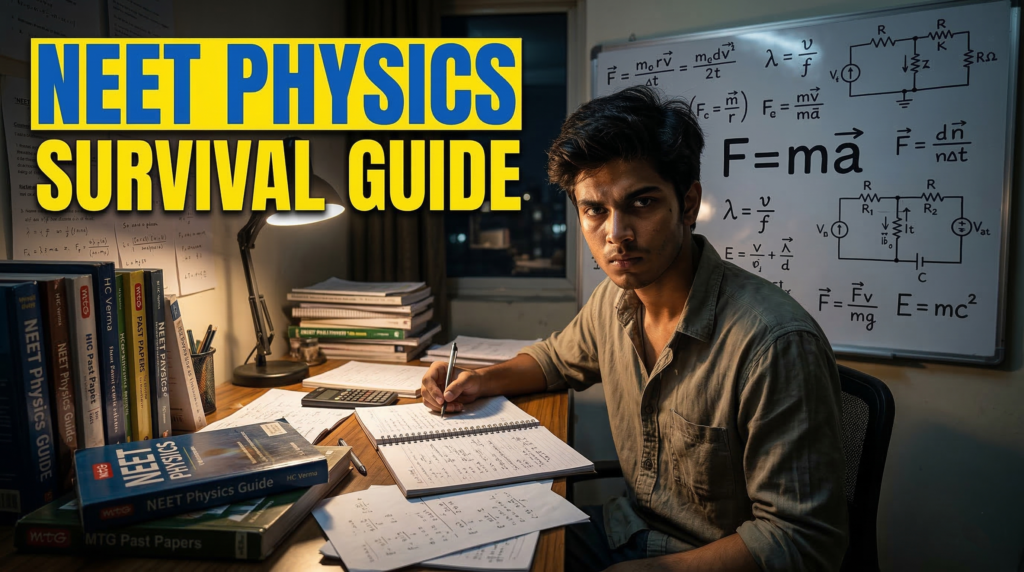
Understanding the NEET physics important chapters helps students prioritize topics that appear frequently in the exam. Based on previous year papers, the following chapters carry the highest weightage.
Mechanics
Mechanics is one of the most crucial areas in NEET physics.
Important topics include:
- Laws of Motion
- Work, Energy and Power
- Rotational Motion
- Gravitation
- Center of Mass
Questions from mechanics often test conceptual clarity and require numerical solving.
Current Electricity
Current electricity is another high-scoring chapter in NEET.
Key topics include:
- Ohm’s Law
- Kirchhoff’s Laws
- Wheatstone Bridge
- Electrical Power
- Series and Parallel Circuits
Many questions from this chapter are direct formula-based numericals, making them easier to solve if concepts are clear.
Ray Optics
Ray optics is considered one of the most scoring topics among the NEET physics important chapters.
Important concepts include:
- Mirror formula
- Lens formula
- Refraction and reflection
- Total internal reflection
- Optical instruments
Students who practice diagrams and formulas from optics often score quickly in this section.
Thermodynamics
Thermodynamics frequently appears in NEET question papers.
Key topics include:
- Laws of thermodynamics
- Heat transfer
- Carnot engine
- Thermodynamic processes
Understanding energy transfer and system behavior is essential for solving thermodynamics problems.
Modern Physics
Modern physics is often considered one of the easiest sections.
Important topics include:
- Photoelectric effect
- Atomic models
- Nuclear physics
- Radioactivity
Many questions from this chapter are conceptual and sometimes directly based on NCERT.
Medium Priority Chapters for NEET Physics
After completing the NEET physics important chapters, students should move to medium-weightage topics such as:
- Electrostatics
- Magnetic Effects of Current
- Electromagnetic Induction
- Alternating Current
- Waves
These chapters require conceptual understanding but can provide additional marks in the exam.
Low Priority Chapters (Quick Revision Topics)
Some chapters appear less frequently but still contribute a few questions.
These include:
- Units and Dimensions
- Semiconductor Electronics
- Communication Systems
- Experimental Physics
Students should revise these chapters but prioritize higher-weightage topics first.
Smart Strategy to Prepare NEET Physics
Preparing physics effectively requires a structured plan.
1. Start with NCERT Concepts
Many NEET questions are derived from NCERT examples and theory. Reading NCERT helps build conceptual clarity before solving advanced problems.
For official exam updates, students can visit the NEET official website.
2. Practice Previous Year Questions
Previous year questions help students understand the pattern of NEET physics problems.
Benefits include:
- Identifying repeated topics
- Improving problem-solving speed
- Learning exam-level difficulty
Practicing PYQs regularly can significantly boost confidence.
3. Maintain a Formula Notebook
Physics formulas are essential for quick revision.
Your notebook should include:
- Important formulas
- Key derivations
- Frequently used constants
Revising formulas weekly helps improve retention.
4. Practice Numerical Problems Daily
Physics becomes easier when students practice regularly.
A good routine includes:
- 1 hour concept revision
- 2 hours numerical practice
- 30 minutes formula revision
Consistency is more important than studying long hours occasionally.
5. Learn Using Diagrams
Visualization helps students understand physics concepts more effectively. Diagrams also play a big role in biology learning.
You can explore this helpful guide for visual learning: Top 10 Tricky NEET Biology Diagrams
Common Mistakes Students Make in NEET Physics
Many aspirants lose marks due to avoidable mistakes.
Common errors include:
- Ignoring weak chapters
- Memorizing formulas without understanding concepts
- Practicing too few numerical problems
- Skipping mock tests
Avoiding these mistakes can significantly improve your physics score.
Final Thoughts
Physics may seem challenging initially, but focusing on the NEET physics important chapters and practicing consistently can make it manageable.
Students should focus on:
- Concept clarity
- Regular problem solving
- Formula revision
- Mock test practice
With the right strategy and discipline, physics can become one of the most scoring sections in NEET.