
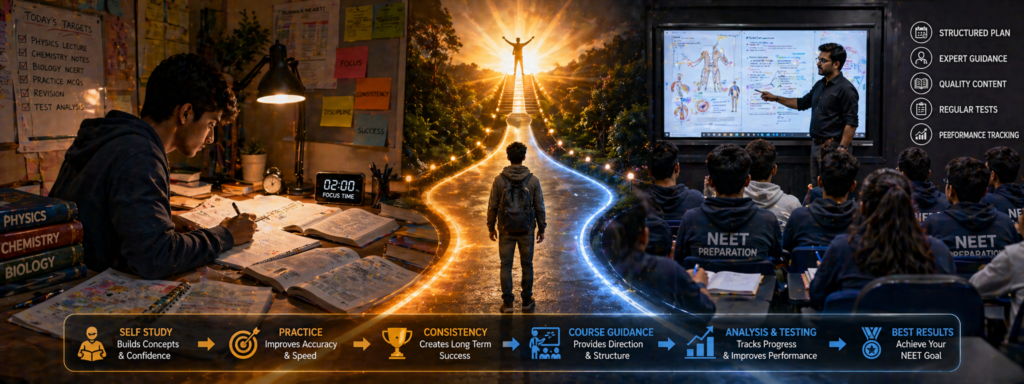
Many NEET aspirants struggle with one core question—should they rely on coaching or focus on self study? The real answer is not choosing one over the other, but learning how to Combine Self Study + NEET Course effectively. When done right, this combination becomes one of the most powerful strategies for NEET preparation. A course provides direction and structure, while self study builds depth and independence. Understanding how to Combine Self Study + NEET Course ensures that you get the best of both worlds.
At the start of preparation, what students truly need is a balanced NEET learning system with structured guidance and personal effort. Relying only on coaching makes you dependent, while only self study can lead to confusion. The key is integration. A smart approach to Combine Self Study + NEET Course creates a system where both complement each other instead of overlapping or conflicting.
Understanding the Role of NEET Course
A NEET course is designed to provide structure. It includes lectures, study material, test series, and sometimes mentorship. The course acts as a roadmap, telling you what to study and when to study it.
When you Combine Self Study + NEET Course, think of the course as your guide, not your entire preparation. Attend lectures actively, take notes, and follow the schedule—but don’t stop there. The real learning happens after the lecture.
Understanding the Role of Self Study
Self study is where concepts become strong. It is the time you spend revising, practicing questions, and clearing your doubts independently. Without self study, even the best lectures become ineffective.
A strong strategy to Combine Self Study + NEET Course ensures that for every lecture you attend, you spend enough time revising and practicing on your own. This is what converts information into understanding.
The Ideal Daily Balance
To effectively Combine Self Study + NEET Course, your day should be divided into three main parts:
Lecture Time
Self Study (Practice + Revision)
Testing / Analysis
For example, if you attend 2–3 hours of lectures, you should spend at least 3–4 hours in self study. This balance ensures that you are not just consuming content but also applying it.
Post-Lecture Strategy (Most Important)
What you do after a lecture defines your preparation. Many students attend classes but fail to revise, which leads to weak retention.
A proper way to Combine Self Study + NEET Course is:
Revise notes within 2–3 hours of the lecture
Solve basic to moderate questions
Identify and note doubts
This immediate reinforcement strengthens concepts and improves retention.
Weekly Planning for Better Integration
Daily balance is important, but weekly planning ensures consistency. A good strategy to Combine Self Study + NEET Course includes:
Weekdays → Lectures + Practice + Revision
Weekend → Full-length test + Deep analysis
This structure allows you to cover new topics while also tracking your progress regularly.
Avoiding Content Overload
One of the biggest mistakes students make is adding extra resources on top of their course material. This creates confusion and reduces efficiency.
When you Combine Self Study + NEET Course, stick to limited, high-quality resources. Use your course material as the base and add only what is necessary for practice or clarity.
Role of Doubt Solving
Doubts can slow down your preparation if not resolved quickly. While courses provide doubt-solving sessions, students should also develop the habit of solving doubts independently.
A smart approach to Combine Self Study + NEET Course is:
Try solving the doubt yourself first
Refer to notes or NCERT
Then ask the teacher if needed
This builds problem-solving ability and confidence.
Importance of Revision Cycles
Revision is often ignored when students rely heavily on coaching. This leads to forgetting previously studied topics.
To properly Combine Self Study + NEET Course, include regular revision cycles:
Daily → Quick revision of current topics
Weekly → Revision of past topics
Monthly → Full syllabus revision
This ensures long-term retention and better performance.
Testing as a Bridge Between Both
Testing connects coaching and self study. It shows whether your preparation is effective or not.
A strong system to Combine Self Study + NEET Course includes regular tests followed by detailed analysis. Tests help you understand your strengths, weaknesses, and areas that need improvement.
Customizing Based on Your Level
Not all students need the same balance.
Beginners → More lecture time, moderate self study
Intermediate → Balanced lectures and self study
Advanced → Less lectures, more testing and analysis
Adjust your strategy as needed to effectively Combine Self Study + NEET Course based on your level.
Common Mistakes to Avoid
Attending lectures passively
Skipping revision
Using too many resources
Ignoring test analysis
Relying only on coaching
Avoiding these mistakes ensures that your strategy to Combine Self Study + NEET Course remains effective.
Final Thoughts
The real power of NEET preparation lies in balance. When you learn how to Combine Self Study + NEET Course, you create a system that is both structured and flexible.
Let the course guide you, and let self study strengthen you. Together, they create a powerful combination that can significantly improve your performance. Because in the end, success in NEET is not about how much you study—it is about how effectively you use your time and resources.
Frequently Asked Questions (FAQs)
1. How to combine self study and NEET coaching effectively?
To Combine Self Study + NEET Course, balance lectures with revision and practice, ensuring active learning.
2. How many hours should I spend on self study?
Ideally, self study should be equal to or more than lecture time.
3. Is coaching enough without self study?
No, self study is essential for understanding and retention.
4. Can I rely only on self study for NEET?
Yes, but combining it with a structured course improves efficiency.
5. Should I use extra books along with coaching material?
Only if necessary—avoid resource overload.