
Biotechnology is spread across two short NCERT chapters, yet it gives as many marks as much longer units. The questions are factual and repeat heavily. This biotechnology NEET PYQ analysis shows which enzymes, vectors, steps and applications NTA asks again and again.
For concept building, pair this with our biotechnology preparation strategy guide, and see where the unit fits in the plan to score 360 in Biology. This article focuses on what past papers actually ask.
Want to test yourself first? Solve the Biotechnology: Principles and Processes PYQs and the Biotechnology and Its Applications PYQs for free, then use this guide to fix the gaps.
Table of Contents
Why Biotechnology Is High-Yield
NEET usually asks five to six questions from the two chapters together. The text is under 25 NCERT pages, so the marks per page are among the best in Biology.
Both chapters are fact-dense, so keep the Principles and Processes class notes and the Biotechnology Applications class notes open while you revise. The unit builds on DNA structure, covered in our Molecular Basis PYQ patterns article.
Biotechnology NEET PYQ Analysis: The Repeated Question Types
When you sort a decade of NEET biology PYQs from this unit, six question types cover almost everything.
| Question type | Frequency | What it tests |
|---|---|---|
| Restriction enzymes | Most frequent | Naming, recognition sites, sticky ends |
| Cloning vectors | Very frequent | pBR322 features, selectable markers |
| PCR and gel electrophoresis | Very frequent | Steps, enzymes, direction of movement |
| Bt crops and RNA interference | Very frequent | cry genes, target pests, nematode resistance |
| Medical applications | Regular | Insulin, gene therapy, molecular diagnosis |
| Transgenic animals and ethics | Regular | Rosie, GEAC, biopiracy |
For a quick warm-up before the full set, try these five quick biotechnology practice questions.
Restriction Enzymes
- The first restriction endonuclease isolated was Hind II.
- Naming: in EcoRI, E is the genus (Escherichia), co the species (coli), R the strain (RY13) and I the order of discovery.
- EcoRI recognises the palindrome 5′-GAATTC-3′ and cuts between G and A, leaving sticky ends.
- Restriction enzymes cut DNA; DNA ligase joins the fragments.
- Exonucleases remove nucleotides from the ends; endonucleases cut within the DNA.
Cloning Vectors: pBR322
| Feature | Role |
|---|---|
| ori | Start of replication; controls copy number |
| ampᴿ | Ampicillin resistance; has PstI and PvuI sites |
| tetᴿ | Tetracycline resistance; has BamHI and SalI sites |
| rop | Codes for proteins involved in plasmid replication |
If foreign DNA is inserted at the BamHI site, the tetracycline resistance gene is inactivated. Recombinants then grow on ampicillin but not on tetracycline. This is insertional inactivation.
With the lacZ gene as a marker, recombinant colonies are white and non-recombinants are blue.
Other cloning vectors and methods to remember:
- Agrobacterium tumefaciens delivers T-DNA into dicot plants through its Ti plasmid.
- Retroviruses are used as vectors for animal cells.
- Bacterial cells are made competent with calcium ions and heat shock.
- Microinjection is used for animal cells; the gene gun (biolistics) is used for plant cells.
PCR Steps and Gel Electrophoresis
The three PCR steps are:
- Denaturation – the two DNA strands separate at high temperature.
- Annealing – primers bind to the template.
- Extension – Taq polymerase, from Thermus aquaticus, adds nucleotides.
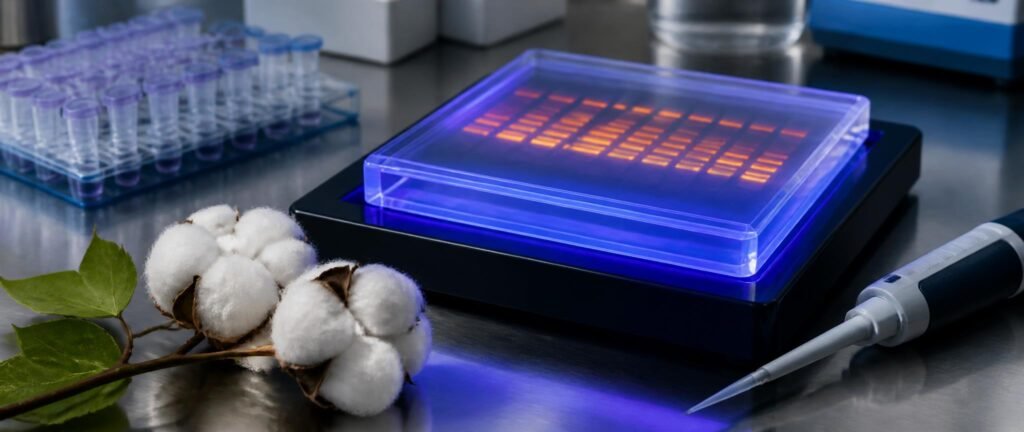
In gel electrophoresis, DNA is negatively charged and moves towards the anode. Smaller fragments travel farther through the agarose gel. Bands are seen as bright orange under UV light after staining with ethidium bromide. Cutting the band out and extracting the DNA is called elution.
To isolate DNA, the cell wall is broken with lysozyme (bacteria), cellulase (plants) or chitinase (fungi). The DNA is finally precipitated with chilled ethanol.
Applications: The Facts That Repeat
- Bt cotton: the cry genes come from Bacillus thuringiensis. cryIAc and cryIIAb control cotton bollworms; cryIAb controls the corn borer. The inactive protoxin is activated by the alkaline pH of the insect gut.
- RNA interference protects tobacco from the nematode Meloidogyne incognita.
- Human insulin: Eli Lilly produced chains A and B separately in E. coli in 1983 and joined them by disulphide bonds. Mature insulin lacks the C-peptide.
- Gene therapy: first given in 1990 to a four-year-old girl with ADA deficiency.
- Molecular diagnosis: PCR and ELISA detect infections early.
- Rosie, the first transgenic cow (1997), produced milk enriched with human α-lactalbumin.
- GEAC decides on the validity of GM research and the safety of GM organisms.
- Biopiracy: the Basmati rice patent case of 1997 is the standard example.
Worked PYQ-Pattern Questions
Q1. A gene is inserted at the BamHI site of pBR322. The recombinant will be:
Answer: Ampicillin resistant and tetracycline sensitive. The BamHI site lies in the tetᴿ gene.
Q2. In which direction does DNA move in gel electrophoresis?
Answer: Towards the anode, because DNA carries a negative charge.
Q3. What is the correct order of PCR steps?
Answer: Denaturation, annealing, extension.
Q4. Which Bt toxin gene controls the corn borer? (a) cryIAc (b) cryIIAb (c) cryIAb (d) cryIIAc
Answer: (c) cryIAb.
Q5. Which enzyme is used to break the fungal cell wall during DNA isolation?
Answer: Chitinase.
Common Traps in This Unit
- Mixing up which cry gene acts on which pest
- Placing the BamHI site in the ampicillin resistance gene
- Saying recombinant colonies are blue in blue-white screening
- Saying DNA moves towards the cathode
- Forgetting that mature insulin has no C-peptide
Practise Every Biotechnology PYQ
This biotechnology NEET PYQ analysis gives you the facts. Practice makes them automatic. Both chapters are available chapter-wise, free:
👉 Solve Biotechnology: Principles and Processes NEET PYQs
👉 Solve Biotechnology and Its Applications NEET PYQs
Do the Principles chapter first, since the Applications chapter uses the same tools.
Conclusion
Biotechnology is short, factual and predictable. Use this biotechnology NEET PYQ analysis to master the enzymes, the pBR322 map, the PCR and electrophoresis steps and the application facts. Then practise until every name and number is automatic.
❓ FAQ
Q: How many questions come from Biotechnology in NEET? A: Usually five to six questions from the two chapters together, which makes the unit one of the most rewarding in Class 12 Biology.
Q: Which chapter of Biotechnology is more important? A: Both matter. Principles and Processes usually gives slightly more questions, mainly on enzymes, vectors and PCR.
Q: Is NCERT enough for Biotechnology? A: Yes. Nearly every question comes straight from NCERT text and figures, including the pBR322 diagram.
Q: What is insertional inactivation? A: When foreign DNA is inserted within a marker gene, that gene stops working. This loss helps identify recombinant colonies.
Q: How should I revise this unit for NEET? A: Use a biotechnology NEET PYQ analysis to list the repeated facts, redraw the pBR322 map, and solve past questions chapter-wise.
Q: Where can I practise Biotechnology NEET PYQs for free? A: You can solve every previous year question from both chapters for free using the practice links in this article.