
Ask a student to rank Biology units by importance and this one lands near the bottom. Ask the paper, and it’s the third largest block on it.
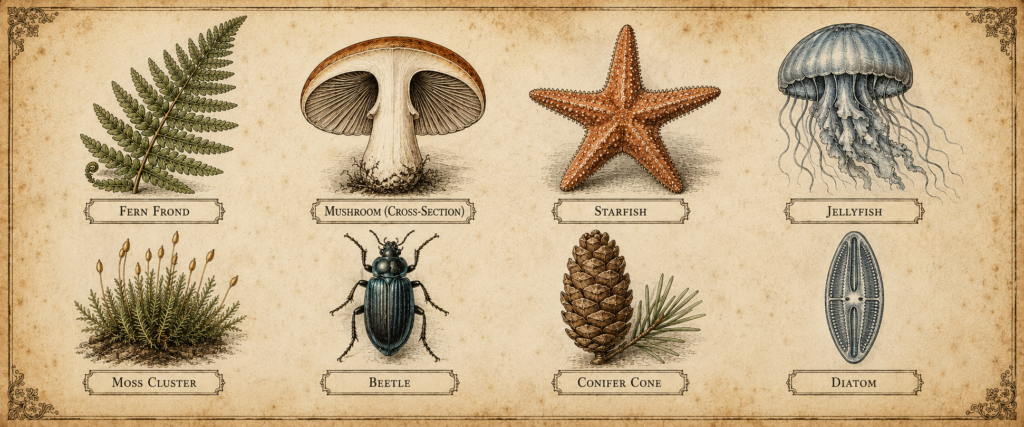
Diversity of living organisms NEET questions account for roughly 14% of the Biology section — more than plant physiology, more than biotechnology, more than cell biology. Students dismiss it because it looks like memorisation, and memorisation feels like something you can do later.
That’s the mistake, and it isn’t the one you’d expect. Set this against subject-wise chapter weightage and what a 360 actually requires before deciding where it sits in your plan.
Table of Contents
Why This Unit Fails Students
Diversity of living organisms NEET marks are not lost by students who skipped the chapters. They’re lost by students who studied them once.
Almost everything here is comparative — not “what is a bryophyte” but “how does a bryophyte differ from a pteridophyte.” Comparative knowledge decays faster than almost anything else in the syllabus, because the individual facts stay in your head while the distinctions between them quietly blur.
A student who read Animal Kingdom thoroughly in September and never returned to it will confidently mark Ctenophora as radially symmetric in April. They knew it. They just stopped being able to tell it apart from its neighbours.
This is why spaced revision that sticks matters more for this unit than for any other in Biology. Coverage isn’t the bottleneck. Retention is, which is why finishing NCERT revision properly beats adding new sources here.
Diversity of Living Organisms NEET: What’s In It
Four chapters, and they’re not equally weighted:
| Chapter | Typical Questions | Nature |
|---|---|---|
| The Living World | 0–1 | Taxonomy, hierarchy, nomenclature |
| Biological Classification | 2–3 | Five kingdoms, viruses, lichens |
| Plant Kingdom | 2–3 | Algae to angiosperms |
| Animal Kingdom | 3–4 | Phyla and their characteristics |
Animal Kingdom alone often outweighs entire units elsewhere in the syllabus, as solving previous year papers makes obvious within an hour. Verify the current chapter scope against the official NMC syllabus, since some taxonomy content was trimmed in the rationalisation — the chapters removed from the syllabus piece covers how to check.
Biological Classification
Five kingdom classification NEET questions trace back to Whittaker’s 1969 system, and the criteria he used are asked as often as the kingdoms themselves — cell structure, thallus organisation, mode of nutrition, reproduction and phylogenetic relationships.
Monera. Prokaryotic. Know the archaebacteria–eubacteria split, and where archaebacteria live: halophiles, thermoacidophiles, methanogens. Methanogens in ruminant guts is a recurring question.
Protista. Eukaryotic, largely unicellular. Chrysophytes, dinoflagellates, euglenoids, slime moulds and protozoans. Dinoflagellates cause red tides; euglenoids have a pellicle rather than a cell wall. Both are asked repeatedly.
Fungi. Phycomycetes, ascomycetes, basidiomycetes and deuteromycetes. Learn the reproductive structures for each, and remember deuteromycetes are the “imperfect fungi” — sexual stage unknown.
Plantae and Animalia get their own chapters. Start making effective condensed notes as you read rather than afterwards.
Then the outliers that sit outside the system entirely: viruses, viroids, prions and lichens. Biological classification NEET 2027 questions love these precisely because they don’t fit — viruses are non-cellular, lichens are an algal–fungal symbiosis, viroids lack a protein coat.
Plant Kingdom
Plant kingdom for NEET 2027 runs algae → bryophytes → pteridophytes → gymnosperms → angiosperms, and the questions follow one of two patterns: pigment and storage product identification, or life-cycle comparison.
Diagram work is unavoidable here, and memorising NCERT biology diagrams covers the life cycles that appear as labelled questions.
For algae, the three classes and their distinguishing pigments and stored food are near-guaranteed marks. For the higher groups, the pattern is a progression — dependence on water for fertilisation decreasing, sporophyte dominance increasing, seed and then flower appearing.
Learn the alternation of generations properly. Whether the gametophyte or sporophyte dominates, and whether the sporophyte is independent, is the single most tested idea in the chapter.
Animal Kingdom
The heaviest chapter in the unit, and the one worth the most practice time.
Most diversity of living organisms NEET questions here are built from the classification criteria rather than the phyla themselves, so start there: because every question is built from them: levels of organisation, symmetry, germ layers, coelom, segmentation and the presence of a notochord. Get these six straight and the phyla organise themselves.
Animal kingdom for NEET questions then run through Porifera, Coelenterata, Ctenophora, Platyhelminthes, Aschelminthes, Annelida, Arthropoda, Mollusca, Echinodermata, Hemichordata and Chordata. For each: symmetry, germ layers, coelom status, one or two diagnostic features, and two examples.
Build this as one large table, in your own hand, in a single-sheet format you can revise in ten minutes.
The Traps
- Ctenophora symmetry. Biradial, not radial. Also bioluminescent.
- Echinoderm symmetry. Larva bilaterally symmetric, adult radially symmetric.
- Coelom confusion. Acoelomate, pseudocoelomate and coelomate — know which phylum sits where.
- Diploblastic versus triploblastic. The boundary falls between Coelenterata/Ctenophora and Platyhelminthes.
- Deuteromycetes. Classified there because the sexual stage is unknown, not because it doesn’t exist.
- Viruses in the five kingdoms. They aren’t included at all.
- Chordate features. Notochord, dorsal hollow nerve cord and paired pharyngeal gill slits — at some stage of life, not necessarily in the adult.
Nearly all of these are comparison errors rather than knowledge gaps, which is exactly the point.
How to Actually Study It
- Read NCERT line by line. This unit is almost entirely NCERT-traceable, which does more here than any reference book.
- Build tables, not notes. One for the five kingdoms, one for plant groups, one for animal phyla. Written by hand, on one sheet each.
- Revise every two weeks, not every two months. Twenty minutes per table. This is the habit that separates students who score in this unit from students who studied it.
- Practise with past questions. Filtered to these chapters, they show how narrowly the same distinctions get asked.
Two to three weeks covers diversity of living organisms NEET properly on a first pass. Then it’s short, frequent maintenance for the rest of the year.
Final Word
Diversity of living organisms NEET gives up its marks more readily than almost anything else in Biology — no reasoning, no numericals, no sequence-heavy processes. Just distinctions, learned once and kept warm.
Students who lose marks in diversity of living organisms NEET questions are almost never students who skipped the chapters. They’re students who finished them in October and never opened them again.
Don’t be that. Build the three tables, and revisit them fortnightly until May.
❓ FAQ Section
Q: How many questions come from diversity of living organisms in NEET? A: Typically 7–10 across the four chapters, roughly 14% of the Biology section. Animal Kingdom usually carries the most, followed by Plant Kingdom and Biological Classification.
Q: Is this unit just memorisation? A: Largely, but it’s comparative memorisation — distinctions between groups rather than isolated facts. That’s why it decays quickly without revision, and why students who study it once still lose marks.
Q: Which chapter is most important in this unit? A: Animal Kingdom, both by question count and by difficulty. Start with the six classification criteria — symmetry, germ layers, coelom, organisation level, segmentation and notochord — since every question is built from them.
Q: Is NCERT enough for this unit? A: Yes, and unusually so. Questions here are highly NCERT-traceable, including specific examples and exceptions. Add previous year papers for exposure rather than reference books for extra content.
Q: How often should I revise this unit? A: Every two weeks once you’ve covered it, using summary tables rather than the full chapters. Twenty minutes per table is enough, and it’s far more effective than a single long revision in April.
Q: How long does it take to prepare? A: Roughly two to three weeks for a thorough first pass across all four chapters, plus ongoing fortnightly revision. The initial coverage is quick; the retention is where the work lies.
[…] Plant Kingdom sits inside the diversity of organisms unit, overlooked facts here often connect to broader classification questions too, making this chapter […]