
Most students prepare plant physiology for NEET 2027 by memorising it. That is precisely why they lose marks in it.
Plant physiology for NEET 2027 is not a list of facts. It is three long processes, each with a strict sequence, a specific location, and a set of products. Memorise the endpoints without the sequence and you can answer roughly half the questions — which, with negative marking, is worse than it sounds.
Start with the wider botany strategy and check subject-wise chapter weightage before deciding how much time this deserves. The short answer: a lot.
Table of Contents
Plant Physiology for NEET 2027: The Chapter List Has Changed
This trips up anyone using older material. Transport in Plants and Mineral Nutrition are no longer in the NEET syllabus — both were dropped in the rationalisation and are among the chapters removed from the syllabus.
Plenty of coaching material and older blog posts still list five chapters in this unit. There are three:
| Chapter | Typical Questions |
|---|---|
| Photosynthesis in Higher Plants | 2–3 |
| Respiration in Plants | 2–3 |
| Plant Growth and Development | 2–3 |
Together, roughly 6–8 questions — about 8–10% of the Biology paper. On plant physiology chapter weightage alone, that justifies serious time. Verify against the official NMC syllabus before you skip anything.


Photosynthesis in Higher Plants
The heaviest chapter in plant physiology for NEET 2027, and the one where sequence matters most. Photosynthesis in higher plants NEET questions concentrate on a few specific places.
Light reaction. Know PS I and PS II properly — P700 and P680 respectively, and it is PS II that carries out photolysis of water. Get the Z-scheme direction right. Cyclic photophosphorylation yields ATP only; non-cyclic yields ATP and NADPH. That distinction is asked almost every year.
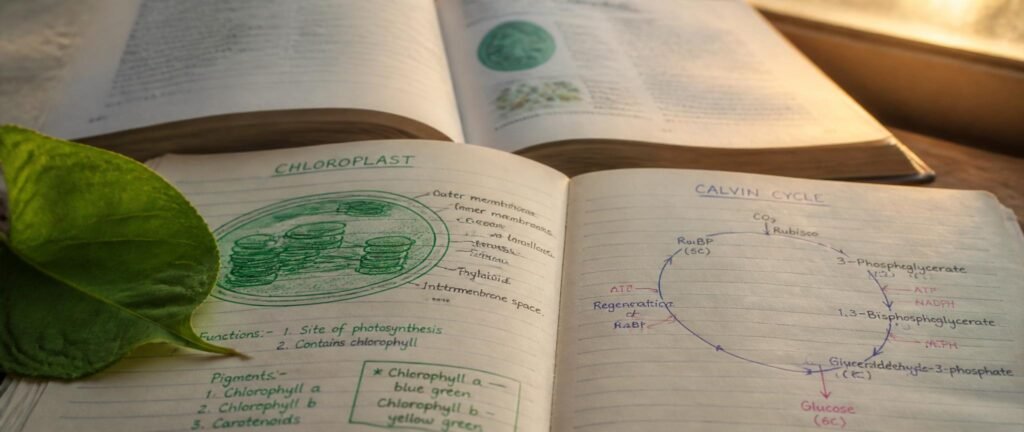
Calvin cycle and C4. First stable product is 3-PGA in C3 plants and oxaloacetic acid in C4. Learn Kranz anatomy and the role of bundle sheath cells, because C4 questions are usually anatomy questions in disguise.
Photorespiration. Understand why it happens — RuBisCO’s competing affinity for oxygen — and why C4 plants largely avoid it. This is the single most conceptually tested idea in the chapter.
Limiting factors. Blackman’s law, and the shape of the response curves.
Diagrams matter enormously here. Memorising NCERT biology diagrams is not optional for this chapter, and solving previous year papers shows how narrowly it is actually asked.
Respiration in Plants
Respiration in plants NEET questions are location questions as much as pathway questions. Get these fixed first:
- Glycolysis — cytoplasm
- Krebs cycle — mitochondrial matrix
- Electron transport system — inner mitochondrial membrane
Then the pathways themselves: glycolysis and its net yield, fermentation in both alcoholic and lactic acid forms, the TCA cycle, and oxidative phosphorylation via chemiosmosis.
Learn NCERT’s exact ATP figures rather than a number you picked up elsewhere — different sources state different totals depending on assumptions, and NEET follows NCERT.
Park these in spaced revision that sticks — they decay fast. Respiratory quotient is nearly free marks: 1 for carbohydrates, less than 1 for fats, around 0.9 for proteins, and greater than 1 for organic acids. Also know what makes the pathway amphibolic.
Your grounding in your cell biology base does real work here — students weak on mitochondrial structure struggle disproportionately with this chapter.
Plant Growth and Development
The most memorisation-heavy of the three, and the most reliably scoring if you’re systematic. Plant growth and development NEET questions split into two halves.
Growth itself: phases of growth, arithmetic versus geometric growth, the sigmoid curve, absolute versus relative growth rate, and the differentiation–dedifferentiation–redifferentiation sequence.
Plant growth regulators: auxin, gibberellin, cytokinin, ethylene and abscisic acid. For each, know discovery, primary functions and the commercial applications NCERT names. Apical dominance, parthenocarpy, bolting and abscission all attach to specific hormones — that mapping is the chapter.
Then photoperiodism and vernalisation. One point students consistently miss: for short-day and long-day plants, it is the critical dark period that governs flowering, not the light period.
A hormone comparison table you build yourself will outperform any you download, because hormone functions decay fast without repetition.
The Traps That Cost Marks
- Swapping PS I and PS II. P680 is PS II and does photolysis. Fix this once.
- Assuming cyclic photophosphorylation makes NADPH. It doesn’t — ATP only.
- Confusing first stable products. 3-PGA for C3, OAA for C4.
- Misplacing pathway locations. Cytoplasm, matrix, inner membrane — in that order.
- Reversing RQ values. Fats below 1, organic acids above 1.
- Attributing a function to the wrong hormone. The most common error in the unit.
- Counting light period instead of dark period in photoperiodism.
How to Study This Unit
- Read NCERT line by line. Almost every question is directly traceable to a sentence in the textbook.
- Draw each pathway once, by hand, from memory. Not copied — reproduced. If you can’t, you don’t know it yet.
- Build comparison tables: C3 versus C4, cyclic versus non-cyclic, the five hormones, RQ values.
- Then practise. Previous year papers filtered to this unit show you how narrowly NEET actually asks.
Budget three to four weeks for plant physiology for NEET 2027. The unit rewards depth, and it’s one of the few places where thorough beats fast.
Final Word
Plant physiology for NEET 2027 decides Botany scores because it is simultaneously high-weightage and highly NCERT-faithful — meaning the marks are genuinely available to anyone willing to learn the processes properly rather than skim them.
Students who lose marks here are almost never students who didn’t study it. They’re students who learned the vocabulary and skipped the sequence.
❓ FAQ Section
Q: How many questions come from plant physiology in NEET? A: Typically 6–8, around 8–10% of the Biology paper, spread fairly evenly across Photosynthesis, Respiration and Plant Growth and Development. Counts vary year to year.
Q: Are Transport in Plants and Mineral Nutrition still in the syllabus? A: No. Both were removed in the syllabus rationalisation. A lot of older coaching material still includes them, so verify against the official NMC syllabus rather than trusting a chapter list you find online.
Q: Which is the hardest chapter in plant physiology? A: Photosynthesis, because it demands sequence-level understanding of the light reaction and Calvin cycle rather than recall. Respiration is similar but more structured, and Plant Growth and Development is largely systematic memorisation.
Q: Is NCERT enough for plant physiology? A: For theory, yes — this unit is unusually NCERT-faithful and questions are often traceable to specific lines. Add previous year papers for question exposure, but don’t substitute reference books for NCERT here.
Q: How important are diagrams in this unit? A: Very. Pathway diagrams, the Z-scheme, Kranz anatomy and growth curves all appear as labelled or interpretation-based questions. Reproduce them from memory rather than just reading them.
Q: How long does this unit take to prepare? A: Roughly three to four weeks for a first thorough pass, plus regular revision. The hormone and comparison content decays quickly, so schedule repeat cycles rather than treating it as finished.