
One of the most common questions students are searching right now is whether the Re-NEET 2026 exam pattern is the same as the original NEET UG 2026 — or if NTA has made any changes after the paper leak controversy.
The short answer: the core structure remains the same. But there are specific details every student must know before walking into the exam hall. If you’ve already checked the Re-NEET 2026 official NTA notice, you’ll know NTA has committed to holding the re-exam under strict guidelines — and understanding the pattern is step one of your preparation.
Let’s go through every detail.
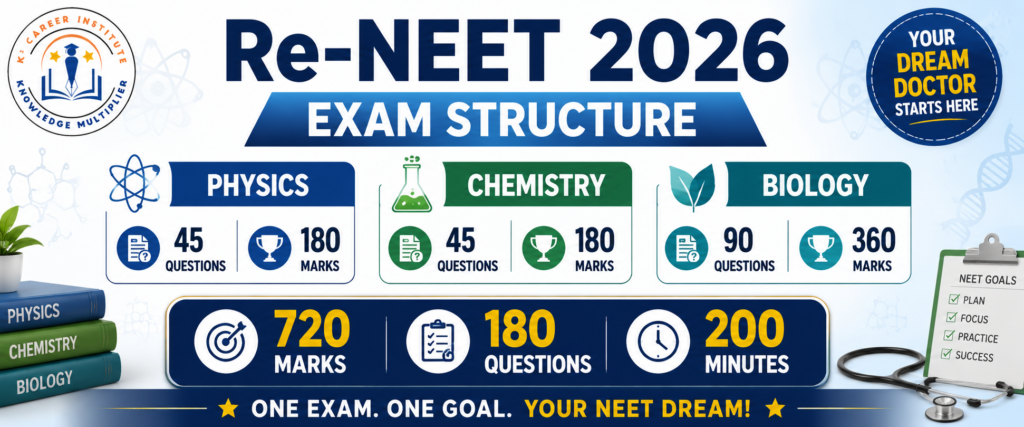
Re-NEET 2026 Exam Pattern at a Glance
| Parameter | Details |
|---|---|
| Exam Name | NEET UG 2026 (Re-Exam) |
| Conducting Body | National Testing Agency (NTA) |
| Mode | Offline (Pen and Paper) |
| Duration | 3 Hours 20 Minutes (200 minutes) |
| Total Questions | 200 (180 to be attempted) |
| Total Marks | 720 |
| Subjects | Physics, Chemistry, Biology (Botany + Zoology) |
| Marking Scheme | +4 for correct, –1 for incorrect, 0 for unattempted |
| Medium | 13 languages including English and Hindi |
Subject-Wise Question Distribution
The Re-NEET 2026 exam pattern follows the same two-section structure (Section A and Section B) introduced in NEET 2021.



Physics
| Section | Questions | To Attempt | Marks |
|---|---|---|---|
| Section A | 35 | 35 (compulsory) | 140 |
| Section B | 15 | 10 (any 10) | 40 |
| Total | 50 | 45 | 180 |
Chemistry
| Section | Questions | To Attempt | Marks |
|---|---|---|---|
| Section A | 35 | 35 (compulsory) | 140 |
| Section B | 15 | 10 (any 10) | 40 |
| Total | 50 | 45 | 180 |
Biology (Botany + Zoology)
| Section | Questions | To Attempt | Marks |
|---|---|---|---|
| Section A | 70 | 70 (compulsory) | 280 |
| Section B | 30 | 20 (any 20) | 80 |
| Total | 100 | 90 | 360 |
Grand Total: 200 questions → 180 to be attempted → 720 marks
Has Anything Changed for Re-NEET 2026?
This is the question everyone wants answered. Based on NTA’s official communications and the re-exam announcement, here is what we know:
What Remains the Same
- Total marks: 720
- Total questions and attempt structure: 200 questions, 180 to attempt
- Marking scheme: +4 / –1
- Exam mode: Offline (OMR-based)
- Syllabus: NCERT Class 11 and 12 (no changes)
- Subject-wise weightage: Physics 180, Chemistry 180, Biology 360
- Section A and Section B structure within each subject
What May Be Different
- Exam centres: NTA is expected to revise centre allocations with stricter security protocols following the paper leak. Students should verify their city and centre details from the Re-NEET 2026 city intimation slip. The Re-NEET 2026 correction Window is open, update address and city preference before May 21.
- Security measures: Biometric verification, CCTV surveillance, and identity checks are expected to be significantly tightened compared to the original exam.
- Question paper sets: NTA is likely to use a higher number of paper sets (different question orders) to reduce chances of malpractice.
- Reporting time: Students may be required to report earlier than the standard 90-minute prior window. Check your admit card carefully once the Re-NEET 2026 admit card is released.
Important: Until NTA releases the official information brochure for Re-NEET 2026, treat the above as the expected pattern. Always verify from the official NTA website before the exam.
Understanding Section A vs Section B — Don’t Make This Mistake
Many students underestimate the Section B choice mechanic and end up losing marks because of it. Here’s how it works:
Section A is fully compulsory. You must attempt all 35 questions in Physics, all 35 in Chemistry, and all 70 in Biology. There is no choice here.
Section B gives you options:
- In Physics: attempt any 10 out of 15
- In Chemistry: attempt any 10 out of 15
- In Biology: attempt any 20 out of 30
The trap: If you attempt more than the allowed number in Section B, only the first attempted answers (in order) will be evaluated. The extra attempts — even if correct — will not count and could cost you marks if the first attempts were wrong.
Topper tip: Always attempt Section B questions you are most confident about. Don’t attempt all 15/30 hoping extra correct answers will be counted — they won’t be.
Marking Scheme Explained
| Answer | Marks |
|---|---|
| Correct answer | +4 |
| Incorrect answer | –1 |
| Question not attempted | 0 |
| More than one answer marked | –1 (treated as incorrect) |
This means for every 4 questions you get wrong, you lose the equivalent of 1 correct answer. Strategic leaving of uncertain questions is as important as solving known ones.
If you’re working on your overall Re-NEET 2026 complete study plan, build mock test practice around this marking scheme from Day 1 — especially practising when to leave a question.
Syllabus for Re-NEET 2026: Any Reductions?
The syllabus for Re-NEET 2026 is the same as NEET UG 2026 — Class 11 and Class 12 NCERT for Physics, Chemistry, and Biology. NTA has not announced any syllabus reduction for the re-exam.
Here’s what that means subject-wise:
Physics
- Class 11: Physical World, Laws of Motion, Work-Energy-Power, Gravitation, Thermodynamics, Oscillations, Waves, and more
- Class 12: Electrostatics, Current Electricity, Magnetism, Optics, Modern Physics, Semiconductors
Chemistry
- Class 11: Basic Concepts, Atomic Structure, Chemical Bonding, Equilibrium, Redox, Organic Chemistry basics
- Class 12: Electrochemistry, Coordination Compounds, Biomolecules, Organic Reactions, Polymers, Environmental Chemistry
Biology
- Class 11: Cell Biology, Plant Physiology, Human Physiology, Structural Organisation
- Class 12: Genetics, Evolution, Biotechnology, Ecology, Reproduction
For subject-specific preparation strategies, refer to the detailed guides on Re-NEET 2026 Biology preparation, Re-NEET 2026 Chemistry strategy, and Re-NEET 2026 Physics preparation.
Exam Day Timeline: What to Expect
| Time | Activity |
|---|---|
| 2 hours before exam | Reporting at exam centre (expected) |
| 90 minutes before | Gate entry closes (typically) |
| 30 minutes before | OMR sheet and question paper distribution |
| Exam start | 02:00 PM (standard NEET slot — confirm from admit card) |
| Exam end | 05:20 PM (200 minutes later) |
How to Use the Exam Pattern for Your Preparation
Knowing the pattern isn’t just exam day information — it’s a prep tool.
1. Practice section-wise time allocation
- Biology (90 questions): ~50–55 minutes
- Chemistry (45 questions): ~40–45 minutes
- Physics (45 questions): ~50–55 minutes
- Review and OMR filling: ~10 minutes
2. Build mock test habits around the real pattern Every mock test you take should mirror the actual structure — 200 questions, Section A + B format, 200-minute timer. This builds the mental stamina needed for the real exam.
3. Don’t ignore Section B strategy Practice deciding quickly which 10 (Physics/Chemistry) or 20 (Biology) Section B questions to attempt. In the real exam, hesitation here wastes precious minutes.
4. Avoid the common pattern-related mistakes Students often mark all 15 Section B questions in Physics out of anxiety or attempt Section A questions they’re unsure about instead of leaving them. Read the full list of mistakes to avoid before Re-NEET 2026 to stay sharp.
Final Takeaway
The Re-NEET 2026 exam pattern is structurally identical to the original NEET UG. 720 marks, 180 questions to attempt, same marking scheme, same syllabus. What changes is the security environment — tighter, more monitored, and more strictly administered.
This is actually good news for honest students. The playing field will be fairer than ever.
Now that you know exactly what the paper looks like, the only variable left is how well you prepare. Use this pattern to design your mock test schedule, time your subject attempts, and build a Section B strategy that won’t fail you on exam day.
The pattern is fixed. Your preparation doesn’t have to be.