Bubbling an OMR sheet and clicking through an on-screen question palette are two completely different skills — and with NEET UG confirmed to shift to CBT mode from 2027, that second skill is one most aspirants have never had to build. The good news is you don’t have to wait for an official NEET CBT platform to start. NTA already runs a free practice app that mirrors its real CBT interface, and getting comfortable with it now is exactly what a proper NEET 2027 CBT mock test guide should point you toward.
This NEET 2027 CBT mock test guide covers exactly how to practice for the shift properly, without wasting time guessing at features NTA hasn’t confirmed.
Table of Contents
The NEET 2027 CBT Mock Test Guide: Where to Start
The NTA Abhyas app — officially called National Test Abhyas — is free and already offers computer-based mock tests in the NEET pattern — even though the live NEET exam itself is still OMR-based today. It runs on the same underlying CBT platform NTA uses for JEE Main, which means the navigation conventions, palette logic, and screen layout you practice on now are very likely close to what NEET 2027 will actually use, since NTA tends to standardise its CBT experience across exams rather than build a separate one from scratch.
Key features worth knowing before you open it:
- Daily fresh mock tests in both English and Hindi.
- Offline test download — you only need internet to log in and submit, not during the test itself.
- Immediate results with question-wise time analysis after every attempt.
- Solutions and explanations available for every question you attempt.
This is the single best starting point for computer based NEET practice, precisely because it’s free, official, and already live — no need to wait for a NEET-specific app that doesn’t exist yet.
Understand the Standard NEET CBT Interface Conventions
Based on NTA’s existing CBT platform used for JEE Main and other exams, here’s what the likely NEET CBT interface is built around — the same interface logic behind general mock test strategy still applies once you’re comfortable with the screen itself, and none of it touches your subject weightage. Treat these as strong expectations rather than confirmed NEET 2027 specifics until NTA states otherwise:
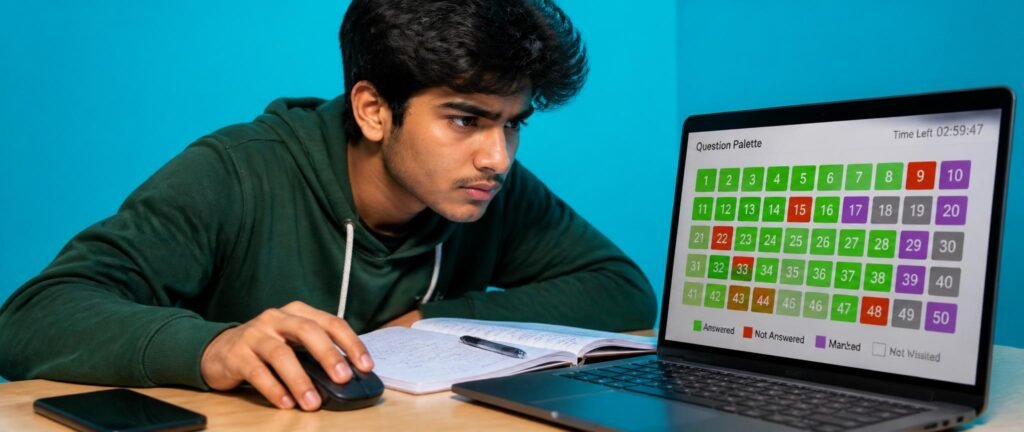
- Color-coded question palette on one side of the screen, showing your status for every question at a glance.
- Green typically marks a question you’ve answered.
- Red marks a question you’ve viewed but left unanswered.
- Purple with a tick marks a question you’ve answered and also flagged for review — this is the only “marked” status that still counts toward your score.
- Mark for Review lets you flag a question to revisit without losing your current answer, which isn’t possible on a physical OMR sheet.
- On-screen timer and section navigation buttons let you jump between subjects instead of flipping physical pages.
The practical upside over OMR: you can change an answer at any point before submission, and the palette gives you an instant visual map of what’s left — something no paper booklet can offer.
The Auto-Submit Rule You Must Respect
One CBT-specific risk that doesn’t exist with paper exams: switching away from the test window, minimizing the browser, or losing focus for too long can trigger an automatic, irreversible submission on NTA’s platform. This is exactly the kind of detail a solid NEET 2027 CBT mock test guide needs to flag early. Practice sessions are exactly where you build the discipline to keep the test window active without distraction — treat every mock like it carries this same risk, because it likely will on exam day.
How to Build a Real NEET 2027 Mock Test Routine
A one-off NEET 2027 mock test won’t build real readiness. Don’t just open the app once and call it done. A structured approach works far better:
- Week 1–2: Interface familiarity only. Take short, low-pressure mocks purely to learn the palette colors, navigation buttons, and Mark for Review flow. Don’t worry about your score yet.
- Week 3–4: Full-length timed mocks. Simulate the real exam length and pressure, tracking how much time interface friction costs you compared to your accuracy on paper-based practice.
- Ongoing: Palette-scanning discipline. In the last few minutes of every mock, practice scanning the full palette and attempting any Red (unanswered) questions where you can eliminate at least two options — this single habit recovers marks that many students otherwise leave on the table.
- Alongside, not instead of, subject prep. CBT comfort doesn’t replace strong fundamentals. Keep running previous year papers and pair your CBT mocks with the same rigorous exam time management habits you’d build for any format.
What Stays the Same as OMR
It’s worth remembering what doesn’t change. Rough work will still be done on paper — NTA is expected to continue providing a physical scribble pad, since on-screen calculation isn’t practical for numerical-heavy subjects like physics and chemistry. The syllabus, question difficulty, and subject weightage are unaffected by the format shift, so don’t let CBT anxiety distract from the fundamentals the format shift doesn’t touch.
Common Concerns Worth Addressing Early
A few worries come up constantly around this transition — and a good NEET 2027 CBT mock test guide should address each honestly rather than dismiss them:
- Screen fatigue from reading 200 questions over three-plus hours — build up gradually rather than jumping straight into full-length mocks in week one.
- Losing the ability to underline or annotate long biology passages by hand — practice mental flagging or use the scribble pad for key terms instead.
- Limited computer exposure, especially for students in rural areas — this is exactly why starting early with a free app matters more than any other single prep decision related to the format shift.
None of these are reasons to panic. They’re reasons to start practicing months before exam day instead of the week before.
The Bottom Line
A proper NEET 2027 CBT mock test guide isn’t about memorising a formula NTA hasn’t published — it’s about building genuine comfort with a screen-based test environment using the free, official tool already available today. Download NTA’s practice app, learn the palette and Mark for Review flow, build up to full-length timed mocks, and keep your rough-work habits sharp on paper.
The students who start this now, quietly and consistently, will walk into NEET 2027 treating the CBT screen as routine — while everyone else is still getting used to the interface on exam day itself.
FAQ
Q: Is there official computer based NEET practice available yet? A: Not a NEET-specific one, but NTA’s own National Test Abhyas app already offers CBT-format mocks in the NEET pattern, built on the same platform NTA uses for JEE Main. It’s the closest official practice option currently available.
Q: What’s the best way to start practicing for NEET 2027’s CBT format? A: Download the NTA Abhyas app and start with short, low-pressure mocks focused purely on interface familiarity — palette colors, navigation, and Mark for Review — before moving to full-length timed practice.
Q: Will NEET 2027 use the same interface as JEE Main’s CBT? A: It’s a reasonable expectation since NTA tends to standardise its CBT platform across exams, but this hasn’t been officially confirmed for NEET 2027 specifically. Treat it as a strong likelihood, not a guarantee.
Q: Can I still do rough work on paper during a CBT exam? A: Yes, this is expected to continue. On-screen calculation isn’t practical for numerical-heavy subjects, so NTA is expected to keep providing a physical scribble pad even in CBT mode.
Q: What happens if I accidentally switch away from the test window? A: On NTA’s existing CBT platform, leaving the test window for too long can trigger an automatic, irreversible submission. Build the habit of staying focused on the test screen during every practice mock.
Q: Does CBT practice replace regular subject preparation? A: No. Interface comfort only affects how efficiently you navigate the exam — it doesn’t substitute for strong fundamentals. Keep CBT mocks alongside your regular syllabus revision and previous year paper practice.