
Quick answer: A reproductive health NEET PYQ analysis shows that NTA asks one to two questions a year from this short chapter, and almost all of them come from three areas: contraceptive methods (especially the types of IUDs and how each works), sexually transmitted infections (which are curable and which are not), and assisted reproductive technologies such as IVF, ZIFT, GIFT, ICSI and artificial insemination. The 2026 papers asked GIFT, contraception and STIs.
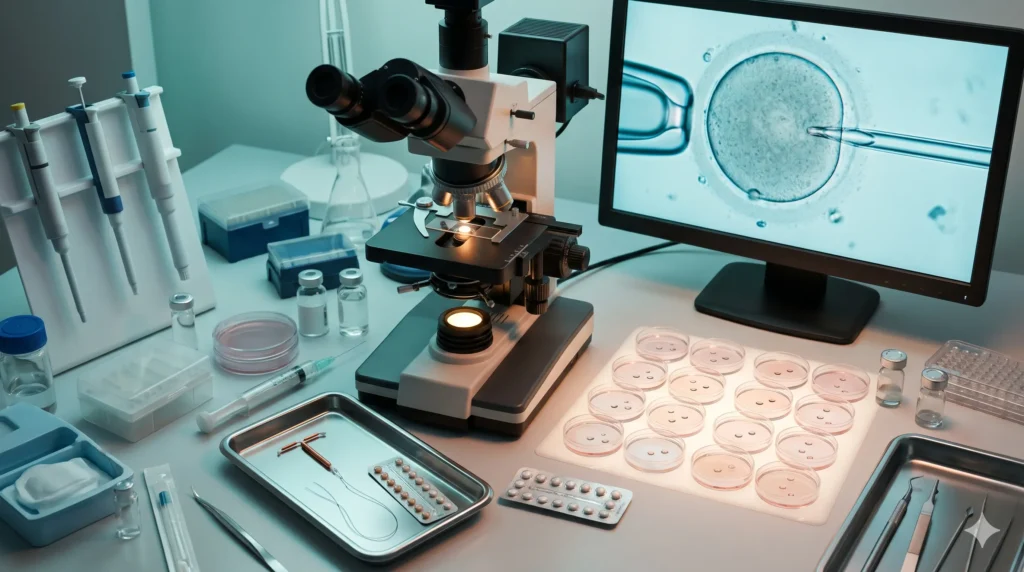
This guide breaks down what NTA repeats, the tables you must know and PYQ-pattern questions with answers. With NEET 2027 coming closer, keep an eye on our NEET 2027 latest updates page for official NTA news.
Want to test yourself first? Solve the Reproductive Health PYQs for free, then use this guide to fix the gaps.
Table of Contents
Why Reproductive Health Is Easy Marks
The chapter is only a few NCERT pages, yet it has about 65 past questions, and they keep testing the same lists: IUD names, STI names and ART abbreviations. Learn three tables and you can answer nearly every question. For chapter notes, use our Reproductive Health class 12 notes, and to see where it sits among other chapters, check the NEET 2027 chapter weightage.
The chapter builds on our Human Reproduction PYQ analysis, since contraceptives act on ovulation, fertilisation and implantation. For a quick warm-up, try these five quick Reproductive Health questions. If you have not started planning your exam timeline yet, our guide to the NEET 2027 registration date covers when the form is expected and what to keep ready.
Reproductive Health NEET PYQ Analysis: What NTA Repeats
When you sort the past NEET biology PYQs from this chapter, four question types cover nearly everything.
| Question type | Frequency | What it tests |
|---|---|---|
| Contraceptive methods | Most frequent | Types of IUDs, barriers, natural methods, pills, sterilisation |
| Sexually transmitted infections | Very frequent | Names, curability, complications |
| Assisted reproductive technologies | Very frequent | IVF, ZIFT, IUT, GIFT, ICSI, AI and IUI |
| Reproductive health and MTP | Regular | Amniocentesis, RCH programmes, MTP rules, population facts |
Reproductive Health and Population
- WHO defines reproductive health as total well-being in all aspects of reproduction: physical, emotional, behavioural and social.
- India started action plans for family planning in 1951; these now run as Reproductive and Child Health Care (RCH) programmes.
- Amniocentesis studies the chromosomes of foetal cells in amniotic fluid. It is legally banned for sex determination, to prevent female foeticide.
- The legal marriageable age is 18 years for females and 21 years for males.
Contraceptive Methods: The Most Tested Part
An ideal contraceptive is user-friendly, easily available, effective, reversible and has few or no side effects.
| Method | Examples and how it works |
|---|---|
| Natural | Periodic abstinence (avoiding days 10–17 of the cycle), withdrawal (coitus interruptus), lactational amenorrhea (effective up to 6 months after delivery while the mother breast-feeds fully) |
| Barriers | Condoms (male and female), diaphragms, cervical caps and vaults (cover the cervix; reusable), often used with spermicidal creams, jellies and foams |
| Oral pills | Progestogens or progestogen–oestrogen combinations taken daily for 21 days from within the first five days of the cycle; inhibit ovulation and implantation and change cervical mucus. Saheli, a once-a-week non-steroidal pill, was developed by CDRI, Lucknow |
| Injections and implants | Progestogens alone or with oestrogen, under the skin; work like pills but last longer |
| Emergency | Progestogens, progestogen–oestrogen combinations or an IUD within 72 hours of coitus |
| Surgical (sterilisation) | Vasectomy (part of the vas deferens removed or tied through a small cut in the scrotum) and tubectomy (part of the fallopian tube removed or tied); very effective but poorly reversible |
Intra-Uterine Devices (IUDs)
IUD questions were asked in 2021, 2022 (twice), 2023 and 2024.
| Type | Examples | How it works |
|---|---|---|
| Non-medicated | Lippes loop | Increases phagocytosis of sperm in the uterus |
| Copper-releasing | CuT, Cu7, Multiload 375 | Copper ions suppress sperm motility and fertilising capacity |
| Hormone-releasing | Progestasert, LNG-20 | Make the uterus unsuitable for implantation and the cervix hostile to sperm |
IUDs are ideal for women who want to delay pregnancy or space children, and they are one of the most widely accepted methods in India.
Medical Termination of Pregnancy
- Termination of pregnancy before full term is called MTP. India legalised MTP in 1971 with strict conditions to prevent misuse such as sex-selective abortion.
- Under the MTP (Amendment) Act described in NCERT, a pregnancy may be terminated within the first 12 weeks on the opinion of one registered medical practitioner, and between 12 and 24 weeks on the opinion of two, for specified reasons.
- MTPs are relatively safe during the first trimester (up to 12 weeks).
Sexually Transmitted Infections
| STI | Curable if detected early? |
|---|---|
| Gonorrhoea | Yes |
| Syphilis | Yes |
| Chlamydiasis | Yes |
| Trichomoniasis | Yes |
| Genital warts | Yes |
| Genital herpes | No |
| Hepatitis B | No |
| HIV infection | No |
- STIs are most common in the 15–24 years age group.
- Untreated STIs can cause pelvic inflammatory disease (PID), abortions, still births, ectopic pregnancy, infertility and even cancer of the reproductive tract.
- Hepatitis B and HIV also spread by sharing needles and surgical instruments, through transfusion of infected blood, and from an infected mother to the foetus.
Sexually transmitted infections were asked in 2020, 2021, 2023, 2024 and 2026, most often as “which is not completely curable?”
Infertility and Assisted Reproductive Technologies
| ART | What happens |
|---|---|
| IVF–ET (“test tube baby”) | Fertilisation outside the body, followed by embryo transfer |
| ZIFT | Zygote or early embryo with up to 8 blastomeres transferred into the fallopian tube |
| IUT | Embryo with more than 8 blastomeres transferred into the uterus |
| GIFT | An ovum collected from a donor is transferred into the fallopian tube of a woman who cannot produce ova but can provide the right environment for fertilisation |
| ICSI | A sperm is injected directly into the ovum in the laboratory |
| AI / IUI | Semen from the husband or a donor is introduced into the vagina or uterus (IUI); used when the male partner cannot inseminate or has a low sperm count |
Assisted reproductive technologies were asked in 2020, 2023, 2025 and twice in 2026.
Worked PYQ-Pattern Questions
Q1. Which of these is a hormone-releasing IUD? (a) Lippes loop (b) CuT (c) LNG-20 (d) Multiload 375
Answer: (c) LNG-20. Progestasert is the other NCERT example.
Q2. Which STI is not completely curable even if detected early? (a) Gonorrhoea (b) Syphilis (c) Genital herpes (d) Trichomoniasis
Answer: (c) Genital herpes. Hepatitis B and HIV infection are also not completely curable.
Q3. In GIFT, what is transferred into the fallopian tube?
Answer: An ovum collected from a donor, for a woman who cannot produce ova but can support fertilisation and development.
Q4. An embryo with more than 8 blastomeres is transferred into the uterus in: (a) ZIFT (b) IUT (c) GIFT (d) ICSI
Answer: (b) IUT. In ZIFT, an embryo with up to 8 blastomeres goes into the fallopian tube.
Q5. Copper-releasing IUDs prevent pregnancy mainly by:
Answer: Suppressing sperm motility and the fertilising capacity of sperm.
Q6. Lactational amenorrhea is effective as a contraceptive for up to:
Answer: Six months after delivery, as long as the mother breast-feeds fully.
Common Traps in This Chapter
- Calling Lippes loop a copper-releasing IUD (it is non-medicated)
- Saying hepatitis B or genital herpes is completely curable
- Swapping ZIFT (up to 8 blastomeres, fallopian tube) and IUT (more than 8, uterus)
- Mixing up GIFT (ovum transferred) and ICSI (sperm injected into ovum)
- Saying Saheli is a steroidal pill (it is non-steroidal)
- Writing the emergency contraception window as 48 hours (it is 72 hours)
Practise Every Reproductive Health PYQ
This reproductive health NEET PYQ analysis shows you where the marks are. Solving real past questions makes the lists automatic. Every Reproductive Health previous year question is available chapter-wise, free:
👉 Solve all Reproductive Health NEET PYQs
Keep the IUD, STI and ART tables beside you for the first round, then solve the second round without them.
Conclusion
Reproductive Health is a short chapter of lists, and NTA keeps asking the same ones. Use this reproductive health NEET PYQ analysis to master contraceptive methods and IUDs, STIs and their curability, MTP rules and assisted reproductive technologies. Then practise the past questions until each answer comes without thinking.
❓ FAQ
Q: How many questions come from Reproductive Health in NEET? A: Usually one to two questions a year, mostly on contraceptives, STIs or ART.
Q: What is the most important topic in Reproductive Health for NEET? A: Contraceptive methods, especially the three types of IUDs and how each works, followed by STIs and ART.
Q: Which STIs are not completely curable? A: Genital herpes, hepatitis B and HIV infection. Most others are completely curable if detected early and treated properly.
Q: What is the difference between ZIFT and IUT? A: In ZIFT, a zygote or embryo with up to 8 blastomeres is transferred into the fallopian tube. In IUT, an embryo with more than 8 blastomeres is transferred into the uterus.
Q: Which oral contraceptive pill was developed in India? A: Saheli, a once-a-week non-steroidal pill developed by CDRI, Lucknow.
Q: Where can I practise Reproductive Health NEET PYQs for free? A: You can solve every Reproductive Health previous year question chapter-wise for free using the practice links in this article.
Related posts:
 Human Reproduction NEET PYQ Analysis: Gametogenesis, Menstrual Cycle and Pregnancy
 Evolution NEET PYQ Analysis: Human Evolution, Hardy-Weinberg and Evidences
 Sexual Reproduction in Flowering Plants NEET PYQ Analysis: Pollination, Embryo Sac and Double Fertilisation
 Animal Kingdom NEET PYQ Analysis: Examples NTA Asks Again and Again