
Choosing the right NEET Physics Chapter Order is one of the most underrated yet powerful strategies in preparation. Most students start studying Physics randomly—picking chapters based on mood, coaching schedule, or perceived difficulty. This scattered approach leads to confusion, weak concept linking, and poor retention. Physics is not a subject where you can jump between topics without structure. It is highly interconnected, and your understanding of one chapter often depends on another.
A well-planned NEET Physics Chapter Order helps you build concepts step by step, reduces mental load, and improves your ability to solve mixed questions in mock tests. When you follow the correct sequence, your preparation becomes smoother, faster, and more logical. Instead of feeling stuck in difficult chapters, you develop momentum.
If your goal is to reach a high score in Physics, you must not just study hard—you must study in the right order. A structured approach like this score 170 NEET Physics strategy works because it aligns chapter sequence with concept building, revision cycles, and mock performance.
Why NEET Physics Chapter Order Matters More Than You Think
The importance of a proper NEET Physics Chapter Order lies in how Physics concepts are layered. Mechanics builds the foundation for almost everything. Electricity depends on earlier concepts like basic mathematics and motion. Modern Physics becomes easier when you understand wave behavior and energy concepts.
If you start with random chapters, you often face problems like:
- Difficulty in understanding advanced topics
- Low confidence due to repeated confusion
- More time spent revising the same concepts
- Poor performance in mock tests
A structured NEET Physics Chapter Order eliminates these issues by creating a natural learning flow.
The Smart NEET Physics Chapter Order (Step-by-Step)
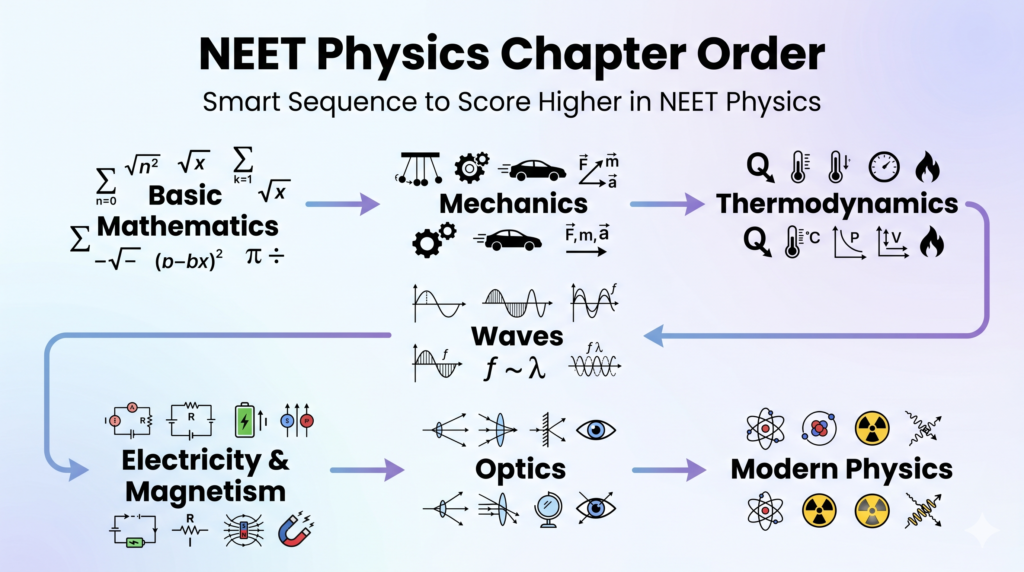
Let’s now look at the most effective NEET Physics Chapter Order that works for both beginners and repeaters.
Step 1: Basic Mathematics in Physics
Before jumping into core Physics, you must be comfortable with basic mathematical tools. This includes vectors, units and dimensions, trigonometry basics, and error analysis. Without this, even simple Physics problems feel complicated.
This step sets the foundation for the entire NEET Physics Chapter Order, as almost every chapter involves calculations and vector understanding.
Step 2: Mechanics (Part 1 – Core Foundation)
Mechanics is the backbone of Physics and should always come early in your NEET Physics Chapter Order. Start with kinematics, then move to laws of motion, and then work, energy, and power.
These chapters build your understanding of motion and forces. Many questions across the syllabus indirectly depend on these concepts.
Step 3: Mechanics (Part 2 – Advanced Application)
Once basics are clear, move to rotational motion and gravitation. These chapters are slightly more complex but become manageable if your foundation is strong.
This phase strengthens your problem-solving ability and prepares you for tougher questions in mocks. A proper NEET Physics Chapter Order ensures you don’t jump into these topics too early.
Step 4: Properties of Matter and Thermodynamics
Now move to topics like mechanical properties of solids and fluids, followed by thermal physics and thermodynamics. These chapters are concept-heavy but scoring if understood properly.
Thermodynamics is especially important and appears frequently in NEET. Placing it correctly in your NEET Physics Chapter Order ensures better understanding and retention.
Step 5: Oscillations and Waves
Oscillations and waves are easier once mechanics is clear. These chapters are relatively scoring and help boost confidence.
They also build conceptual links to modern physics and optics later in your NEET Physics Chapter Order.
Step 6: Electricity and Magnetism
Now comes one of the most important sections in the NEET Physics Chapter Order—electrostatics, current electricity, magnetism, and electromagnetic induction.
This section carries high weightage in NEET. Concepts here are interconnected, so studying them in sequence is critical. If done properly, this section can significantly increase your score.
Step 7: Optics
Ray optics and wave optics come next. Ray optics is highly scoring and formula-based, while wave optics is more conceptual.
By this stage, your confidence in Physics should be higher, making it easier to handle these chapters in your NEET Physics Chapter Order.
Step 8: Modern Physics
Modern Physics is one of the easiest and most scoring parts of NEET Physics. Topics like photoelectric effect, atoms, nuclei, and semiconductors are relatively direct.
Keeping Modern Physics toward the end of your NEET Physics Chapter Order helps in quick revision and score boosting before the exam.
Common Mistakes Students Make While Choosing Chapter Order
Many students unknowingly follow a poor NEET Physics Chapter Order, which slows down their preparation. Some common mistakes include starting with difficult chapters like rotational motion without building basics, skipping mathematics, or studying Modern Physics too early and ignoring core topics.
Another mistake is constantly switching chapters without completing one properly. This breaks continuity and reduces conceptual clarity. A smart NEET Physics Chapter Order avoids these traps and keeps your preparation stable.
How to Customize NEET Physics Chapter Order Based on Your Level
Not every student needs the exact same sequence. Your NEET Physics Chapter Order should depend slightly on your current level.
If you are a beginner, follow the sequence strictly from basics to advanced topics. If you are a repeater, you can start with your weak areas but still maintain logical flow. If your basics are strong, you can mix revision with advanced chapters.
The key is not to randomize completely. Even while customizing, your NEET Physics Chapter Order should maintain concept dependency.
How Chapter Order Impacts Mock Test Performance
A proper NEET Physics Chapter Order directly affects your mock test scores. When you study in sequence, your brain connects concepts faster during exams. You spend less time thinking and more time solving.
Students with a random study pattern often struggle in mocks because their understanding is fragmented. They may know individual chapters but fail to apply them together.
This is why toppers follow a structured NEET Physics Chapter Order and revise in the same sequence multiple times before the exam.
Final Thoughts
The right NEET Physics Chapter Order can completely change your preparation quality. It reduces confusion, improves retention, and increases your ability to solve mixed questions in exams.
Do not underestimate the power of sequence. Physics is not just about what you study, but how you study it. A smart chapter order ensures that every concept you learn supports the next one.
If you want consistent improvement in mock tests and better accuracy, start fixing your study order today. Once your foundation is strong and your sequence is clear, scoring in Physics becomes much more predictable.
FAQ
What is the best NEET Physics Chapter Order for beginners?
The best NEET Physics Chapter Order for beginners starts with basic mathematics, followed by mechanics, then thermodynamics, waves, electricity, optics, and finally modern physics.
Can I study NEET Physics chapters randomly?
Studying randomly is not recommended. A proper NEET Physics Chapter Order helps in building concepts logically and improves long-term retention.
Which chapters should I study first in NEET Physics?
You should start with basic mathematics and mechanics, as they form the base of the entire NEET Physics Chapter Order.
Is Modern Physics easy for NEET?
Yes, Modern Physics is relatively easy and scoring. It is usually kept toward the end of the NEET Physics Chapter Order for quick revision.
Does chapter order really affect NEET score?
Yes, a proper NEET Physics Chapter Order improves understanding, reduces confusion, and helps perform better in mock tests and the final exam.