
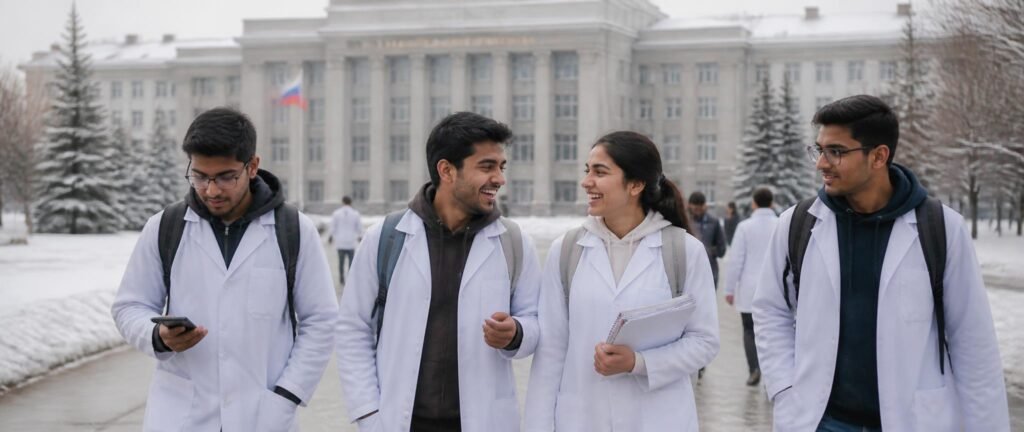
For a student who qualified NEET but cannot afford a private Indian medical college, Russia has quietly become one of the most practical routes to a doctor’s coat. MBBS in Russia for Indian students offers a globally recognised degree at a fraction of private Indian fees — but only if you pick an NMC-approved university and understand the licensing exam waiting for you back home.
This guide covers the real costs, the eligibility rules, the top colleges, and the FMGE and NExT route you must clear to practise in India. If you are still comparing paths, our honest breakdown of studying abroad versus India is worth reading first, and if your rank is low, see your options at a low rank before committing to anything.
Table of Contents
Why MBBS in Russia for Indian Students Works
Russia’s appeal is not hype — it rests on a few concrete advantages that matter to a middle-class family:
- Low cost, zero donation — government-funded universities charge a fraction of private Indian fees, with no capitation.
- English-medium programmes — top NMC-approved universities teach in English, with clinical training from the third year.
- Global recognition — degrees from WHO-listed universities are accepted for FMGE/NExT in India, and for USMLE, PLAB, and AMC abroad.
- Structured six-year path — five years of study plus a one-year internship, awarding an MD equivalent to the Indian MBBS.
That combination is why pursuing MBBS in Russia for Indian students has grown steadily, especially among NEET-qualified aspirants priced out of private seats at home. For a sense of what those home fees look like, compare against private college fees in India.
MBBS Russia Eligibility for Indian Students
The MBBS Russia eligibility rules are set by NMC’s foreign-education guidelines, and they are strict about one thing above all — NEET. You must:
- Qualify NEET UG — a NEET qualification is mandatory for any Indian studying medicine abroad and later practising in India.
- Meet the academic bar — Class 12 with Physics, Chemistry, Biology, and English, scoring at least 50% (40% for reserved categories).
- Be at least 17 years old as on 31 December of the admission year.
- Choose an NMC-approved, WHO-listed university — this is non-negotiable if you want your degree to count in India.
Miss the NEET requirement or pick an unapproved university, and your degree becomes unusable for Indian practice no matter how well you score abroad.
MBBS in Russia Fees: Total Cost Breakdown
The headline number families care about is the total, and here Russia genuinely delivers. The MBBS Russia fees for the full six-year programme typically land between ₹22 lakh and ₹40 lakh, all-inclusive — a 50 to 70% saving against private Indian colleges, where the same degree can cost ₹50 lakh to ₹1.5 crore.
| Cost Component | Approximate Annual Cost |
|---|---|
| Tuition fee | ₹2.7 – 4.5 lakh |
| Hostel and living expenses | ₹1.2 – 2.4 lakh |
| Approximate total per year | ₹4 – 6 lakh |
| Full six-year cost | ₹22 – 40 lakh |
Exact figures vary by university, city, and the rouble exchange rate. If the upfront cost is still a stretch, an education loan for MBBS can bridge it, and many public-sector banks lend against NMC-approved foreign programmes.
Top NMC Approved Universities in Russia
NMC currently recognises dozens of Russian medical colleges, but they are not equal — FMGE pass rates swing widely between them. Some of the most established NMC approved universities Indian students choose include:
- Sechenov University (First Moscow State Medical University)
- Kazan Federal University and Kazan State Medical University
- Pirogov Russian National Research Medical University
- Tver State Medical University
- Omsk State Medical University
- Siberian State Medical University
- Voronezh State Medical University
Always cross-check a university’s live status on nmc.org.in before paying anything, and weigh its FMGE pass percentage — an approved university with a 15% pass rate is a worse bet than one consistently above the national average.
The FMGE and NExT Route: Practising in India
This is the part students underestimate. A Russian MBBS does not let you practise in India automatically — you must clear a licensing screening exam first. As of 2026, that exam is still the FMGE (Foreign Medical Graduate Examination), conducted by the National Board of Examinations.
NMC has announced that FMGE and NExT will merge, with the National Exit Test eventually replacing FMGE for foreign graduates — but no firm rollout date has been confirmed for overseas students. The safest approach is to prepare on the FMGE syllabus while tracking NMC notifications, since the switch could land during your course. The transition is expected to fold licensing and PG entrance into one exam, so understanding NExT early is worth your time.
Things to Check Before You Apply
A little diligence here prevents an expensive mistake later:
- Verify NMC approval in writing — recognition lists are revised annually, so confirm the current status before any payment.
- Check the FMGE pass rate, not just the brochure — it is the single best predictor of whether you will actually practise.
- Ask about COVID-era compensation training — NMC now requires in-person compensation training for students who took online classes during 2020–22 at some foreign universities, so confirm your batch is unaffected.
- Avoid donation or agent pressure — genuine Russian admissions are merit-based with no capitation, so treat any donation demand as a red flag.
Final Word
MBBS in Russia for Indian students is a genuinely sensible route for NEET-qualified aspirants who want a recognised medical degree without a crippling loan — provided you pick an NMC-approved, WHO-listed university and go in clear-eyed about the FMGE. The degree opens doors in India and abroad, but the licensing exam is the real finish line, not graduation.
Do your homework on approval status and pass rates, budget honestly for six years, and treat FMGE preparation as part of the plan from day one. Done right, Russia turns a missed private seat into a real path to becoming a doctor. If you are still weighing every option, compare Russia honestly against your alternatives before you decide.
❓ FAQ Section
Q: Is NEET mandatory for MBBS in Russia for Indian students? A: Yes. A NEET UG qualification is mandatory for any Indian student who wants to study MBBS in Russia and later practise medicine in India, as per NMC’s foreign medical education guidelines. Without it, your degree cannot be used for Indian licensing.
Q: What is the total cost of MBBS in Russia? A: The full six-year programme typically costs between ₹22 lakh and ₹40 lakh, including tuition, hostel, and living expenses. This is roughly 50 to 70% cheaper than a private MBBS seat in India, with no donation involved.
Q: Do I need to clear FMGE or NExT after MBBS in Russia? A: To practise in India, you must clear the licensing screening exam. As of 2026, this is still the FMGE. NMC has announced NExT will eventually replace FMGE for foreign graduates, but no confirmed rollout date exists yet, so prepare on the FMGE syllabus.
Q: Is a Russian MBBS degree valid in India? A: Yes, provided the university is NMC-approved and listed in the WHO World Directory of Medical Schools. You must also have qualified NEET and clear the FMGE or NExT exam to register as a doctor in India.
Q: How long is the MBBS course in Russia? A: The MBBS course in Russia is six years — five years of academic study plus a one-year internship. The degree awarded is an MD, which is equivalent to the Indian MBBS, with clinical training usually beginning in the third year.
Q: How do I choose the right NMC-approved university in Russia? A: Confirm the university’s current NMC approval on nmc.org.in, check its FMGE pass percentage rather than relying on marketing, ensure it is English-medium and WHO-listed, and avoid any institution or agent demanding a donation.
[…] MBBS in Russia for Indian Students — Low-cost, NMC-approved MBBS with globally recognized universities and simple admission process. […]